
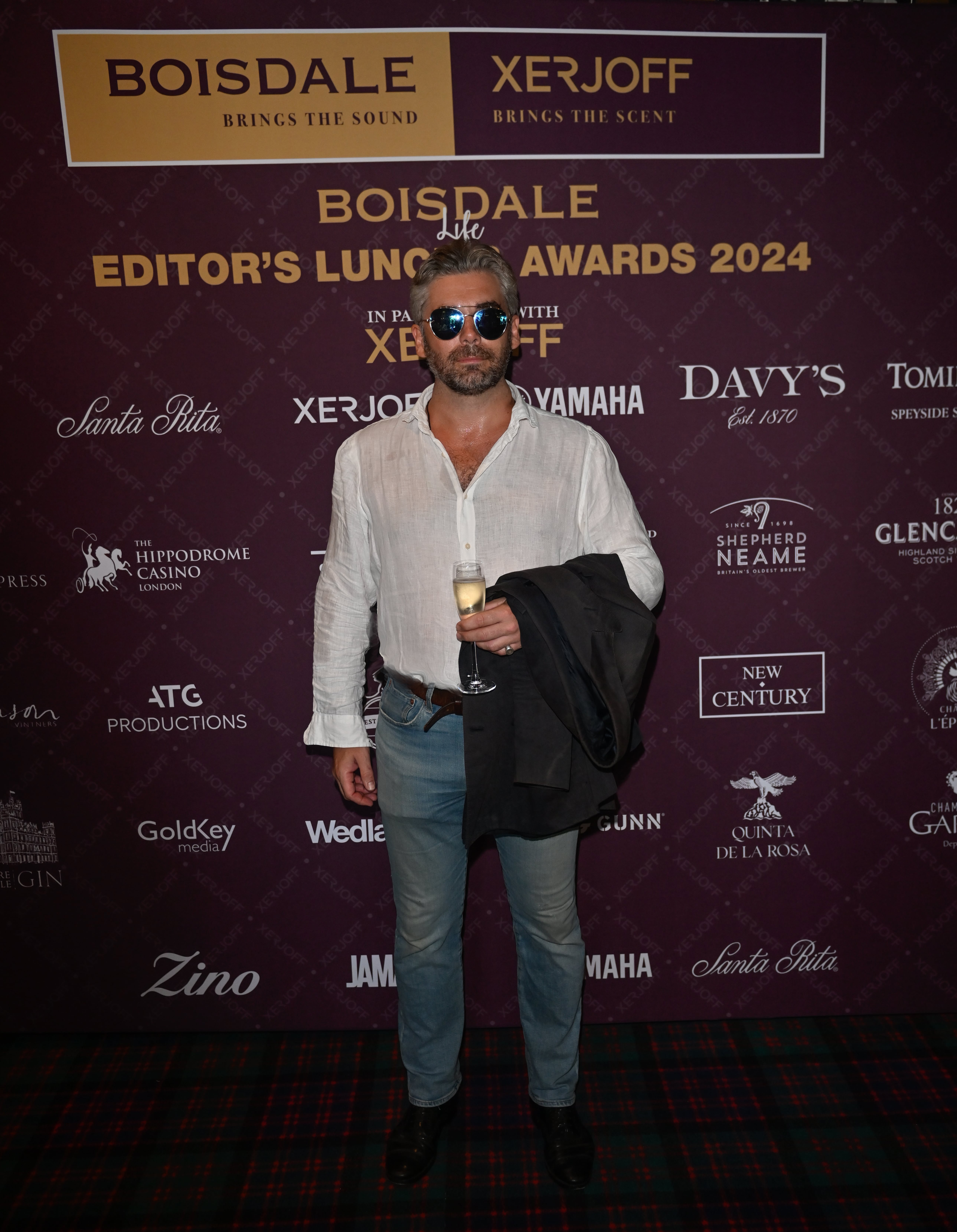
Introduced by H. M. The Queen’s son, Tom Parker-Bowles, Natasha Hamilton, formerly of the band Atomic Kitten and, far right, William Sitwell, restaurant critic for The Daily Telegraph, host as Roy Sommer, Managing Director of Davidoff cigars presents the ‘Davidoff Bon Viveur of The Year Award’ to Alexander Fiske-Harrison, for his article ‘Courage Best’. On the left is AFH’s old friend, whom he had not seen since 1991 and who recently left the British Army after 23 years, including two decades in the 22 SAS, and with whom AFH is now working on new project, more which later (Photo: Jules Annan)
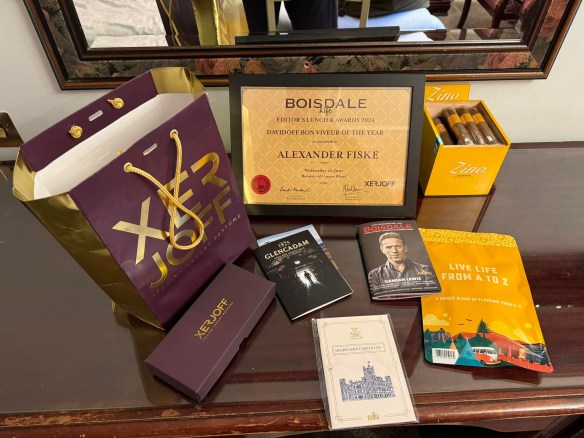


Click on image for PDF
COURAGE BEST
Alexander Fiske-Harrison
Britain’s only bullfighter and veteran bull runner, pays homage to British stoicism and bravery
THE most laconic tale of British bravery in combat is arguably Lord Uxbridge’s sang froid remark after being struck by cannon shot at the Battle of Waterloo: “My God, Sir, I’ve lost my leg.”
To which the Duke of Wellington replied:
“Yes, Sir, so you have.”
One doesn’t need to be a Kenneth Tynan to recognise this as a performance, even if made unconsciously, with understatement used to say infinitely more than the words themselves. It does not make much difference if the story is apocryphal: the mere fact that the story has survived in popular consciousness in this form tells us exactly what the British perceive their own particular brand of bravery to be.
It is also hardly surprising, then, that I grew up with the Charge of the Light Brigade as my model, as it was to the British Army. Indeed, it is from the cannon captured that day that most of the Victoria Cross medals are cast (more of the VC later).
Compare this form of courage with a tale from my adopted country of Spain. In 1936, during the Spanish Civil War, the medieval Alcázar fortress of Toledo was under siege to little effect, when the attackers captured the son of the colonel of the garrison. They reconnected the severed telephone lines and summoned the colonel to the parapets so he could watch as his son was handed the telephone to tell him that he would be executed unless the fortification surrendered. The colonel told his son that ‘he knew what to do’. Father and son saluted one another, the son turned and told his captor to shoot him, which he duly did, before he turned to salute the father, who returned the salute.
The tales of Uxbridge and the Spanish colonel are extreme examples of courage. But like a cocktail mixed with alien versions of similar ingredients, the latter’s is somehow un-British. Nevertheless, we recognise the resemblance.
Seneca, the father of Roman Stoicism, was a Spaniard born in Córdoba, hence the Hispanic flair in his pronouncements on this subject. “A man who has learned how to die has unlearned how to be a slave,” he wrote. It was no idle theorising, for within twelve months the Emperor, his former pupil, falsely accused him of conspiracy. Seneca duly took his own life, remarking, with more than a hint of caustic Britishness: “After murdering his mother and brother, it only remained for Nero to kill his teacher and tutor.”
One of the reasons I came to Spain was to witness an echo of such bravery outside of war. Ernest Hemingway gave a similar reason for coming to watch bullfights one hundred years ago. I remember when I first went to Pamplona to run with the bulls, I witnessed the boiling mass of 300 tonnes of humanity fleeing four tonnes of toros bravos, Spanish fighting bulls. The mass of people shattered and fled like a medieval rabble under a heavy cavalry charge. This was a sight few people in the modern era will ever see: a populace put to flight through its own streets, as though a siege had been broken, a city wall breached. Of course, I am aware that the event itself, and even talking about having done it, is all rather un-British.

Alexander Fiske-Harrison runs between two bulls in Pamplona in 2011
But back to British courage. It was while doing some historical research that I came across a compendium of true Britishness: the citations for the award of the VC. I had begun with the Gough brothers and son — great-grandfather and great-uncles to my own uncle-by-marriage — who won theirs in the Indian Mutiny and Somaliland. However, their stories were historically distant and awarded in circumstances which today are viewed as somewhat politically complicated.
The accounts that stuck me far more were those of Captain Charles Upham. He was born in New Zealand, but five days before it transitioned from colony to dominion status, so I think we can claim him as one of our own.
Upham remains the only combat soldier — and one of only three men in history, the other two being military physicians — to receive the award twice, the unicorn of gallantry: VC and Bar.
His first award, as cited in the London Gazette for an action in Crete in 1941, contains much of what one would expect: he fired and was fired upon; he was blown up; injured by shrapnel; etc, etc… Certain terse disclosures stand out: “He also received a bullet in the foot which he later removed in Egypt.” Most powerful of all was his reaction to the award: “It’s meant for the men.”
I would argue that a defining feature of British bravery might be found in details such as that. For it is not just the switch from ‘flight’ — or ‘freeze’, the other adrenal option — to ‘fight’ that defines the highest human capabilities under such circumstances: a fighting bull, as its name suggests, will do that quick enough. There is a fourth option one might call ‘finesse’, meaning the ability to rise above the situation to find an even grander form of response.* [See Appendix below. AFH]
Returning to Upham: four years later, he was awarded his Bar for his actions at El Alamein in 1943. Shot twice, he “destroyed a German tank and several guns and vehicles with grenades”; shot again he was taken to “the Regimental Aid Post but immediately his wound had been dressed returned to his men, remaining with them all day long under heavy enemy artillery and mortar fire, until he was again severely wounded and being now unable to move fell into the hands of the enemy”.
Upham then spent the rest of the conflict as a prisoner of war, constantly escaping or trying to escape, and all recounted in his extraordinary biography, Mark of the Lion, by Kenneth Sandford. It is during that period that we find the zenith, the apotheosis, the quintessence of British bravery — of courage on parade: his broad-daylight attempt to climb the fences at Camp Oflag 5A in Weinsberg. Thinking he could simply scale the barrier and then leap from one fence to the other over the rolls of razor wire beneath, he misjudged the quality of German engineering when the top wire detached from its post. Falling short, he found himself wrapped in serrated steel. The prison guards ran towards him and levelled their rifles as their corporal, enraged and shouting, put a loaded pistol to his head.
Technically, it was only legal to shoot a PoW during the act of escaping itself, so, very slowly, while lying tangled, trapped and bleeding, he took out a cigarette, lit it, and began to smoke.
As he put it to his biographer, “the moment of killing was lost”, but even so he continued to lie there as his fellow PoWs began chanting his name. Several minutes later, still between the two fences and smoking, the senior British officer arrived and asked him what he was going to do.
“Nothing, They can damn well come and get me. And I refuse to be shot by a bloody corporal. Tell ’em to bring an officer.”

Sergeant Jack Hinton (1909-1997, left) and Captain Charles Upham (1908-1994) are awarded the Victoria Cross (VC), at Buckingham Palace, 11 May 1945
If ever there was an example of finesse, this was it. It’s just a shame we don’t have an English word for it.
It is to honour Captain Upham that when I run with the bulls nowadays — which is usually escorting paying clients, from the Board of Directors of NASCAR to Hollywood producers — and those around me turn paler and paler as we wait in the street until the mass of cattle and humanity hurtle towards us, as though pursued by the devil himself, I say to my companions, “hold on a moment” and I slowly light a cigarette. Admittedly it’s not one I ever get to finish.
Alexander Fiske-Harrison’s Into the Arena: The World of the Spanish Bullfight (second edition) is out soon. He can be contacted at alexander@bullfightingandalusia.com.
P.S. Alexander Fiske-Harrison’s book on the annual July encierros, the ‘bull-runs’ of San Fermín, The Bulls Of Pamplona is available on Amazon in Kindle or physical editions. He will be in Pamplona where he works as an expert guide for Bullfighting Andalusia, having mentored clients ranging from the board of directors of NASCAR to billionaire Hollywood producers, from within the run itself, to teaching them bullfighting with small bulls alongside his colleague, top matador Eduardo Dávila Miura, of the famed Miura family after whom the first Lamborghinis are named, to sitting with them through the evening bullfights and providing context and commentary.
* APPENDIX: It is seldom that I put up parts of articles that editors – often for all the right reasons, as in this case by the great Michael Karam – decided to cut. However, as a relatively newly enrolled postgraduate student at the School of Neuroscience at King’s College, London, I think this is fascinating on the subject of why people run with bulls.
As someone who in another part of their life works in academic neuroscience, I see the answer as more complicated. In my research I came across the work of Andrew Huberman at Stanford, who with his colleagues has been investigating how the so-called fight-or-flight hormone is, in fact, misnamed and the idea of the appeal of adrenaline vastly oversimplified.
The clearest evidence of this is that of the lion pursuing the antelope. At the level of hormones, and general physical excitation, one cannot tell the difference between the predator and the prey. And yet, for the cat, this is very much a situation in which he delights (I am humanising and summarising the description of animal mental states of necessity), and one the deer detests.
I would argue that with vastly more powerful and nuanced neurological resources of a human brain in Pamplona we are dancing between the two to better control being both prey and predator… and many other things besides.
In one experiment, Dr Huberman and his colleagues enhanced activity in the xiphoid nucleus in the heart of the brain of a mouse when it believed was under threat of predation, and it switched from its natural murine response – flight or freeze – to an unlinked behaviour, that of fight: i.e. it switched gears from fear to courage.
This same neural role is served in humans by the centromedian nucleus of the thalamus and it is that which seems to be the physical mechanism through which our brains are rewarded when we confront our fears. The evolutionary reason for such a reward system is obvious: just think of the fate of those humans who never overcame their instinctive fear of fire.
Of course, in the human model, the overcoming of paralysing terror does not inevitably result in the urge to fight. We have more options, which I would like to call ‘finesse’. We can derail the neural patterns of fear so that higher cognitive functions can take over – we can assess, decide and act. The downside of this is that such cogitation takes time, but if one adds experience, knowledge and learned short cuts, aka technique, it is better than being the proverbial rabbit in the headlights.
I once watched one of the bravest men I have ever met, a bull-runner and practitioner of the bloodless form of bull-dodging and leaping performed in public called recortes, Miguel Ángel Castander, save the life of such a frozen man. A bull who had become loose from the galloping herd lost its way and defaulted to its natural adrenalized mental state: fight. The half ton bull ploughed the human statue into the wooden barrier with his horns and proceeded to work him over against the planks like a heavy-weight boxer finishing off a vastly smaller opponent on the ropes.
Miguel calmly slapped the bull in the face, drawing it on to his body as lure, and then moved – despite being almost 50-years-old – in such a fast tight arc that the bull could not match it and was drawn to standstill at his side.Another experienced runner then caught the bull’s attention with the flash of a t-shirt, and Miguel, whose hip was touching the bull’s chest just behind the horns, knew this bull was “done” for him: he calmly looked up from the animal and down the street for the next threat, despite the half-tonne of bull panting at his waist.
The animal proceeded off towards the ring chasing down runner after runner working in relay, while Miguel walked down the road for his morning coffee.
I watched this from fifteen feet away – which if sounds brave, is not, I was no more in that gunfight than the cowboy at the saloon bar down the road from OK Corral – and I could not believe my eyes. I have rewatched it a dozen times on YouTube and still feel the same, reminding myself of it whenever I delude myself that I am brave, or competent, or experienced (he has run several thousand encierros to my one hundred or so.)
With profound thanks to my old friend Ranald Og Angus Macdonald, Younger of Clanranald, son of Ranald Alexander Macdonald of Clanranald, 24TH Captain and Chief of Clan Macdonald of Clanranald, and proprietor of Boisdale Jazz & Cigar bar in Belgravia, Boisdale Restaurant in Canary Wharf – and for a long time Boisdale City on the site of my father’s late friend Bill Bentley’s at Bishopsgate. I was a founding member of Boisdale when I was 18, had my 21st birthday, and traipsed down there from 114 Eaton Sq. until I left the parental home far too late in my twenties.
No better restauranteur, nor better restaurant, there is none.
 Alexander's Journal