
The Dominican Republic, located on the eastern side of of the island of Hispaniola. French-speaking Haiti forms the western side, and they are divided by a border wall, begun in 2022, and second in scale in the region only to that which divides Mexico and the USA, begun post-9/11 by President Bush (and continued by Obama, Trump and Biden.)
The DR was the site of the first European settlement in the Americas and is home to Santo Domingo, the oldest European-founded city in the New World. El Caribe, established in 1948 and based in Santo Domingo, is a widely read national newspaper, written in Spanish, the national language. It has been translated by myself with the help of Chat GPT.
While it is always flattering to be referenced as an authority on the subject of el mundo de los toros bravos, ‘the world of the Spanish fighting bulls’, it does mean I feel compelled to write a few words to explain what this article is actually about.
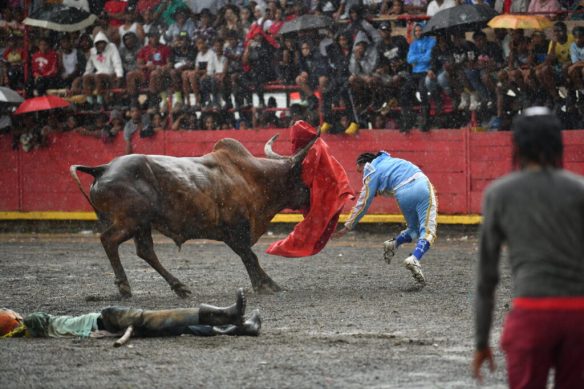
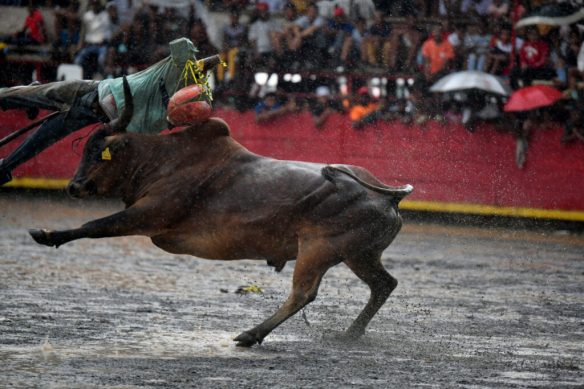
In Spain, this event would be called a capea, not a corrida, due to its informal style, lack of the traditional three act structure, and also that these are clearly not fighting bull breed animals. In fact, they are not even the same species. These are zebu cattle, Bos indicus, while toros de lidia, aka toros bravo, ‘Spanish fighting bulls’, are a strain of Bos taurus. What is more, they are bred for ferocity, and raised in a semi-feral environment with no contact with humans – other authors like to call this ‘wild’, but this is a scientific misnomer for any animal of domesticated heritage – and these animals below are clearly not naturally aggressive but what the Spanish call manso, ‘tame’, hence they require so much provocation to charge and are so unreliable when they do, precluding the practice of true toreo, the Art of Bullfighting.
Ironically, this also makes the event, in its own way, even more dangerous.
Alexander Fiske-Harrison
EL CARIBE
Bullfighting, a Cultural Passion That Endures in El Seibo
Manuel Antonio Vega
November 22, 2024

Bullfighting, a Cultural Passion that Endures in El Seibo (Photos by Danny Polanco)
 Alexander's Journal