
(Originally published in French by Au Diable Vuavert, translated from the original English enclosed below. En español aquí. )

THE UNTOUCHABLE
by Alexander Fiske-Harrison

I was told this story by an elderly Englishman who boarded the ‘Ciudad de Sevilla’ alongside me at the Port of Marseilles, en route to Rio de Janeiro in the Spring of 1940. His French was rusty and this had led to some confusion with the marseillais-speaking porters, so I assisted him and he thanked me in my own native Castillian, even though we had conversed in English up until that moment.
Seeing him dining alone that evening, I accepted his invitation to join his table. The rest of the ship’s passengers were refugees from Europe’s troubles, and that difference in itself gave us something in common.
He was clearly a man of private means and was journeying to Petrópolis to pay his respects at the funeral of the son of the old Emperor, whom he had known as a young man. I told him that I worked as a translator and had been sent by a publishing house to assist one of their authors, an Austrian, who had fled due to his religion and race and was seeking safe haven in Latin America.
We bonded over a shared love of history and storytelling and, as the wine flowed, he gained confidence and began to switch readily between my language and his, and I remarked that he must have spent some time in Spain.
This remark, innocently made, gave him pause, and I wondered if I had offended him or opened some old wound, and I apologised. He brushed my words aside and, having made some internal decision, began to tell me the story which I recount below, to the best of my ability and memory.
What shocked me at the time was not the story itself – fiction is at least half of my work – but the way that he told it. As I say, I cannot speak for its truth, although one wonders how an Englishman would know so accurately the inner workings and ritual of that closed, arcane and cruel world of ‘tauromachy’.
However, on his absolute sincerity I would bet my life: he believed every word he spoke. With each passing segment of memory his skin flushed and paled, his fingers trembled and steadied and the tendons of his hands and neck swelled and became distinct as though in a much younger man under great physical and emotional strain. This was not a performance, but a reliving of events both terrible and mystifying.
As a side note I should add that the ship docked at Barcelona the next day to take on a last group of passengers before heading out into the Atlantic. When I did not see the Englishman at dinner I enquired of the steward and was told he had unexpectedly disembarked in Spain. Whether he caught another ship or ever even made it to Brazil, I do not know.
* * *
I travelled through Spain in my twenties on a small inheritance. I had served in the Second Battle of Ypres, where I lost my innocence and the use of one leg, which explains the silver-headed cane which I carry to this day. Being no use in battle, and with the war between the various descendants of the Celts and the Saxons continuingly so bloodily in the north, I travelled south, to Madrid, and gained an interest in the more personal, less mechanised form of slaughter so wrongly called by my countrymen the bull-fight.
It was for that reason I saw a famous young toreador of the day with a bull named Barbero on the 27th of June 1917. It was the same day my brother succumbed to wounds received at Messines. Such were the times. That is also why I remember the date, although I should always remember that bullfight. Until, that is, I saw one better. I get ahead of myself, though. Suffice to say it was no coincidence that it was then that my passing interest turned to a fascination in that strange, formalised dance between man and beast that is la corrida.
I spoke with friends in the city, and they told me to head further south, and, from there, friends in Seville sent me out into the countryside so I could see from where those magnificent animals and valorous young men gain their instincts and their techniques.
I saw things in those days I had not thought possible. I have seen courage in the field: I have seen a regiment of men hold steady as half their number, comrades and friends, were snatched out of existence as though by the hand of some impatient deity, leaving behind a mist of pale redness and the sound of roaring thunder.
However, I had never seen a man, armed only with a piece of cloth, hypnotise a half of a ton of wild beast until it rests its horn against him like the Lady and the Unicorn in those tapestries which were also the products of Flanders but in a more civilised age.
As with the visionary and the zealot, at each new revelation my obsession grew.
It was around that time that I heard the story of a matador who was so nonchalant of death that the people who saw him said the bull that would kill him was not only weaned and eating grass but had probably already been loaded onto the truck bound for the plaza de toros that morning.
They had continued to say this about him for fifteen years.
The strangest thing of all about this fearless and nerveless man, besides his apparently charmed life, was the evolution of his character: at one point he had been the star of the bullfighting world, but that had changed. He had ceased fighting in the major bullrings or cultivating the visibility that such a profession requires. When he was young he had fought in Barcelona and Madrid and been seen in the finest restaurants of those great cities. Then he started only to fight in small, unknown towns, Tafalla in Navarre or Osuna in Andalusia – do you know them? No one does.
He even began signing his contracts under an assumed name so he would not appear on the posters announcing his bullfights. He stopped paying the customary bribe to the critics in the newspapers, and they duly ceased writing about him. Then, finally, he ceased appearing altogether.
However, among those with deep afición, true lovers of the taurine arts as I was seeking to become, his name was still one to conjure with, spoken with passion in those hidden bars near bullrings with their dark-wood walls and cigar-smoke air.
His name was José Luis Castro Martín, but he was known more simply as ‘The Untouchable’.
I was in one of those shaded bars in Jerez on the morning after their Feria when I overheard the foreman of old Juan Pedro Domecq, the bull-breeder, say to his master that ‘The Untouchable’ was rumoured to be making a reappearance. It was to be the very next day in a bullring somewhere in the mountains and forests between Gibraltar and Ronda, near an old village called Xemina that dwelt in the shadow of a Moorish castle.

Ximena
I left the bar that instant and purchased myself a mare, Jerez being the Feria of the Horse. I packed my few things into saddle bags and rode due east.
I do not know how familiar you are with the Ferias of sherry country, but after so many consecutive nights of fortified wine and flamenco, the world takes on a dreamlike quality, in which one is not quite sure if one is awake or asleep. Despite this, I was a competent horseman in those days, and she was a fine mare. We crossed the forest that divides that part of Spain, with its great waves of cork-oaks rising from a sea of barren rock and thistle. The sun was above us and then behind us, but there were streams and trees and we had sufficient water and shade.
Perhaps an hour before the sun was due to set, I came upon the village and was directed by a goat-herder to an inn. The ingratiating innkeeper apologised and said that he had no room, all the while studying my unfamiliar clothing through the dust, so I offered him double the usual price.
He turned to speak with someone inside the door who then pushed him aside and spoke to me with all the authority of a sergeant-major addressing the troops.
“Who are you?”
Recalling my days in the Army, I looked the man up and down – taking in the straight back, the weathered and tanned face and the fine weave of his suit – and replied courteously.
“I am an exhausted Englishman looking for a stable for my mount and a bed for myself. The real question, though, torero, is who are you to ask me?”
The man looked angry at my response, but then turned and spoke to the innkeeper in the andaluz of the region outsiders find so hard to follow, saying something about my knowing too much already, before stalking angrily away.
The innkeeper took my horse and told me I could have the room at the top of the main staircase. As he handed me my saddlebags, he looked me in the eye for the first time.
“The matador José Luis Castro is staying here and paid to take over the entire hostelry for himself and his team. He guards his privacy jealously, and you are only invited to stay as they do not want you staying in another hostel and talking about them. The Maestro does not like to be approached or addressed before the corrida, so I ask that you stay in your rooms. I will bring you some food and some wine.”
The hostel was one of those places constructed from several small houses knocked together, forming a labyrinth of irregular chambers. As a result, and I am sure without realising it, my host had placed me above the main courtyard so I could observe the courtyard, while those within it would have had to crane their necks uncomfortably upward to catch a glimpse of me.
Which was why I saw, dressed in shirtsleeves and breeches, what could only be ‘The Untouchable’ himself, swinging his large two-handed magenta cape in practice.
Toreo de salón is almost as much an artform as toreo practised with the animal, and this man was mesmerising to watch. He went through a series of passes devised in his imagination – veronicas and faroles, delantales and revoleras – with such grace as I had never before seen.
In my youth I had seen Ana Pavlova dancing with Nijinsky in Covent Garden and they were not more graceful. I also saw Jack Johnson boxing with Davies in Plymouth and it did not contain more threat.
Two other things struck me: that although his hair was grey, the strength and suppleness of his limbs and joints were apparently limitless. He moved like the stirring of the air. And his combination of focused will and nonchalant abandonment engaged the human heart with the smallest of gestures.
He also drank. Between sets of passes, and sometimes in the middle of them. He walked over to a table on which were placed a half dozen open bottles of wine in a row. At one end the bottles stood empty, at the other, they were full. There were no glasses.
He was halfway along that drinker’s row when he threw his cape into the hands of an unseen peon in a corner of the yard, and another of his team walked forwards and handed him a sword and the one-handed red serge cloth called the muleta, and he embarked on another set of practice-passes.
I sat entranced at the performance and knew how remarkably lucky I was to be the sole public witness of such a thing.
In the meantime, the innkeeper brought me my food and my wine – I closed the shutters for his visit so he should not know I had been watching – and the food and drink fed and watered my delight. As this display of artistry drew to a close, I felt I had to communicate the feeling of witnessing something extraordinary, something important, to another human being. And the opportunity of speaking it directly to the person who had engendered those sensations was too much to be denied. Once he had finished, I walked down the stairs and through the maze of interconnected rooms until I eventually found the entrance to the courtyard.
There was a hand pump in the middle of the colonnaded space, and one of the men was working it as the Maestro washed the sweat from his bare torso in the Andalusian heat. It was for that reason that I caught sight of something which made me stop stock-still in silence.
I have seen many wounds and scars, but nothing upon someone living like those I saw on that man’s back. They were old scars, pale white upon the tanned skin. On one side of his spine great grooves had been scored into his flesh. On the other side there was a single pale mark, the size of a child’s fist, and perfectly circular like the sun seen through a smoke-hazed sky.
To those who know bullfighting, it was clear as a diagram: he had been gored such that one horn had entered his body fully, and the bull then had the opportunity to try to place the other horn beside it. It was the mark of a goring which a man does not survive. Not then, twenty years ago, and not today, and not twenty years from now either.
As I stared, the bullfighter I had met at the door walked up to me with an agitation verging on violence.
“You were told to stay away!”
“I am sorry. I just wanted to say to the Maestro…” Words failed me for a second and then returned, “They call him ‘The Untouchable’.”
The man followed my gaze and at that moment his master turned around. His face, which had clearly once been strikingly handsome, was now not just aged but held a haunted expression which spoke of a life far longer than his years.
He addressed me.
“The untouchable,” he said, “not the untouched.”
At that he turned away as his assistant propelled me from the courtyard.
Before I left, I caught a brief glimpse of his team standing around the edges of that cloister. They were all older than such a team of banderilleros and picadors usually are, and also haunted like him, as one imagined the cursed crew of some ghost ship might be, the Mary Celeste or the Flying Dutchman. As I turned, one of them made the gesture, surreptitiously, to ward off the evil eye.
I returned to my rooms and a little while later I heard my door locked from the outside. I returned to my hidden vigil at the window.
The assistant bullfighter with whom I had spoken – Diego, I had heard him called – ordered the others away. It was now dark and, judging by the play of light and shadow from lanterns and candles, I could judge that they were housed in unconnected parts of the building.
I had not lit the lamps in my own room and sat watching: fatigued from my travel but too intrigued to retire to bed. I heard something heavy and wooden dragged across the stones and risked leaning out to see Diego now sitting in a great chair in front of a small, narrow staircase, as though to block it.
Suddenly, he was bathed in light from behind, and the voice of his master called out to him.
“Good night Diego.”
“Good night Maestro.”
And the light was gone with the sound of a closing door, and I watched through the windows on the floors above Diego the light of a lamp ascending stairs into another room before all fell silent.
My chair was comfortable, and I was tired, and I allowed my eyelids to close for a moment.
I do not know for how long I had been asleep when I was awakened by a woman’s voice. I realised the windows opposite me had been opened against the heat. I sat in the dark and listened.
“What is it?” The woman asked. “What do you want? Why do you bring me here?”
“The game.” The voice of José Luis responded. “I am here to play the game.”
“I don’t want to play the game anymore.”
“You do not have a choice.”
“You dare say that to me?”
The woman’s voice was different, deeper now, its tone not angry but proud.
“You do not have a choice; you gave your word.”
At that there was a great crash, as though some large piece of furniture had been hurled across a room to its destruction.
“That for your games! Do you know the work I have to do? Do you know what I am?”
There was a pause, and out of curiosity, I leaned out of the window to look down at Diego, to see how he would respond to the sounds of violent altercation in the room he had been set to guard.
I saw his eyes glittering in the faint light, open but unmoving. His hands, meanwhile, gripped the arms of his chair like claws. I swear I could see him shaking with fear.
“I know exactly who you are.” José Luis said calmly. “I knew who you were when you first came to me in the hospital in Córdoba and you promised to love me.”
“You fool!” She said with frustration, but there was affection in her voice as well. “You were so beautiful.”
“You still are.” He said quietly.
“I gave you everything I promised.” She sighed. “You were the most famous bullfighter in Spain. You danced with me every night.”
“But I could not have you. I could not share my glory with you.”
“I was already married, you knew that.”
“I didn’t care. I didn’t care about the fame either. And people began to wonder. The gypsies began to talk.”
“I know. We went from the palaces to… to this hovel.”
There was disdain in her voice.
“I could spend more time with you in such places.”
“And I hated it! I warned you to leave me alone.”
“You left me alone.”
“I told you, I have been busy.”
“I know.”
There was a pause and the sound of a sigh.
“Well, now here I am.”
“That is the promise. This is the game. And tomorrow I will show you the Beauty.”
I heard a chair move slightly and then shadows flicker and then there she was, standing at the window looking out.
I do not know if there was a moon that night which illuminated her face, or if it glowed from within, but she was the most beautiful woman I had ever seen in my life and have ever seen since. She had black hair and pale skin, punctuated by red lips and dark eyebrows and lashes. However, it was the eyes that struck one most: the palest of blues, seemingly unseeing, until, even in the dark, they saw me. She was staring directly at me. Into me.
For the first time in my life, I realised that beauty could contain within it a form of terror, for I felt a great wave of dread roll over me. I was reminded of the passage in the Old Testament when the desert God said “I will put my fear in their hearts, that they shall not depart from me.”
It was she who turned away from me, and I must have finally succumbed to my exhaustion then, as I fell into a deep sleep late into the morning.
* * *
The bullfighters had left by the time I woke, so I had the inn to myself until the afternoon, when I collected my belongings and my horse once more and was given directions to the bullring by the innkeeper.
The bullring was of the type they call a ‘portable’, constructed especially for the event and made out of great wooden beams strong enough to withstand the undirected ferocity of the bull which confronts its opponent’s skill with its unrestrained rage.
The structure was small but packed full, and I took my seat among at least a thousand other souls crowded together even though not one poster had advertised it. I saw many faces well-known in that world among the audience: they had clearly heard in a similar manner to my own about the return of ‘The Untouchable’.
My eyes hunted a different quarry in the crowd, though, for I had caught a glimpse of the woman from the night before as I entered the ring, dressed in the traditional black veil and shawl. It was only for an instant, and I felt sure she had seen me as well, and the opportunity to study her in daylight excited me almost more than that of seeing this genius torero at work. However, I could not find her and gave up my search when the trumpets sounded and the first bull came out.
It was an imposing and noble animal, with great arcing horns, quick to take the lure and straight and true in its actions. And what followed was… well, it was the greatest exposition of bullfighting art and technique that I had ever seen. And what made it all the better was that no one in that audience other than myself understood what was quite so extraordinary about it.
If one had not seen José Luis the night before, one would have seen a man with a suavity of movement, a perfection of grace, a thoughtlessness about personal risk and the proximity of the horned beast.
However, having seen what he had done when there was no animal present, I could see how absolutely unaffected he was by the animal. It was as though the bull found the spaces between the passes to inhabit them and play its dark and violent counterpoint to the music of this matador. The bull seemed to exist only to unwittingly make the dance more beautiful, as thunder announces and enhances the lightning that conjures it into existence.
It was everything: a masterclass in technique, a paean to control, it told a story like a series of paintings but made from living sculptures. It was superlative as Art, while all the while being a real and mortal ballet between Life and Death.
It was then, at the end as he placed the final sword – bringing the bull first to its knees, and then out of this world and into the next – that I finally caught sight of her. She was standing in shadow in one of archways leading into the stands opposite mine.
As the bull died, José Luis looked up from his place in the centre of the ring and saw her and he smiled. She stepped out into the sunlight, and I could make out upon that face of terrifying and enthralling beauty a stream of tears.
She was not the only person crying in that ring, including old men, such perfection had the bullfight been, but her tears had another quality as well. When I looked back at José Luis I saw that he had seen this too, for he had turned pale white.
I looked back to her and realised that now she was staring at me. There was something queer in the way she looked at me, and I suddenly had the distinct impression that she had wanted me to see her tears, wanted me to bear witness to that moment.
When the next bull came out it was so wild as to seem unfaceable. However, José Luis, who was sole matador that day, went out to stand before it all the same.
There was none of the beauty of a moment before, for it was like a creature possessed. Despite this, it seemed unable through some trick of luck or technique to catch José Luis with its horns, instead evading and avoiding him as though he were not its actual target, as though it were seeking something else altogether.
The picador was summoned into the ring to ‘cut it down to size’, as they like to say, and it was then the animal lost all semblance of sanity. It charged across the ring away from the horse and leapt onto the barrier of the ring. However, unlike so often when that happens and it drops harmlessly into the bullfighters’ alleyway, this time it held its balance atop the wooden fence and hurled itself up into the stands, into the crowd.
From my vantage across the ring I witnessed the whole horrifying scene, although many of the details I could not piece together until later.
The bull carved its way through the spectators as though it had some preordained destination. Many were injured, but it never paused to gore a single one on its journey. The bull reached the archway where woman had been standing, and from there it headed underneath the stands, where carefully balanced struts support the massive weight of people and timber. Incoherent screams went up, but one voice shouted clearly that there was a woman trapped under the stands with this black chaotic fury.
All of this had happened within a matter of seconds, and that was how long it had taken José Luis to sprint across the ring and vault the barrier. He did not hesitate for a moment but disappeared into the archway and under the stands, his golden suit glinting in the evening sun.
It was not long after that the stand on the sunlit side of the ring collapsed on itself and then everything descended into shrill pandaemonium.
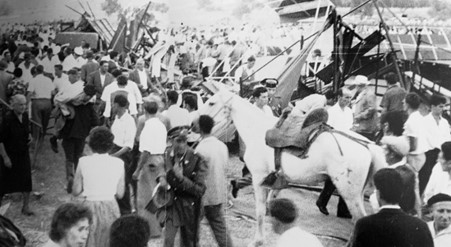
Las consecuencias del colapso del ruedo portátil en Ximena
* * *
I discovered in one of those dark bars a little later that twelve people had died that evening – along with the bull – and they included José Luis.
I slept in a field with my horse that night, not having the heart to return to the inn. The next morning, before I left, I visited the local infirmary and asked the doctor if a woman had been among those killed, and they told me that no, there had not even been a single señora among the injured.
I then asked how José Luis had died, wanting to know the end of so terrible a day, and the doctor with whom I spoke said he had died as bravely as he lived. He had been horribly injured, and the doctor had known his injuries would prove fatal, but José Luis had refused either ether or morphine for relief. He had to stay awake, he said. Just in case, he said. Although he would not explain why.
I felt I had to ask one final question.
“The nature of his injuries… was there a horn wound?”
“No, it is funny you should mention as my nurse and I had remarked upon it as well. He was killed by the collapsing structure and debris. The bull never even touched him.”
As I said, I have never seen another bullfight nor returned to Spain. Although I always wondered if I should. You ask why? I always wondered if I should meet her again. And how she would appear. And if she would see in the ageing bachelor I am today the young man she had once graced with her gaze.

Copyright © Alexander Fiske-Harrison 2022 – All Rights Reserved
Shortlisted for Le Prix International Hemingway 2022 and published, in French, as ‘L’Intocable’ in La Dernière Chance de El Lagartijo: Et autres nouvelles du Prix Hemingway (Au Diable Vauvert, 2022)
 Alexander's Journal