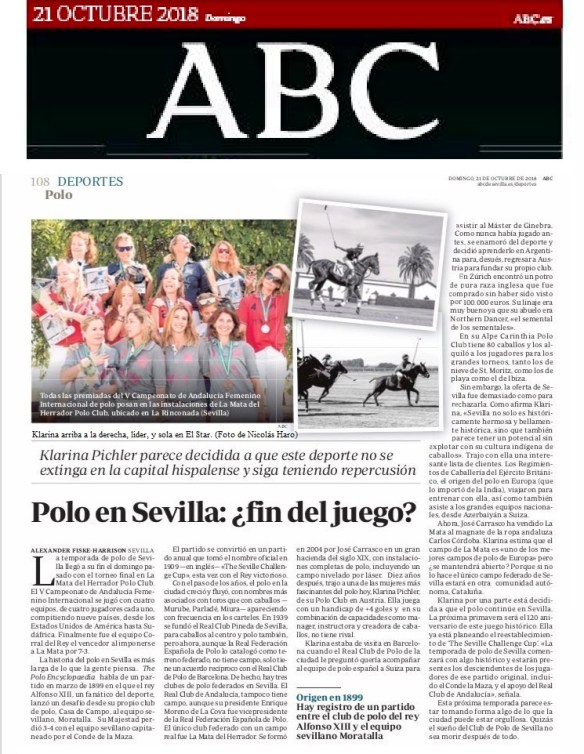
Klarina Pichler – Polo In Seville: The End Of The Game? (ABC)

The original article as it appeared in the Spanish national newspaper ABC.

Polo in Seville: The End Of The Game?

The polo season of Seville came to a close last Sunday with the final tournament at La Mata del Herrador Polo Club. The 5° Campeonato de Andalucía Femenino Internacional was played with four teams – of four players each – competing from 9 countries, from the United States of America to South Africa.

Polo is the only sport, in the serious sense of the word – a sport that was Olympic until the 1930s – in which men and women compete on an even playing field (excuse the pun), although that tournament is for women only. In the end the team sponsored and named for the ‘Hotel Corral del Rey’ beat the home team of La Mata.

The history of polo in Seville is longer than people think. The Polo Encyclopaedia speaks of a match in March 1899 in which King Alfonso XIII, an avid fan of the sport and the first ever reigning monarch to play in public, issued a challenge from his own polo club Casa de Campo to the Seville team, Moratalla.

Despite playing alongside his English coach, George Miller – one of the family that introduced polo to Argentina and later an Olympic Gold medallist in the sport – and the madrileño Santos-Suárez brothers, José and Joaquín, His Majesty lost 3-4 to the sevilllano team of the Conde de la Maza, the Marqués de Viana, the Marqués de Villavieja and the Duque de Arión.

King Alfonso XIII playing polo in 1922 – on the ball

However, there was then no polo club in Seville and the games were played at the old racecourse at Tablada. The match became an annual fixture taking the official name in 1909 – in English – “The Seville Challenge Cup”, with the King leading his team once again, this time to victory, and the cup being presented by the Sociedad de Carreras of Seville.

Over the years polo in the city ebbed and flowed, with names more associated with bulls than horses – Murube, Parladé, Miura – appearing frequently on the cartels. In 1939 the Real Club Pineda de Sevilla was founded with horses at its heart and polo on its fields. Indeed, it is still listed as a federated ground by the Real Federación Española de Polo, and yet it has had had no polo field for decades. Instead, it signed a reciprocal deal with the Real Club de Polo de Barcelona in 2014.

Indeed, there are three federated polo clubs in Seville. Another, the Royal Club of Andalusia, ‘El Aero’, also has no field, although it had until recently 2016, its own annual cup in the Andalusian Cathedral of Polo, Santa María Polo Club in Sotogrande, Cadiz – its president Enrique Moreno de la Cova having been until recently the vice-president of the Real Federación Española de Polo.

The only federated club with an actual field was La Mata del Herrador.

Formed in 2004 by José ‘Pepe’ Carrasco Vergara, a committee member of the Federación Andaluza de Polo, who purchased this grand 19th century hacienda with its 20 hectare olive farm and constructed within it full polo facilities (which, when one considers it can cost €400,000 just to laser-level the polo field flat, is no mean feat.)

Polo Club La Mata del Herrador (Photo courtesy of Polo+10, read their article online here)

Determined to expand it, ten years later he brought in one of the most fascinating women in polo today, Klarina Pichler, from the Alpe Carinthia Polo Club in Austria. Klarina is a player of whom it was said she was in the top ten women in the world. She still plays off a +4 handicap and her capacities as a manager, instructor and creator of both horses and players is unrivalled.

Growing up with horses in her native Salzburg, she was a champion at dressage, showjumping and ‘volteo’ – a form of horseback gymnastics popular in Austria – but by the age of twenty-five she had moved on to jockeying racehorses in Munich in Germany.

A nomadic soul like her beloved herds, it was a year later that she decided to move to Barcelona where their Royal Polo Club contacted her asking if she would like to accompany the Spanish polo team to Switzerland for the Geneva Masters to assist. Having never played before, she fell in love with the sport and decided it was to learn to play it properly, so she moved again, this time to the modern home of polo: Argentina. There she worked with the great +8 goal Argentinian player, Ignacio Tillous, at his club La Carlota in the province of Cordoba and then returned to Austria to found her own club. Being a person who likes to approach a thing from every facet, she created not only herself as a player, but her horses as well.

Klarina Pichler playing on Elstar at her polo club in Seville

In Zurich she found a English thoroughbred male foal who had originally been purchased sight unseen for €100,000, so good was his lineage: his grandfather was Northern Dancer, the 20th century’s “sire of sires” and his other antecedents no less prestigious. A few years later Klarina bought him for an undisclosed lesser sum as her stallion, Elstar, as he had not quite lived up to his DNA on the racetrack. Unlike, for example, his unbeaten first cousin Frankel, who the World Thoroughbred Racehorse Rankings Committee rated as the best racehorse in their history.

She then selected four mares exclusively from Argentina, from the herds of established high goal players, starting with Ignacio Tillous, and imported them.

“I wanted the very best and wanted to start small, because I wanted to make them one by one myself, to train them myself, in my own way.”

Inspired by the “natural horsemanship” techniques of Monty Roberts – the source for the novel and film ‘The Horse Whisperer’ – Klarina disliked others methods of making a horse rideable.

“They break its spirit through fear. I come from the idea of inspiring confidence, making the horse confident about being ridden, and then training it for polo from there.”

She founded the Alpe Carinthia Polo Club in 2008 and there hosted 80 horses of other players along with her own growing, renting them out to players for tournaments from the snow polo of St Moritz and Kitzbuhel, to the beach polo of Ibiza, as well as the major European grounds like Barcelona, the Legacy Club in Zurich, the Aviator Club in Prague.

La feria de abril de Sevilla, ‘The April Fair of Seville’, 2018 (Photo ABC)

However, when her co-founder, an Argentinian polo professional, exited it became too difficult to run the club on her own. So Sr Carrasco’s invitation to host her herd and use her as polo manager for La Mata was a timely intervention. Also, as Klarina says, “Sevilla is not only historically beautiful and beautifully historic, it also seemed to have an untapped potential with its indigenous horse culture, after all, what is a caballero if it is not a man with a horse?”

She brought with her an interesting list of clients. The British Army’s Cavalry Regiments, the very origin of polo in Europe who brought it from India, come out to train with her, in particular the Royal Dragoon Guards who were so intrinsic in the liberation of Spain from the Empire of Napoleon Bonaparte.

She also assists the great national teams, from Azerbaijan – the part of the world from where polo came – to Switzerland.

In fact, she found herself recently put in the difficult position of assisting the Swiss National polo team at the European Championships in Villa A Sesta when her birth country of Austria decided to enlist her as first substitute in case of injury for their own team.

That said, Sr Carrasco has sold La Mata to Andalusian clothing magnate, Carlos Cordoba, and so the question arises as to whether or not what Klarina calls “one of the greatest polo fields in Europe”, will remain open. Because if it does not Seville’s only federated club ground will be in another province, Catalonia – and according to some, another country. Sources say this will not be so.

Klarina for one is determined that Sevilla Polo will continue.

6th Ladies International Championship of Andalusia at Polo Club La Mata del Herrador – Klarina Pichler right – 2018

“Next Spring will be the 120th anniversary of that historic game, and 110th of the Seville Challenge Cup. She is already planning its reestablishment. The polo season of Seville will begin with something historic and monumental. And will, of course, end, with the 6th Ladies International Championship of Andalusia.”

And this author, and amateur polo player, will be there, and inviting my friends from the world of the bulls who descend from the players of that original match – Sainz de la Maza and Ybarra, Santos-Suarez (courtesy of Adolfo Suárez Illana), even the photographer for this article, Nicolás Haro Fernandez de Córdoba, descendent of the Duke of Arion. With the support of the Royal Club of Andalusia under its president Enrique Moreno de la Cova, we hope to get the rest, and, as in the original match, we will have a young English player from one of my own countries great polo dynasties who is said to be one of the young great hopes of British polo who is coming to study in Seville, this next season looks to be shaping into something the city can be proud of.

Perhaps the dream of El Club de Polo de Sevilla is not dying after all.
THE LAST ARENA: For The Love Of ‘Toreo’ – article in ‘Boisdale Life’ on bullfighting

FOR THE LOVE OF TOREO

When Englishman, Old Etonian and Boisdale regular Alexander Fiske-Harrison travelled to Spain to write a book on bullfighting, he never imagined that he’d be stepping into the ring himself. But after he picked up the red muleta for the first time, everything changed

Anyone who speaks of their first time in the ring in terms of the sweat or the heat, the overwhelming fatigue or the numbing fear, the grittiness of the sand under foot, or the particular odour the Spanish fighting bull brings with it from the corrals, is either lying, misremembering or deranged. For such detailed cognition is not how such massive levels of acute stress work in the normal human mind.

When you are first faced with a bull your world consists of two things: the animal’s eyes and where they are looking, and the animal’s horns and where they are going. As the saying goes of war: there are far too many things to be afraid of to have time to be scared.

By the time I was facing a big animal – three years old and weighing a third of a ton – I had learned how to control that adrenal flow so that I could devote time to reading the animal. For example, seeing which horn he preferred to lead with (like boxers, bulls are either southpaw or orthodox), and noticing whether he wanted to break into a canter in a close-range charge or preferred merely to extend his trot. Then there was the choice of pass I’d make with the muleta – the red cloth with a wooden stick for a spine – extended wider with the sword in its folds when used for a derechazo on the right, or on its own on the more risky, but more elegant, left for a pase natural.

To read on click here.

Unpopular Truths: Bullfighting & Sufism, Beauty & Wisdom


AFH with Juan José Padilla at his home in 2012 the day before his return to the ring. (Photo: Zed Nelson for GQ magazine)

I recently did an interview with fellow author – a specialist on Spanish and Moorish History and Art – Jason Webster for the Idries Shah Foundation (online here) on my interest in Sufism and my history in el mundo de los toros, ‘the world of the bulls’ in Spain.

Sufism is perhaps best described as a mystical form of Islam more closely related in its theology and philosophy to Buddhism than the other interpretations of Mohammed’s teachings, and as a result is the most internally persecuted variant of that religion both historically and during its current civil war.

Idries Shah was a noted author for many reasons but most of all introducing the ideas of Sufism to the West, as he did to me via his book The Caravan of Dreams.

Sufism’s link to the corrida de toros, a dance with the evident threat of – and executing with a sword the magnificent reality of – a Spanish fighting bull may seem distant, but they are there.

One link is purely circumstantial: I first read his writings immediately before I discovered Spain because, as I say in the interview, his was one of the few books I took with me when I went to live in the Sahara desert. When I returned to Europe, it was by ferry from Tangiers, so I landed in – and fell in love with – Spain. (Almost exactly twenty years ago to the day.)

I hope I brought out more than such minor personal and geographical links, though, in my rather digressive responses to Jason’s questions, ranging as they do from German philosophy to the Qur’an, Oscar Wilde to William Shakespeare.

Now I must return to work on the second edition of Into The Arena: The World Of The Spanish Bullfight, to take advantage of a resurgent publicity in its favour, such as in the most popular magazine in bullfighting, 6Toros6 (right), or in my long feature in the most recent issue of the Boisdale Life (see post above.)

Anyway, once again, the interview is here.

Alexander Fiske-Harrison

Seville in September

Alexander Fiske-Harrison in front of the Cathedral of Seville (Photo: Samantha Mullins)

Having spent the early part of the summer writing the second edition of the Wallpaper* City Guide: Madrid for Phaidon Press, I thought it worth reminding people that I did the same for their guidebook to Seville in 2014.

These guidebooks tend towards the modern – unsurprising given that Wallpapermagazine is design led – but I have always found a way to include establishments which aren’t defined by their youth, but by their quality.

Seville – where I have been coming for 20 years – has its finest month in September, especially this year with the 20th Biennial of Flamenco opening on September 7th in la Plaza de Toros de la Real Maestranza, the great bullring – the oldest of its kind in Spain – and running shows throughout the month – some for free – everywhere from the grand Teatro Lope de Vega and the Royal Gardens of the Alcázar Palace to the Church of San Luis de la Franceses to Café Alameda.

AFH and Padilla (Photo: Paloma Gaytán de Ayala y de Queralt)

Then, on the 29th, in that same ring, the most famous bullfighter in Spain, the one-eyed Juan José Padilla, is fighting his last ever bull as a professional. And this is no washed up matador making a last stand, he was ranked number one in Spain when he made the decision to retire last year, and has triumphed across the country on his final tour. (In Pamplona when I saw him he was extraordinary.)

I’ll write more about this further down this post – he is a personal friend and mentor after all – but to make it easier, I’ll say here that, tickets for that Saturday’s corrida are available to purchase and print online from the English-language version of the official site of the bullring by clicking here. (Tip: you want to sit as close to the centre of the ring, i.e. the sand, as possible, and preferably in the sombra, ‘shade’, or sol y sombra, ‘sun’ that becomes shade as the evening progresses.) The other matadors that day and the next are all extraordinarily talented – and ranked in the top ten for what that’s worth.
Continue reading

RIP: Prince Georg-Constantin von Saxe-Weimar-Eisenach

BBC News
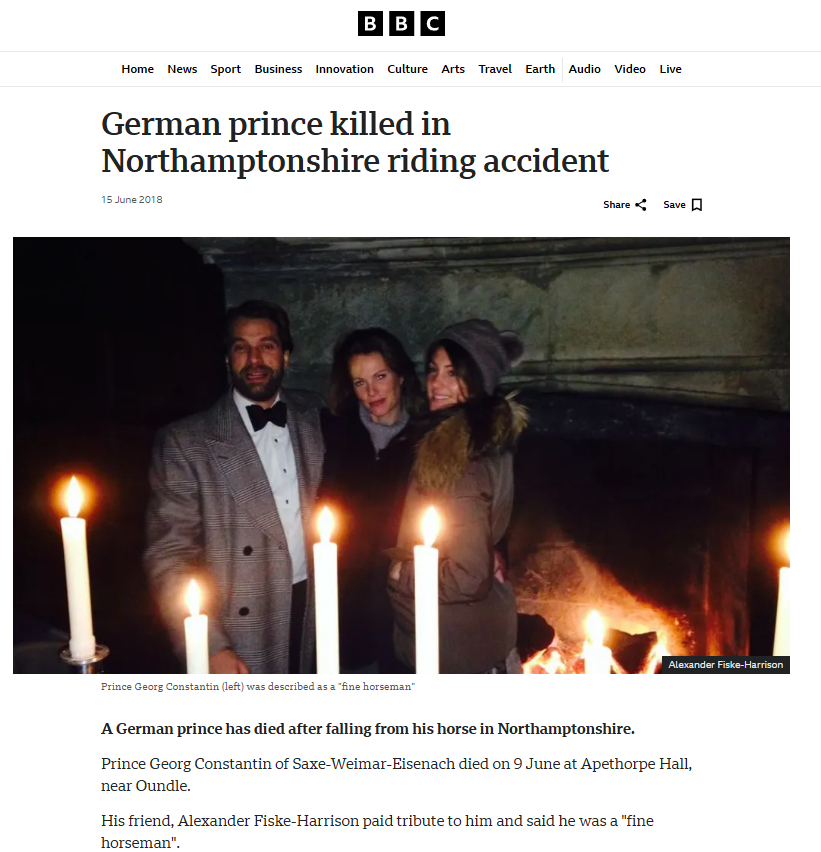
German prince killed in Northamptonshire riding accident
15 June 2018
Prince Georg Constantin (left) was described as a “fine horseman” (Photo: Alexander Fiske-Harrison)
A German prince has died after falling from his horse in Northamptonshire.
Prince Georg Constantin of Saxe-Weimar-Eisenach died on 9 June at Apethorpe Hall, near Oundle.
His friend, Alexander Fiske-Harrison paid tribute to him and said he was a “fine horseman”.

Prince Georg-Constantin of Saxe-Weimar-Eisenach, was heir presumptive to the hereditary Grand Duchy of Saxe-Weimar-Eisenach, the most senior branch of the House of Wettin, also holding the titles of Landgrave in Thuringia, Margrave of Meissen, Princely Count of Henneberg, Lord of Blankenhayn, Neustadt and Tautenburg.

Outside of England, in precedence they rank even above the cadet branch of Wettin, Saxe-Coburg and Gotha, renamed Windsor in the United Kingdom where they rule, as they do in Belgium under that country’s name, and also did in Portugal, as they did in Bulgaria where His Majesty Simeon II was the last king, and later Prime Minister, and whose grandson and heir, Boris, Prince of Tarnovo, is a dear friend.

Constantin – Con – and I first met in 2014 in The Racing Post public house off the King’s Road through our then girlfriends, Olivia and Sarah.

Sadly, in the way of such things, after that relationship of mine ended the last time I saw him was in 2017, although we had been planning to meet on my return to London from Seville at the end of this month to discuss something horse-related (Riding Andalusia.)

I woke up yesterday morning, sore from my own first day in the saddle since 2016, and my first day playing polo (a sport in which Con had taught me more than one dirty trick) since the year before that, to messages from mutual friends asking if it was true that Con was dead.

Having lost – and written in the Telegraph about the death of – my own brother, I know the importance of memory. In words and photos, like the one above the night he got engaged which I took. And others… I find it odd that I have photos by him, and of him, but none of us together – but then it was always us four. (His photography, like his horsemanship, was always better than mine. The latter so much so that the irony in his manner of death while out for a gentle hack – not even playing polo, hunting or racing – shocks me, but my brother died skiing in a similarly freak accident of an expert doing that at which they are so gifted.) 

Anyway, I wrote the social media post above for our many mutual friends, which was in turn quoted from the BBC to The Daily Telegraph  (along with The Sun and Daily Mail), from ¡Hola! to El Mundo in Spain where I live, from Bunte to Die Zeit where Con’s Grand Duchy lay.

FACEBOOK: Alexander Fiske-Harrison’s post 12 June 2018 Rest In Peace my poor friend Con – Prince Constantin von Saxe-Weimar. It seems like yesterday that we dined like this by candlelight in the hall of Apethorpe Palace and you cooked over the great fire and you got me to help in your subterfuge so you could ask Olivia to marry you, and you nearly dropped the diamond in the dark and I lit the fireworks for you in the park afterwards and set fire to myself in the same grounds where you have fallen. I remember most the quiet nights like the next one when we dined à quatre and the Puligny-Montrachet never ran out. And all those London nights at your place on Lots Road and the Chelsea Ram back when we were neighbours. I remember you riding in that race at Cheltenham and polo in Berkshire and your stories of riding to your hounds in France. That such a fine horseman should go out that way. My thoughts and prayers are with you and your family. Goodbye my friend…

I remember that New Year’s Eve at Apethorpe so well: we had no electricity and cooked and dined using with only the great fire and candlelight, with Con’s best friend – and the new owner of the grandest private palace in England – Jean Christophe, Baron von Pfetten. (Before that it had been the family home of another friend, Burghie, Earl of Westmoreland, whose grandfather had sold it.)

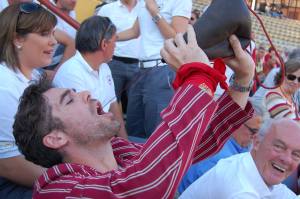
Burghie Westmorland, right, and Alexander Fiske-Harrison, enjoying a ‘bota’ of wine in the bullring of Cuéllar in Old Castile in 2013, where Fiske-Harrison had just run with the bulls in his Eton College Athletics Team ‘colours’ blazer that morning.

Most of all from that time, I remember sitting one night having a quiet drink with Con at Rushton Hall, just the two of us – he newly engaged to be married the night before – both of us dreaming of what we wanted from life.

One of those crystal-quality moments of memory when the rest of the world does not intrude, but two people who think they can dominate life – dominate death even, as we both did – and make plans that will leave a mark on history.

Sarah & Alexander Fiske-Harrison at Con’s house (Photo: Prince Georg-Constantin von Saxe-Weimar-Eisenach)

And the gods laughed at us.

Life is cruel sometimes, but crueller still would have been a world without him.

Prost Con, Prost mein Freund. Requiescat in Pace, Princeps

Alexander Fiske-Harrison

Constantin at The Chelsea Ram pub on Lots Road (Photo: Alexander Fiske-Harrison)


On BBC Radio 4’s Today Programme today: me.

Back in London from updating the Wallpaper* City Guide Madrid, when the BBC sends me a message saying only “we’d like to talk to you about poshness”.

It turns out that one of the former members of the flagship ‘Today’ programme team on Radio 4, Steph McGovern, had said in an interview – in response to a question on the gender pay gap no less – that social class was an often ignored contributing factor to inequality in the work place.

So, their research team trawled the internet and came across a piece I’d written for The Spectator a couple of years ago headlined (by the editor) – “[James] Blunt Is Right. Being Posh In The Arts Is Career Suicide.” It is online here.

So it turns out that my debut on the Today programme is not for my travel writing, not for my forthcoming book The Bulls Of Pamplona (with chapters by John Hemingway, Ernest’s grandson, and Beatrice Welles, Orson’s daughter, and a forward by the Mayor), nor the book I am just prepping to research on wolf conservation, reintroduction and how they made us human just as we made them into dogs – provisionally titled The Land Of Wolves – but instead because I was sent to an expensive boarding school.

Oh well. The one thing I can say without reservation is that what Ms McGovern’s complaints are, with a six figure salary at 35, she is certainly being paid more than this Old Etonian freelancer at 41. For this interview, I don’t get a dime. (At least they’re sending a car.)

Anyway, in case anyone is interested, below is my most recent interview – and product placement – on the wolf project. Already been out to the last great virgin forest in Romania, and to revisit Paul Lister’s reintroduction site in the Scottish Highlands with the great biologist Prof. Doug Smith, next stop the site of Doug’s own reintroduction, Yellowstone Park…

Alexander Fiske-Harrison

@fiskeharrison

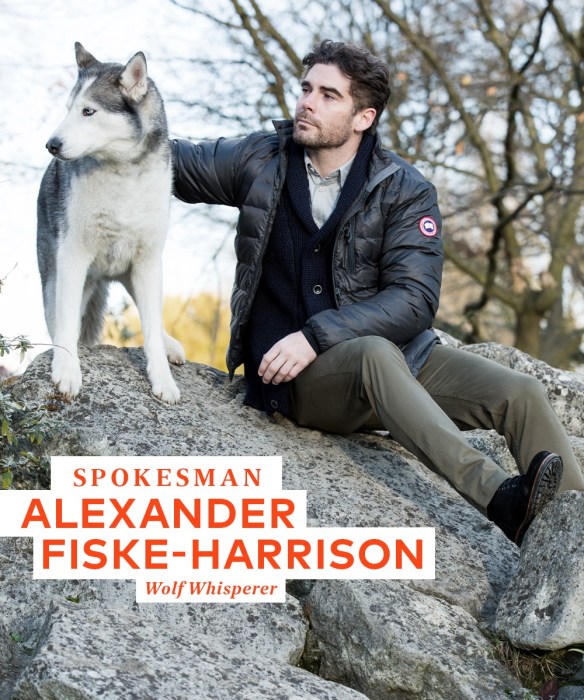
SPOKEsman // Alexander Fiske-Harrison: Always carry a blade…


THE LAST ARENA: Iván Fandiño: We Who Are About To Die Salute You…

Death closes all: but something ere the end,
Some work of noble note, may yet be done,
Not unbecoming men that strove with Gods.

(from Tennyson’s Ulysses)

The 36-year-old Basque matador Iván Fandiño was killed by a bull in the ring yesterday in Aire-Sur-L’Adour, near Mont de Marsan, in the Nouvelle-Aquitaine region of southwestern France.

The hierro, ‘iron’ or brand, of the ranch of Baltasar Ibán along with its colours.

The bull, Provechito No. 53, was born in March 2013 in El Escorial in the province of Madrid, on the well-known as respect ranch of Baltasar Ibán – founded 1920 – whose herd is of the Contreras bloodline – whose origin is the historic Murubé line – with a touch of Domecq – whose origin is the historic Parladé line.

It was the third of six bulls fought that evening, and was actually being fought by the matador Juan del Álamo when Fandiño stepped in to perform a quite upon it – a sequence of artistic manoeuvres with cape done after the bull has faced the mounted picador with his lance.

This is not an uncommon occurrence in the centuries-old scripted sequence of a corrida. The corrida is not a sport, nor a fight (even though I use that English verb as “torear” has no proper translation) – nor thought of, discussed or reviewed in the papers as such. It is a tragic spectacle culminating in a ritual sacrifice.

Fandiño had already been awarded an ear from his own bull, the first of the evening as most senior matador – he became a full matador in 2005 in Bilbao (he was the only Basque matador at the time of his death) – and clearly thought this bull special enough that he could do something to entertain, impress or move the audience with it.

July 11, 2013-Pamplona, Spain- Matador Iván Fandiño does a pase de pecho with a bull from the ranch of Torrestrella of Álvaro Domecq (Photo © Jim Hollander / EPA)

To read on click here

An Establishment Man: R.I.P. Victor Sandelson, 1928-2017


I was saddened to see in The Times that my family friend Victor Sandelson has died.

My memories of Victor are mainly from my childhood at Fiske & Co’s old summer parties on the Pavilion Terrace at the Palace of Westminster. He was one of my father’s Cambridge friends and you always could find him chatting, cigarette balanced delicately between upturned fingers (with a portable solid gold ashtray in the other hand), staring down at waters of The Thames, his words drifting between subjects with his friends, medicine or the sea with our GP Sir Nigel Southward (then Apothecary to the Royal Household and later Vice Commodore of the Royal Yacht Squadron), business or horses with Sir Martyn Arbib (then owner of both Invesco Perpetual and racehorses like Snurge who won the St Leger) or history and politics with the Marquess of Ailesbury (then a member of both the House of Lords and the board of Fiske.)

Victor’s brother Neville had been a Member of Parliament, one of the infamous Labour MPs who helped set up the Social Democratic Party, SDP, and then defected to it in 1981. Victor would always speak of his brother as “the clever one”, even though it was he had been invited back to Cambridge University to teach. Older than my father, he had poached him Sandelson & Co from Panmure’s (with David Cameron’s father Ian), until my father left for Fiske, a briefly acrimonious split which got them both in the pages of Private Eye more than once.

My fondest memory of Victor, though, is one of intellect and generosity at a dinner party of my parent’s in Eaton Square when I was twenty. I just had just begun my Philosophy, Politics and Economics (PPE) degree course at Oxford and while researching some essay or other I had come across Hugh Thomas’s 1959 book of essays The Establishment. Lord Thomas is now better known as a historian of Spain, but in those days he was a noted journalist and had coined the phrase “The Establishment” in 1954. He’d asked Victor to contribute a chapter on The City, and with characteristic wit Victor had titled it ‘The Confidence Trick.’

More than the content of the piece I remember his delight that it was still being read almost four decades later, and after I brought it up we spent a memorable evening in a discussion which began with finance, moved on to the nature of power and elites, and then and ranged everywhere from the philosophy of fin de siècle Vienna to the fate of the Jews in Europe in the 20th century – Victor was proudly a Jewish English gentleman.

Most of all from that night, I came away with a realisation that discussions of great depth could also be carried out with humour and charm if you possessed his particular lightness of touch, something I have still yet to master. This was further reinforced by my return Oxford a few days later, where I found a handwritten letter waiting at the Porter’s Lodge of my college thanking me profusely for my company at dinner and containing a book token for £100 so that I could buy at least a few of the many he had mentioned in passing. It was a gesture which I have never forgotten.

The world is less without him.

Alexander Fiske-Harrison

Bull-Running In The Land Of Buffalos

I will be talking about the encierros – the ‘bull-runs’ – of Pamplona on Classic FM South Africa at 10a.m. local time, which is 8.a.m. GMT, which gives me about ten minutes to make a coffee. For more details on the subject, read the eBook guide I edited and co-authored with contributions from everyone from the Mayor of Pamplona to John Hemingway, grandson of the great author and bulls aficionado Ernest Hemingway, The Bulls of Pamplona – click here for more details.

Alexander Fiske-Harrison

Merry Christmas

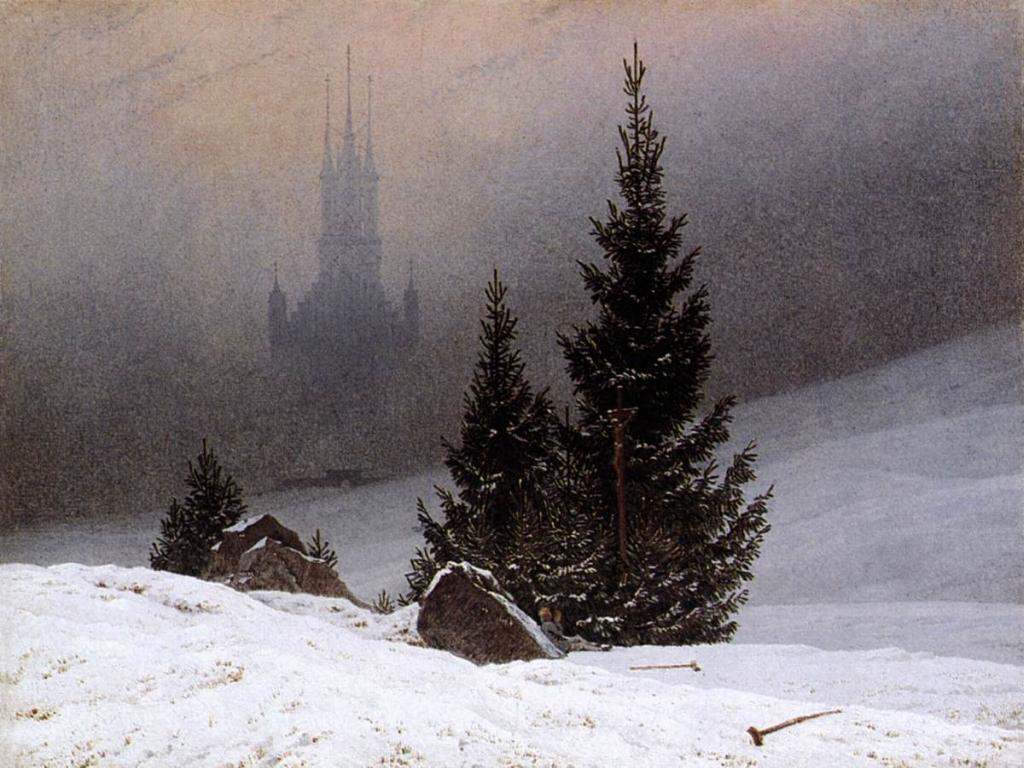
Caspar David Friedrich - Winter Landscape (1811)

Caspar David Friedrich – Winter Landscape (1811)

Some say that ever ‘gaint that season comes
Wherein our Saviour’s birth is celebrated,
The bird of dawning singeth all night long.
And then, they say, no spirit dare stir abraod.
The nights are wholesome. Then no planets strike,
No fairy takes, nor witch hath power to charm,
So hallowed and so gracious is that time.

Hamlet, Act One, Scene One

Xander