THE LAST ARENA: An artist comes to the bulls – David Yarrow in Miura

(En español aquí)

When the legendary fine art photographer David Yarrow calls you answer. Not least when he says he wants to extend his famed art photography of wild things to the animal that most closely resembles the wild ancestor of all modern cattle (Bos taurus), the aurochs (Bos primigenius primigenius.)

David’s up close and personal shots of the beasts of the wilderness, reproduced on the internet ad infinitum, but in actuality produced as vast, wall-sized prints of the highest quality, hair-fine resolution, sell for tens – sometimes hundreds – of thousands of pounds, euros and dollars.

CHARGE by David Yarrow (2013)
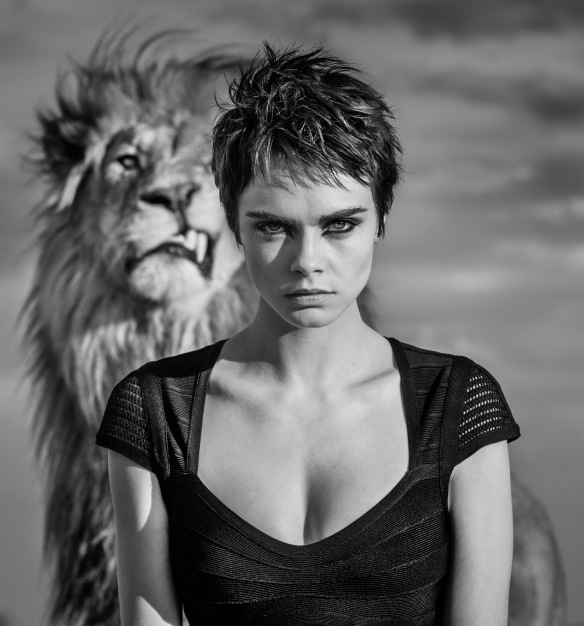
Cara Delevingne with lion for Tag Heuer #dontcrackunderpressure campaign by David Yarrow (2018)

The Spanish toro de lidia, aka toro bravo, ‘brave bull’, comes in the top ten genetically for relatedness to the ancestral aurochs, and six of the others in the top ten are its Spanish cousins (including the berrendas who feature later.) However, the toro bravo is the closest in phenotype – anatomy, morphology and behaviour – by far.

The Aurochs from Vig, whose skeleton is in the National Museum of Denmark, weighed almost 1000 kg (2,200 lbs), and its shoulder height was almost 2 metres (6 feet 6 inches.)

You can see the relatedness of the toro de ‘Lidia’ to a British fossil of aurochs, in this summary for Rewilding Europe of the paper ‘Genetic origin, admixture and population history of aurochs (Bos primigenius) and primitive European cattle‘, published in the journal Heredity in 2016.

Having received my brief, I knew exactly where to go: the one breeding ranch, founded in 1847, which is famed for the cattle that most closely match the vast size of the aurochs of all strains of toros bravos and whose extraordinary ‘feral’ (I mean that in the biologist’s sense of the word) aggression most matches the aurochs’ wild character. It is the family name which conjures most fear among matadors. As Ernest Hemingway put it in his 1932 classic, Death In The Afternoon:

There are certain strains of bulls in which the ability to learn rapidly in the ring is highly developed. These bulls must be fought and killed as rapidly as possible with the minimum of exposure by the man, for they learn more rapidly than the fight ordinarily progresses and become exaggeratedly difficult to work with and kill. Bulls of this sort are the old caste of fighting bulls raised by the sons of Don Eduardo Miura of Sevilla… which made them the curse of all bullfighters.

A study by the University of Complutense in Madrid, published as ‘Ancestral matrilineages and mitochondrial DNA diversity of the Lidia cattle breed‘ in the journal Animal Genetics in 2008 showed how among the toros bravos which all show “a certain degree of primitivism”, the Miuras stand alone as a breed-within-a-breed.

That’ primitivism’ is the reason why Ferruccio Lamborghini, formerly a friend and customer of Enzo Ferrari, took the bull as his logo to contrast with the ´prancing pony´, and why the world’s first supercar was launched under the name Lamborghini Miura in 1967.

As you can see below, Ferruccio personally took it to Spain and drove it to show it to old Eduardo Miura, father of the present owners, brothers Eduardo and Antonio. Several more models from that marque also took their name from individual Miura bulls afterward: from the Islero in 1968 to the Murciélago in 2001.

Autumn 1968. Finca Zahariche in Lora del Río, Spain. Standing, in a black suit, Ferruccio Lamborghini, next to Eduardo Miura, patriarch of the famous family of fighting bull breeders. The year before, the legendary car began to be sold, the Lamborghini Miura, the first supercar in history.
Continue reading

THE LAST ARENA: Bullfighting in the Dominican Republic – Alexander Fiske-Harrison in El Caribe


The Dominican Republic, located on the eastern side of of the island of Hispaniola.  French-speaking Haiti forms the western side, and they are divided by a border wall, begun in 2022, and second in scale in the region only to that which divides Mexico and the USA, begun post-9/11 by President Bush (and continued by Obama, Trump and Biden.) 

The DR was the site of the first European settlement in the Americas and is home to Santo Domingo, the oldest European-founded city in the New World. El Caribe, established in 1948 and based in Santo Domingo, is a widely read national newspaper, written in Spanish, the national language. It has been translated by myself with the help of Chat GPT. 

While it is always flattering to be referenced as an authority on the subject of el mundo de los toros bravos, ‘the world of the Spanish fighting bulls’, it does mean I feel compelled to write a few words to explain what this article is actually about. 

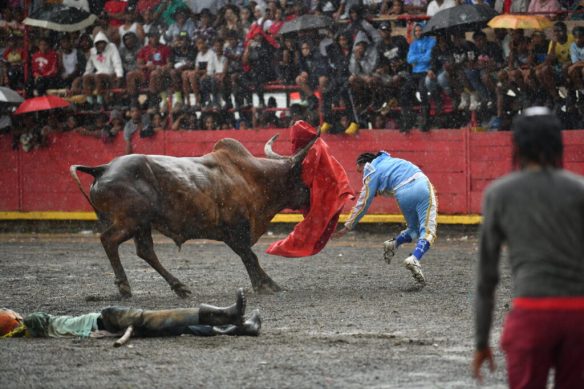
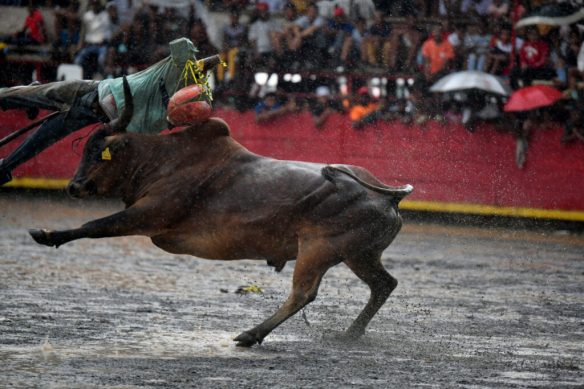
In Spain, this event would be called a capea, not a corrida, due to its informal style, lack of the traditional three act structure, and also that these are clearly not fighting bull breed animals. In fact, they are not even the same species. These are zebu cattle, Bos indicus, while toros de lidia, aka toros bravo, ‘Spanish fighting bulls’, are a strain of Bos taurus. What is more, they are bred for ferocity, and raised in a semi-feral environment with no contact with humans – other authors like to call this ‘wild’, but this is a scientific misnomer for any animal of domesticated heritage – and these animals below are clearly not naturally aggressive but what the Spanish call manso, ‘tame’, hence they require so much provocation to charge and are so unreliable when they do, precluding the practice of true toreo, the Art of Bullfighting. 

Ironically, this also makes the event, in its own way, even more dangerous. 

Alexander Fiske-Harrison

EL CARIBE

Bullfighting, a Cultural Passion That Endures in El Seibo

Manuel Antonio Vega

November 22, 2024

Bullfighting, a Cultural Passion that Endures in El Seibo (Photos by Danny Polanco)

Bullfighting has been intrinsically linked to Spanish culture, but records suggest that its practice dates back to two millennia before Christ.

El Seibo, Dominican Republic – Bullfighting, a centuries-old cultural and artistic event in Europe, was introduced to El Seibo, a province on the eastern part of the Island of Hispaniola, by a Spanish national around 1890. Known locally as “tarde taurina seibana”, ‘Seiban bullfighting afternoon,’ it was incorporated into the festive cycle honouring the Holy Cross.

According to documented data from the records of the Brotherhood of the Devout, an organization linked to the Catholic Church in El Seibo, the event was initiated by a Spaniard who settled in this distinguished and noble eastern city to entertain the residents during the festive period.

The practice of bullfighting in El Seibo traces its roots to Spanish culture, but has evolved in other countries, including the Dominican Republic, where the bull is neither killed nor ridden.

Some experts view bullfighting as a sport, while others see it as a cultural and recreational event. It involves enticing the bull until it begins chasing the matador, a deep-seated tradition that excites the spectators.

Recently, the event in El Seibo has seen innovations that increase the risks to the bullfighter, including the use of wild bulls provided annually by the Central Romana Corporation at the request of the Hermandad de Fervoroso, ‘Brotherhood of the Devout’.

Alexander Fiske-Harrison, an expert on the subject, defends in his studies as a bullfighter the practice of bullfighting, “tauromachy”, and maintains that it is one of the most fascinating on earth, not only for the excitement it provides to the bullfighter but also for its capacity to engage the audience.

To continue reading click her|

Adolfo Suárez Illana and Juan José Padilla tell my story (in part)

Fond memories of how I met the Spanish politician and amateur bullfighter, Adolfo Suárez Illana – number two in their conservative party, Partido Popular (PP), and son of the founding Prime Minister of Spanish democracy, Adolfo Suárez González – and the number one matador of Spain for so many years, Juan José Padilla. These two were my first teachers, and first friends, in the world of the bulls.

Nice to see them surprised on Spanish television by a question on the origin of their friendship with me, although Adolfo may be overstating it when he says I am better known in Seville than himself and Padilla.

(The video automatically starts at 1:00:45, but one can scroll back.)

Alexander Fiske-Harrison


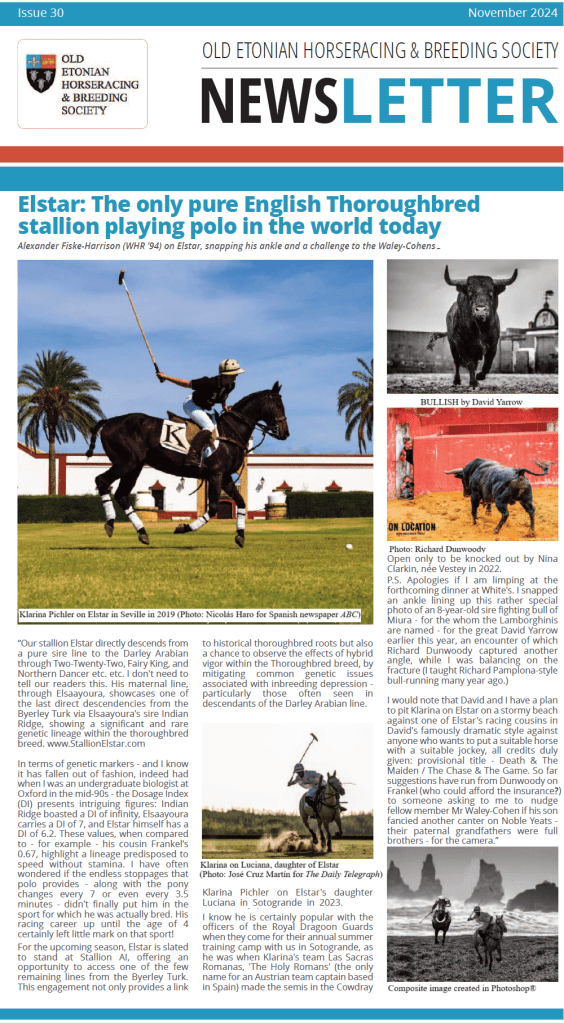
Elstar: The only pure English Thoroughbred stallion playing polo in the world today

Email contact@internationalpoloevents.com

OLD ETONIAN HORSERACING & BREEDING SOCIETY NEWSLETTER

Issue 30 November 2024

Elstar: The only pure English Thoroughbred stallion playing polo in the world today

Alexander Fiske-Harrison (WHR ’94) about Elstar, snapping his ankle and a challenge…

“Our stallion Elstar directly descends from a pure sire line to the Darley Arabian through Two-Twenty-Two, Fairy King, and Northern Dancer etc. etc. I don’t need to tell our readers this. His maternal line, through Elsaayoura, showcases one of the last direct descendants from the Byerley Turk via Elsaayoura’s sire, Indian Ridge, showing a significant and rare genetic lineage within the thoroughbred breed. www.StallionElstar.com

In terms of genetic markers – and I know it has fallen out of fashion, indeed had when I was an undergraduate biologist at Oxford in the mid-’90s – the Dosage Index (DI) presents intriguing figures: Indian Ridge boasted a DI of infinity, Elsaayoura carries a DI of 7, and Elstar himself has a DI of 6.2. These values, when compared to, for example – his cousin Frankel’s 0.67 – highlight a lineage predisposed to speed without stamina. I have often wondered if the endless stoppages that polo provides – along with the pony changes every 7 or even every 3.5 minutes – didn’t finally put him in the sport for which he was actually bred. His racing career up until the age of 4 certainly left little mark on that sport!

For the upcoming season, Elstar is slated to stand at Stallion AI, offering an opportunity to access one of the few remaining lines from the Byerley Turk. This engagement not only provides a link to historical thoroughbred roots but also a chance to observe the effects of hybrid vigour within the English Thoroughbred breed, by mitigating common genetic issues associated with inbreeding depression – particularly those often seen in descendants of the Darley Arabian line.

P.S. Apologies if I am limping at the forthcoming dinner at XXXX. I snapped an ankle lining up this rather special photo of an 8-year-old sire fighting bull of Miura – for the whom the Lamborghinis are named – for the great David Yarrow earlier this year, an encounter of which Richard Dunwoody captured another angle, while I was balancing on the fracture (I taught Richard Pamplona-style bull-running many years ago).

I would note that David and I have a plan to pit Klarina on Elstar on a stormy beach against one of Elstar’s racing cousins in David’s famously dramatic style against anyone who wants to put a suitable horse with a suitable jockey, all credits duly given: provisional title – Death & The Maiden / The Chase & The Game. So far suggestions have run from Dunwoody on Frankel (who could afford the insurance?) to someone asking me to nudge Mr XXXX if his son fancied another canter on XXXX – his and Elstar’s paternal grandfathers being full brothers – for the camera.”‘

Email contact@internationalpoloevents.com

Hanging Up The Jacket: A Farewell To Arms

Alexander Fiske-Harrison running in his red-and-white striped Eton College athletics ‘colours’ blazer, which is in the same as the traditional colours of the Fiestas of San Fermín. (His hand is momentarily and illegally touching the bull as he balances himself before slipping into the middle of the herd between this bull and the bull behind him in the photo below.)

Para leer esta publicación, ‘Colgando La Chaqueta: Adiós a las armas’, en español, por favor haga clic aquí

On Sunday in my beach café in Sotogrande in Andalusia I opened the Spanish newspapers to see myself and my bull-running jacket – originally my old secondary school athletics ‘colours’ blazer awarded for running the 400m when I was 17 and which just so happened to be in the traditional red and white of the world famous Fiestas of San Fermín in Pamplona – being discussed in the national newspaper La Razón under the headline, “Why are there young men who run the bull-runs of Miura wearing jackets in San Fermín?”

Why are there young men who run the bull-runs of Miura in San Fermín?

This 14th of July, the Seville-based ranch marks 42 years at the Pamplona festival

After eight days of bull runs, the legendary and totemic Miura bulls, as feared as they are revered, bring a climax, with the permission of the “pobre de mí“, to the San Fermín festival. The six bulls from the Sevillian ranch (raised on the Zahariche estate in Lora del Río) return for another year, now for the 42nd time, to test the runners who dare to position themselves in front of the herd.
This 14th of July 2024, the Miuras mark their 42nd bull-run, a breed that never disappoints with its challenging behaviour. They are especially dangerous in the final barriers and at the entrance to the bullring, due to their skill in orientation.
Moreover, this is the ranch that has caused the most injuries of all types in the history of San Fermín: 225 in total. In the last bull run of 2023, fortunately, there were no injuries from bull horns, but there were six cases of trauma. The duration of the run was two minutes and 14 seconds.”

Running the Bulls in a Jacket


For those who follow the bull-runs on TV, there is one image that particularly stands out: a significant number of young men dressed in jackets, instead of the classic white shirt and red scarf. We wonder why this is:
As journalist Chapu Apaolaza recounts in his book ‘7th of July’, it was a trend started by the American spy Keith Baumchen, known as ‘El Bomber’: “Bomber and his friends decided one day to run the bull run in jackets, as one would attend Sunday mass in the USA, as a sign of respect.
“This custom is still maintained today in the Miura bull runs. Bomber’s jacket was ivory-coloured. All kinds of blazer models parade down Estafeta Street, including the red with white stripes from Eton College worn by Alexander Fiske-Harrison,” Apaolaza reports.
However, as I said, I was drinking an café cortado on the other side of Spain and my jacket was hanging in a wardrobe at my family home in East Anglia.

Alexander Fiske-Harrison, bottom left in jacket, arm raised, running the bull-run down the side of a mountain in Falces in Navarra

Continue reading

THE LAST ARENA: An artist returns to the bulls – David Yarrow in Miura II

BULLISH by David Yarrow (2024)

(Para leer esta publicación en español, haga clic aquí.)

When the great fine art photographer David Yarrow contacted me to help him capture an image of a Spanish fighting bull, I contacted my friend, mentor, colleague and the greatest ambassador el mundo de los toros, ‘the world of the bulls’, could ever ask for, matador Eduardo Dávila Miura. We then took David to the most famous fighting bull-breeding ranch in the world, Zahariche, outside Seville, which is owned run by Eduardo’s uncles, Eduardo and Antonio Miura, and introduced him to the 8-year-old, two thirds of a tonne semental, or breeding sire, bull Pañolito, who has never been fought and never will be.

David Yarrow and Alexander Fiske-Harrison in the ring with the bull Pañolito at Finca Zahariche, Ganadería Miura, outside Seville in 2024 (Photo: David Richard Dunwoody)

No animals were harmed in the taking of this photo, only humans (I am still walking with a stick after breaking my ankle in that ring.) You can read all about it in my earlier post here, with a selection of photos by the rest of our team, including three-time British Champion Jockey and two-time Grand National winner Richard Dunwoody – who took the photo above – and professional polo player and horse-breeder – and semi-finalist in the British Ladies Open Polo at Cowdray Park last year – Klarina Pichler.

EL TORO by David Yarrow (2024)

To read on click here

For all enquiries, contact alexander@thelastarena.com

THE LAST ARENA: My comments on US National Public Radio on women in bullfighting

You can read the full interview for free online here.

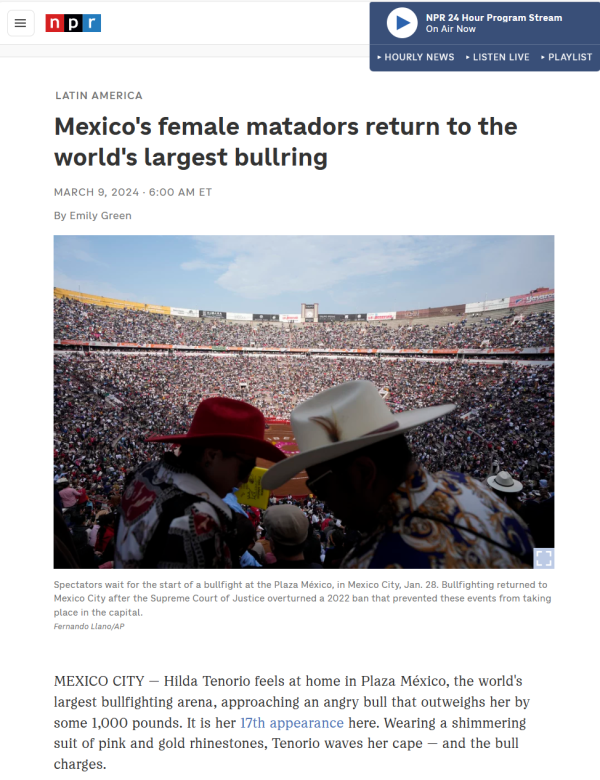
I was contacted by the National Public Radio Service of the United States originally to give some comments on the reopening of the largest plaza de toros, ‘bull-ring’, in the world, in Mexico City after it was sumararily closed by a judge on what appears to have been a whim. The legal argument proffered, that the citizens of the city had a right to live in an environment free from violence was entirely without merit as it hard to see how boxing tournaments and martial arts contests would surely be banned under those auspices, unless it is the killing of the animal which is the crux, in which case farewell to slaughterhouses.

In the end, I was actually asked to talk about women in bullfighting, which I have always found a fascinating subject. I actually began the post-script of my book, Into The Arena, by saying:

The book is dominated by men. This is because it is representative, but there are women in the world of the bullfight. Like the Venezuelan torera Conchita Cintrón, ‘The Golden Goddess’, who died aged eighty-six in February 2009, warranting obituaries in every major British newspaper as one of the greats of the bullfighting world, although in the write-ups her abilities were overshadowed by her sex. Antonio Ordóñez and Luis Miguel Dominguín were not so well covered in death. Or Cristina Sánchez, who was by all accounts a great matadora (not just a torera, as, by the time of her ‘moment in the sun’, a woman could officially take that title) but whose career stalled because the great men of the day would not fight by her side. Or the novillera Conchi Ríos, whom I saw turn the men’s sniggers into olés in Casa Matías as we watched her on the television while she fought around the corner in the Maestranza in May 2010. Or another trainee, who partnered me in training … to whom I explained that the bullfighter could be Lady Macbeth too, although what she did with that advice I’ll never know.

I had not revisited those words since I wrote them almost fifteen years ago, but apparently Shakespeare is still foremost in them, as the article version of the interview NPR published – and over 250 other stations republished from Alabama to Wyoming

Alexander Fiske-Harrison, author of Into The Arena: The World Of The Spanish Bullfight, likened female bullfighters to women playing Shakespeare’s Hamlet or Macbeth. “If the setup is such that it is defined by masculinity, you are subverting expectations,” he says.

Necessarily, such interviews always cut out the complexity and nuance of a real viewpoint on such matters: at the time the context I was discussing was how all art is an act of subversion as creativity requires innovation rather than meeting expectation through repetition, but there is always a line about how far one can go before one has departed from the chosen artform all together. I referenced successful examples like Matthew Bourne’s famous all male Swan Lake and my personal favourite, Denzel Washington’s extraordinary performance as a black Macbeth in Joel Cohen’s film of that name.)

I went on to make a more important practical points about the problems of a spectacle where the audience is 2:1 ratio men to women (and most of those women attending with a man), followed by what I have always thought was the greatest difficulty in a career where advancement comes from appearing alongside superior exponents.

Fiske-Harrison says male bullfighters have historically not wanted to mix with women.

To read on, click here.

THE LAST ARENA: The Last Matador for GQ (unedited)

Padilla at home (Photo Zed Nelson/GQ/Condé Nast 2012)

It was the last bullfight of the Spanish season, held, as it has been for centuries, in the 250-year-old plaza de toros in Zaragoza in north-eastern Spain.

It was the last bullfight of the Spanish season, held, as it has been for centuries, in the 250-year-old plaza de toros in Zaragoza in north-eastern Spain.

Juan José Padilla, a 38-year-old matador from Andalusia in the south, was fighting the fourth bull of six (he’d also fought the first.)

The bull, ‘Marqués’, was a 508kg (1,120lb) toro bravo born 5 years and 8 months previously on the ranch of Ana Romero, also in Andalusia. Before entering this ring it had lived wild, ranched from horseback, and had never before seen a man on the ground.

Padilla passing a bull with the magenta and gold two-handed capote, ‘cape’ (Photo: Alexander Fiske-Harrison 2012)

Padilla was midway through the second of the three acts of the spectacle. He had already caped the bull with the large, two-handed magenta and gold cape, the capote, then the picador had done his dirty work with the lance from horseback, tiring the bull and damaging its neck muscles to bring its head down.

Now Padilla, rather than delegate to his team as other matadors do, was placing the banderillas himself, the multi-coloured sticks with their barbed steel heads. He had put in two pairs and was on the third. He ran at the bull with a banderilla in either hand, it responded with a charge, Padilla leapt into the air, it reared, he placed his sticks in its shoulders and landed.

Padilla places the banderillas

Running backwards from the charging bull, his eyes were focused on the horns coming at him in an action he had performed tens of thousands of times before. However, this time his right foot came down slightly off centre and in the path of his left, foot hit ankle, and then he was down.

In a breath the bull was on him and its horn took Padilla under his left ear, cracking the skull there, destroying the audial nerve, and then driving into the jaw at its joint. It smashed up through both sets of molars and ripped through muscle and skin before exploding his cheek bone as surely as a rifle bullet, stopping only as it came out through the socket of his left eye – from behind – taking his eyeball out with it, shattering his nose and then ripping clean out of the side of his head.

There is an image I will never lose, much as I wish I could. It is of a man standing with half his face held in his right hand. Cheek, jaw and eyeball, like so much meat, resting in his palm as he walked towards his team uncomprehending, and they, with looks of absolute horror, grabbed his arms and rushed him to the infirmary of the ring.

The second worst image

And yet here, in the amongst the carnage inflicted on a human body by a half ton of enraged animal, is the key to Juan José Padilla. The clue is in the phrase “stood up.”

Soccer players are stretchered off the field from a tap to the ankle. Boxers go down from a padded glove. This was more than half a ton of muscle, focused into a pointed tip that ploughed through his skull like a sword through snow. And the man got up and walked.

Then came coma and intensive care and surgery after surgery.

Click here to read on at my bullfighting blog, The Last Arena…

Article about me in The Spectator

An amusing article about me in the oldest – and most successful in current affairs – magazine in the English language, The Spectator, founded in 1828.

Bruce Anderson godfather-patron of the Conservative Party, friend of Prime Ministers (and part of the No.10 Downing Street Policy Unit under Margaret Thatcher) and former political editor of ‘The Speccie’. He interviewed me at The Travellers’ Club, the oldest gentleman’s club on Pall Mall in St. James’, London. Our club is the haunt of diplomats and spies, explorers and mercenaries. I once stayed there and dined with the Papal Nuncio, the Archbishop appointed as Ambassador from the Vatican to the UK, and breakfasted the next day with the Colonel of the Special Boat Service (the SBS is what they modelled the Navy Seals on, for my American readers.) AFH

Original article online here

THE SPECTATOR

Bruce Anderson

What wine should you serve to a matador?

26 August 2023

We were talking bulls. A friend of mine, Alexander Fiske-Harrison, is a remarkable character who can claim at least two distinctions. First, he must have been about the worst-behaved boy in the modern history of Eton College. He claims that this is an understatement and that he heads the role of infamy since the days of Henry VI.

He was certainly put ‘on the Bill’ – that is, for a disciplinary interview with the headmaster – on 68 occasions. So he was fortunate that corporal punishment had been abolished before he arrived, though his career of rapscallionry was possibly not the strongest argument for its demise.

He must have come close to expulsion. But there was apparently a feeling that Fiske-Harrison would make his mark in the world. And those who argued in that vein might now feel vindicated, because Alexander became a matador.

He insists that this is a slight overstatement and that he is only partially qualified, not the full Escamillo. But he did kill a bull in a ring: impressive enough for me. He is also the first Etonian ever to hold that honour. If not the full Hemingway, he has written well on bullfighting. He also runs with the bulls at Pamplona and other towns: whence a remarkable story which I have mentioned here before. Continue reading