My column in The Olive Press: Armed Struggle

My latest, and fourth, column entry is Spain’s number one English language newspaper. AFH

The Olive Press

July 26th-August 8th – Vol. 17 Issue 424

At Home With Xander:

Armed Struggle

NAVARRA could not be more different from Andalucia.

Down in the south they provide an archetype of Spain, propagated as something of a national myth since the 19th century and a lure to foreign holiday makers and their money. In reality, Andalucia was once an endless warzone, out of which the survivors built unions of   Castilian formality merged with Moorish art and flamenco.

In contrast, Navarra was once a great kingdom, spanning both sides of the Pyrenees, and later absorbed by the Catholic Kings, Ferdinand and Isabella, in their 15th century reconquest and unification of Spain. The French side came to be abandoned as indefensible by their grandson, the Holy Roman Emperor Charles V in the 16th, but the his- tory and influence remain. It is beautiful, verdant countryside, which I have walked through many times on the Ruta De Santiago, or Way of St James.

As you cross the border through the stunning Roncesvaux Pass nothing changes except the name to Roncesvalles.

Many locals actually call it ‘Orreaga’, as Basque was the original language here and has had a strong resurgence   since the 1970s, even if the   politicians who encourage the region’s separation – and once used armed struggle to do so – now take a hammering at the ballot box.

Speaking of armed struggle,   mine is struggling to work after running the bulls in Pamplona, the capital of Navarra. Judging by the comments section on previous columns, many readers will…
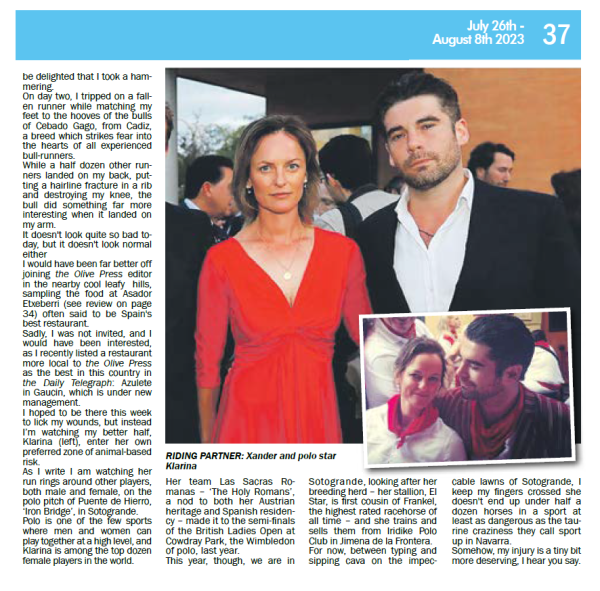
Click to enlarge

…be delighted that I took a hammering. Continue reading

My article in The Telegraph: As an expat in Vienna, I love everything about Europe (except the EU)


THE TELEGRAPH


COMMENT


As an expat in Vienna, I love everything about Europe (except the EU)

Selfishly, I have indeed benefited from the EU, but that’s not to say it’s the best thing for Britain


(The original article can be found by subscribers at The Telegraph online here.)

It was at a lunch with several grandees of old Vienna where I was forcibly reminded that it was in this city that the longest European peace since the original ‘Pax Romana’ – from the fall of Napoleon to the rise of the Kaiser – was negotiated between a British Foreign Secretary, Viscount Castlereagh, and Prince Metternich, the chief negotiator of the European Unionists of that epoch, the Habsburg Monarchy, who had only just renounced the title of Holy Roman Emperor.

The 1815 Congress of Vienna was soon followed, in 1820, by Britain’s official and complete withdrawal from European affairs into “splendid isolation”. The effects of this, the original Brexit, were so positive that one US Secretary of State, Henry Kissinger, would later publish his Harvard PhD thesis on the period under the title ‘A World Restored’.

Personally, there is no denying that as a British citizen living in Mitteleuropa, and who spent the first lockdown as a resident in Spain, I have encountered a great deal of incomprehension among my Continental friends as to why Britain would want to leave this benevolent, if quasi-Imperial, set up.

And, as an Englishman with an Austrian fiancée, a Belgian shepherd dog and a breeding herd of horses all descendant from an Irish thoroughbred (Elstar, first cousin to the legendary Frankel no less), I truly do see myself as, in Metternich’s own phrase, “a Citizen of Europe”. Continue reading