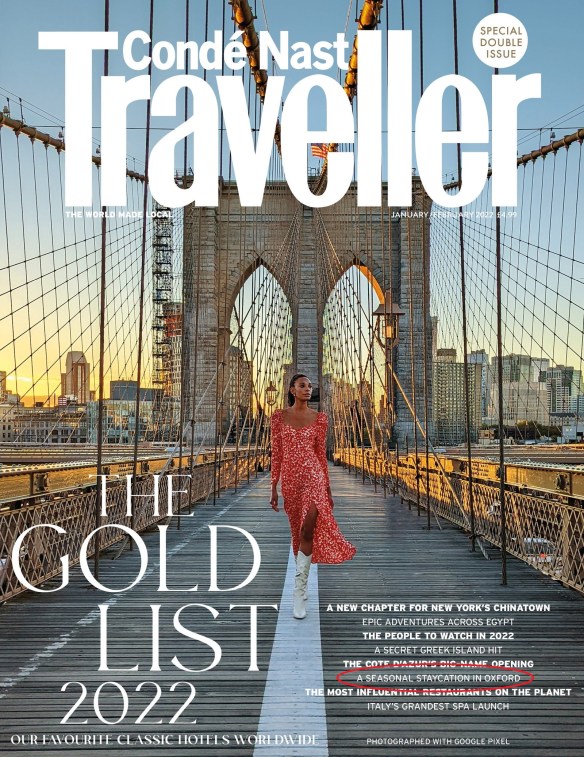
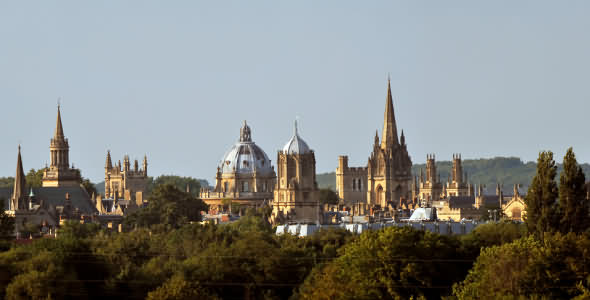
Oxford puts the classics in classic. Yet recent additions are moving the story on. Alexander Fiske-Harrison retraces his university days and discovers new exciting hangouts
I have a fondness for smaller cities. Compared to the great metropolises, they are more discrete, more human in their scale. They are also often built upon a single resource. One thinks of Salzburg, with its salt mines, or Seville, which hosted all the gold of the Americas. Oxford is the most human of all, though, as it is built on the very commodity which puts the sapiens into Homo sapiens. Here, they mined wisdom.
I remember my own sense of awe when I arrived as an undergraduate in the mid-1990s – first as a biology student under one of Kenya’s greatest ecologists, and then studying philosophy under a tutor whose own tutor could trace a direct line, tutor to tutor, back to Immanuel Kant himself. I remember how, in the warm autumn sun, the university buildings stood like vast stone-clad thrones for the human mind – their distinctive golden colour coming from the ancient coral reefs that fossilised to form the limestone deposits of nearby Headington.
(The full length and slightly edited version can be found by subscribers at The Telegraphonline here.)
Since the beginning of the novel coronavirus pandemic I have written in these pages about the European countries in which I have suffered their various countermeasures.
I witnessed Marines patrolling the streets in one of the hardest lockdowns in Europe, Spain, where I ran a half-marathon inside a small apartment in an attempt to stay sane and fit while they locked their physically vulnerable elderly and psychologically vulnerable children away from all sunlight and exercise, despite the measurable protection these two factors offer against the virus.
I returned to England when I was allowed, and was invited to bear witness to the catastrophic collapse of the hospitality industry, with hotels and restaurants desperately trying to outweigh the off-putting countermeasures of the odour of bleach, enforced hand-sanitisation, masks, and social-distancing, by practically begging customers – and travel writers like myself – to visit.
(The original article can be found by subscribers at The Telegraphonline here.)
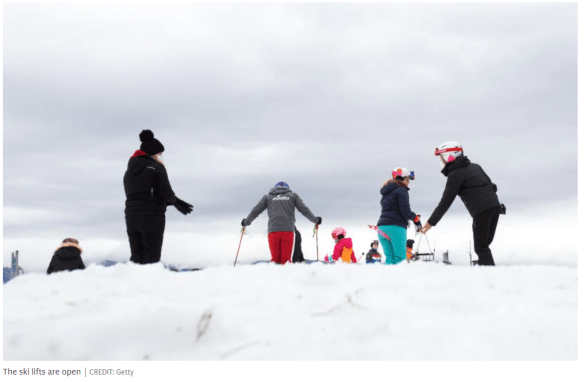
With the snow piling thick on the ground in Salzburg, I am amazed at two things in Austria which I do not think are unrelated.
The first is that neither temperature nor lockdown has in any way affected the average citizens’ visibility in the streets.
When I walk out of my front door on the Nonnberg, adjacent to the ancient convent where Julie Andrew’s portrayed a novitiate in The Sound Of Music, there are invariably locals tramping up and down the stairs and slopes, wading through drifts and sliding across ice, to stare at alpine mountain ranges in the middle distance.
As they say here, there is no such thing as bad weather, only the wrong clothes.
The second striking fact about living in Austria is that during this ‘lockdown’ – their third – in which you may leave your house at any time of day or night for any reason, psychological or physical, they have reduced the contagion of this novel coronavirus by 90% since mid-November.
Yes, it is true that bars, restaurants and hotels are all closed, and only one person from a household may visit “close family members” or “important contacts with whom contact is maintained several times a week” in another household.
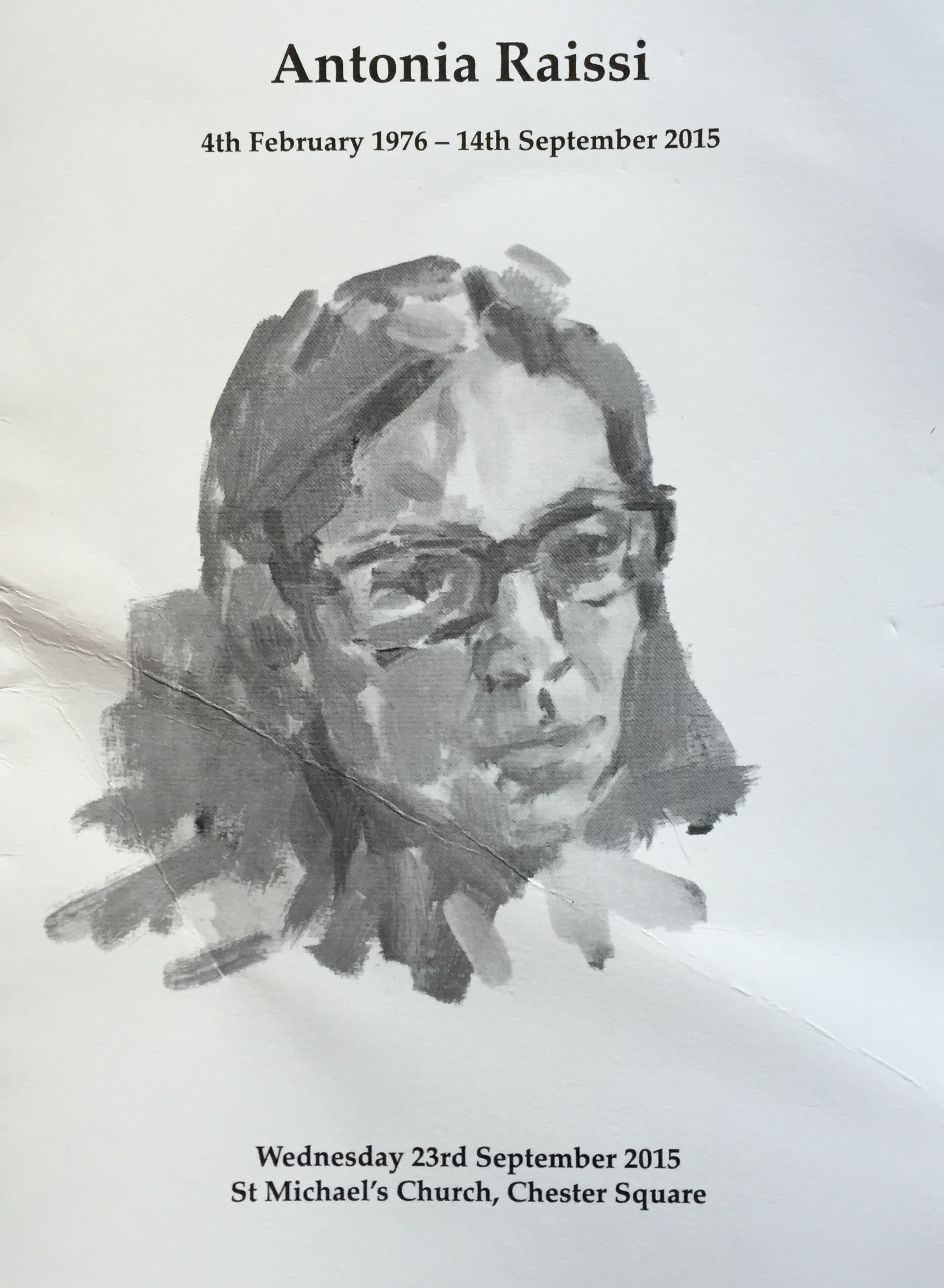
I have come to hold the belief that one of the most powerful and definitively human compulsions is that of being remembered: that when the physical reality of self has perished, that echo of appearance, the memory of self in other minds, should be confirmed in defiance of death. Hence the funeral, the oration, the headstone, the monument, the memorial service, the obituary and this, the personal memoire. That, and an expiation.
So I am not writing claiming I knew Antonia better than others – her mother and stepfather, her husband and her sons, her other family and many of her other friends had that privilege – but we had our moments over twenty or so years. I want to write down those I remember, and those I can repeat, before my recollections of them change and mutate any more than they already have. To ‘re-member’ to, as the word suggests, is to piece back together the members, the parts, of a dismembered whole. At best this is a jerry-rigged fiction that just about passes muster and at worst an outright lie, fuelled by want, and perspective, and sorrow.
AFH
* * *
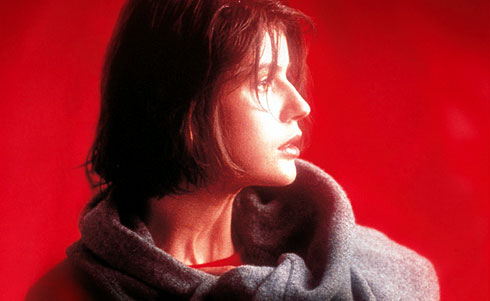
It was in her room in the top floor of Matthews Building I first met her, second on the right. A single bed, a desk, armchair and a basin in cupboard, divided by no more space than you could lie down in, loo and shower down the corridor. St. Peter’s College, Oxford, wasn’t exactly as glamorous as Brideshead Revisited, but Antonia was. Tall, lithe, exquisite faced which she fought against – admiring the strong more than the pretty – speaking with clipped St. Mary’s (Calne) tones and Eton-cropped black hair, which I would later cut to make her look more like Irène Jacob in Kieslowski’s Trois Couleurs : Rouge the film we all fell in love with that year. Just as we all fell in love with her.
In that tiny room we were all packed, a group, almost exclusively male at its core, and regarded as deeply, almost hilariously pretentious even by the standards of Oxford undergraduates. However, looking back one can see it was just curiosity and fascination and youthful gaucheness.
There was Hugh Dancy, George Pendle and Paul Curran, all studying English under Dr Francis Warner, Dominic Elliot studying Archaeology and Anthropology, and Steven France studying Philosophy under Dr John Kenyon. Antonia would within her first year abandon Geography for English, and I would only make it to the end of my second before switching from Biology to Philosophy under Kenyon.
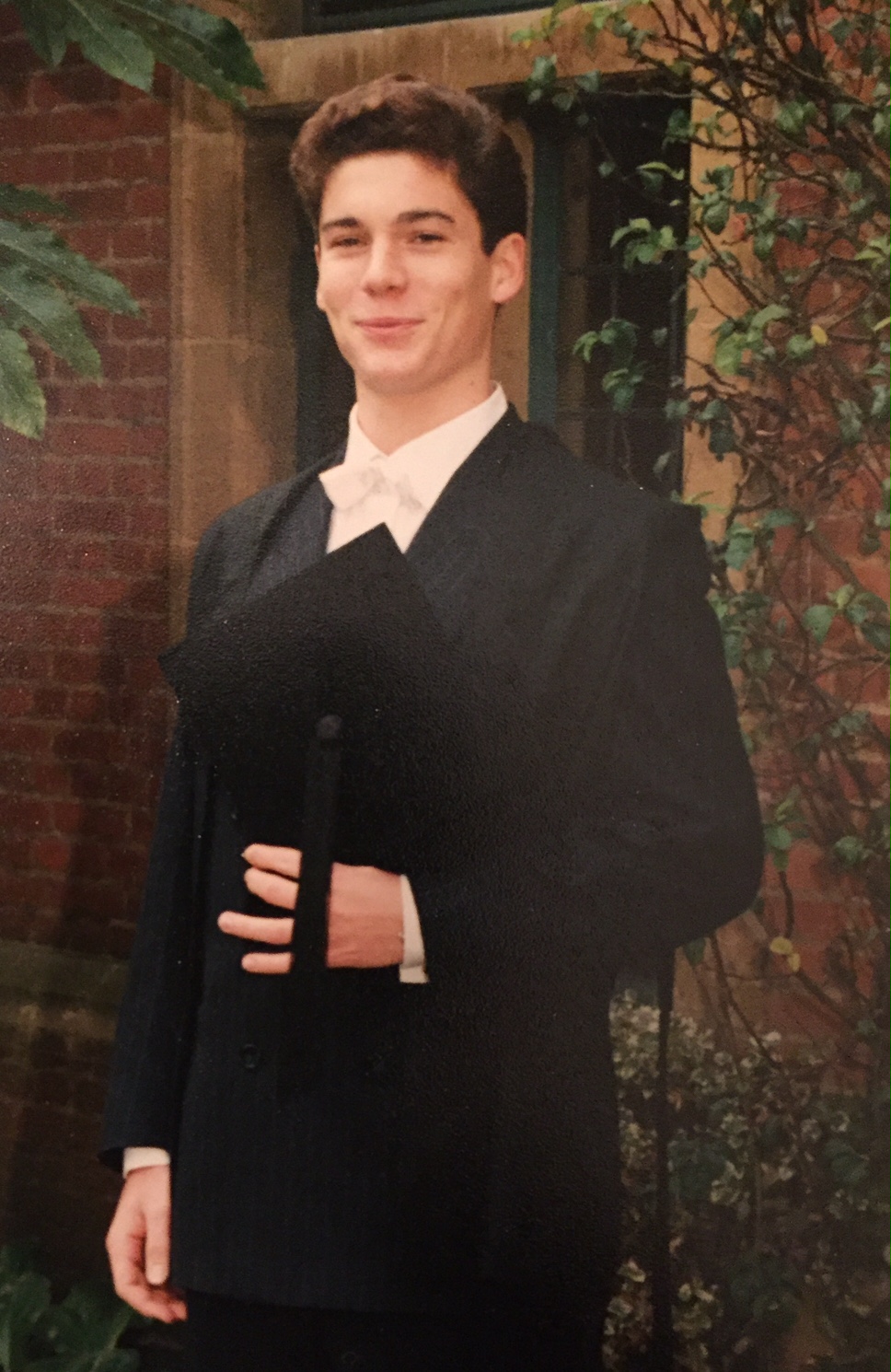
Me, matriculation day, October 1994
One of her first stories to me, a story which would have perhaps annoyed the more sophisticated and subtle person she became, was of her summer holiday, just prior to coming up to Oxford, in Kenya. I remember still the image she conjured so well of her sitting, dressed in white, smoking Cartier cigarettes, the only non-male, and indeed only non-Masai sitting around a camp fire in The Mara. She would have been eighteen years old.
I wonder if she viewed us like Masai too. She certainly preferred the company of us men, and although she was not a tomboy in the sense of climbing trees, her way of speaking was… well, like anti-aircraft fire – not always deadly accurate, but incessant and intimidating to fly amongst, the dark crumping bursts of her conversational shells peppering the night sky. And it was usually night sky – we sat up late into the night talking and talking, me smoking Marlboro, her Lights, me Coke, her Diet. She wasn’t much of a drinker, disliking the silliness, the loss of control, or so she claimed. When I did see her tipsy for the first time I was surprised at how girly she became. I think that was what she feared most.
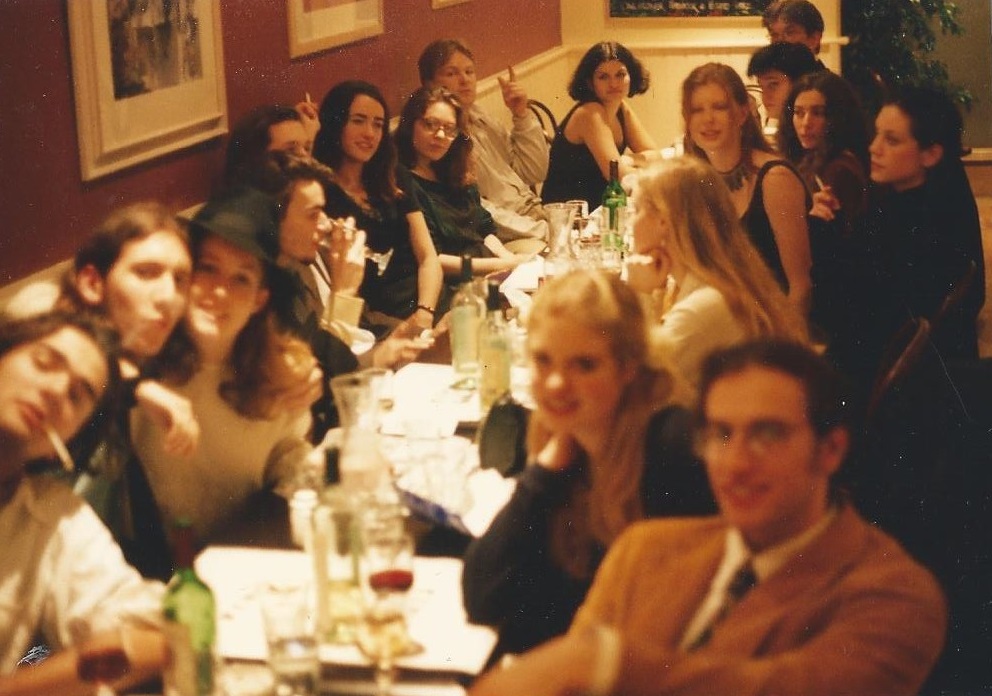
Antonia’s 19th Birthday Party, Gloucester Green pizza restaurant, clockwise from bottom left: George Pendle, Dave – & ?, Steven France, Hugh Dancy, Genevieve Connors, ?, John Mühlemann, ?, David Collard, David Budds, Biranda Ford, Lucy -, Antonia Francis, Caroline Early, Catherine Bagshaw, Joshua Steckel (Photo by Alexander Fiske-Harrison) Detail from above (Photo: Alexander Fiske-Harrison)
It was inevitable that I would fall head over heels for her – I mean I was only a few months out of an all boys boarding school, grew up without sisters and had never had a girlfriend. And here was this stunning and exotic creature, fitting no standard feminine norm that I knew of – never a skirt or dress, but black boots and jeans on those very long legs, and almost invariably a black polo neck, channelling Juliette Greco with a hint of Audrey Hepburn. Of course, now in retrospect I can see that Antonia wasn’t oblivious to the effect she had on us boys – and we were just boys – wrangling us to some extent with those quirks honed to charms, equalising the gender imbalance using that weapon among all the others at her disposal. Continue reading →
I was originally asked to write this piece by The Spectator, but apparently I was a bit too late filing my copy – zoology professors and professional hunters are hard to round up at short notice – so here it is, unexpurgated and unimproved.
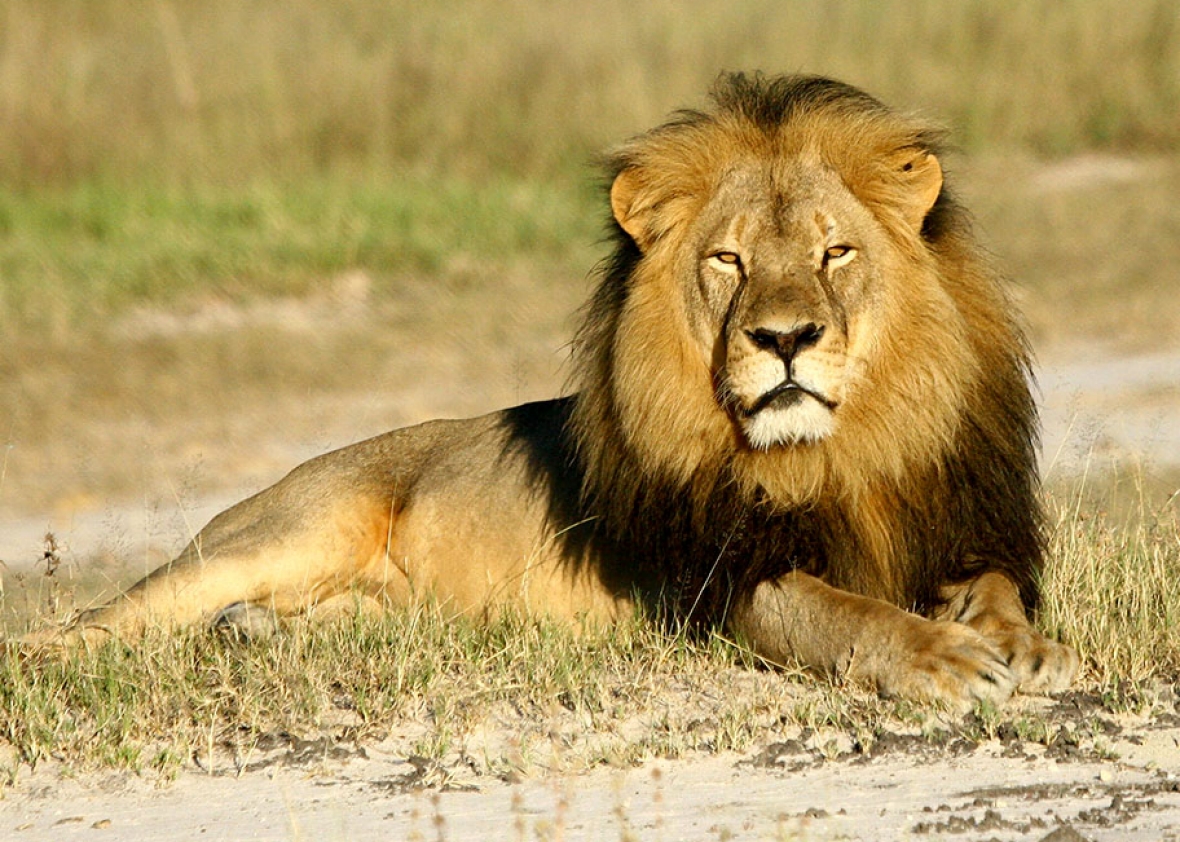
I never cease to be surprised either by the posturing courage or the sheer inhumanity of the expressions of ‘moral’ outrage on social media, but this recent furore over the death of the ageing Zimbabwean lion everyone knows as Cecil really has been quite special.
The complicity of the press is particularly grotesque. CNN went as far as to run a photo of the big cat with the caption, “Cecil the lion probably never knew how beloved he was,” surely winning some sort of prize for most redundant use of the modifier ‘probably’ in journalism.
He also certainly didn’t know he was called Cecil, a hilarious piece of nominal colonialism by British conservationists working in the country bloodily carved out of the Dark Continent by Cecil Rhodes and for almost a century called Southern Rhodesia in his questionable honour. (Rhodes is a distant relation of mine.)
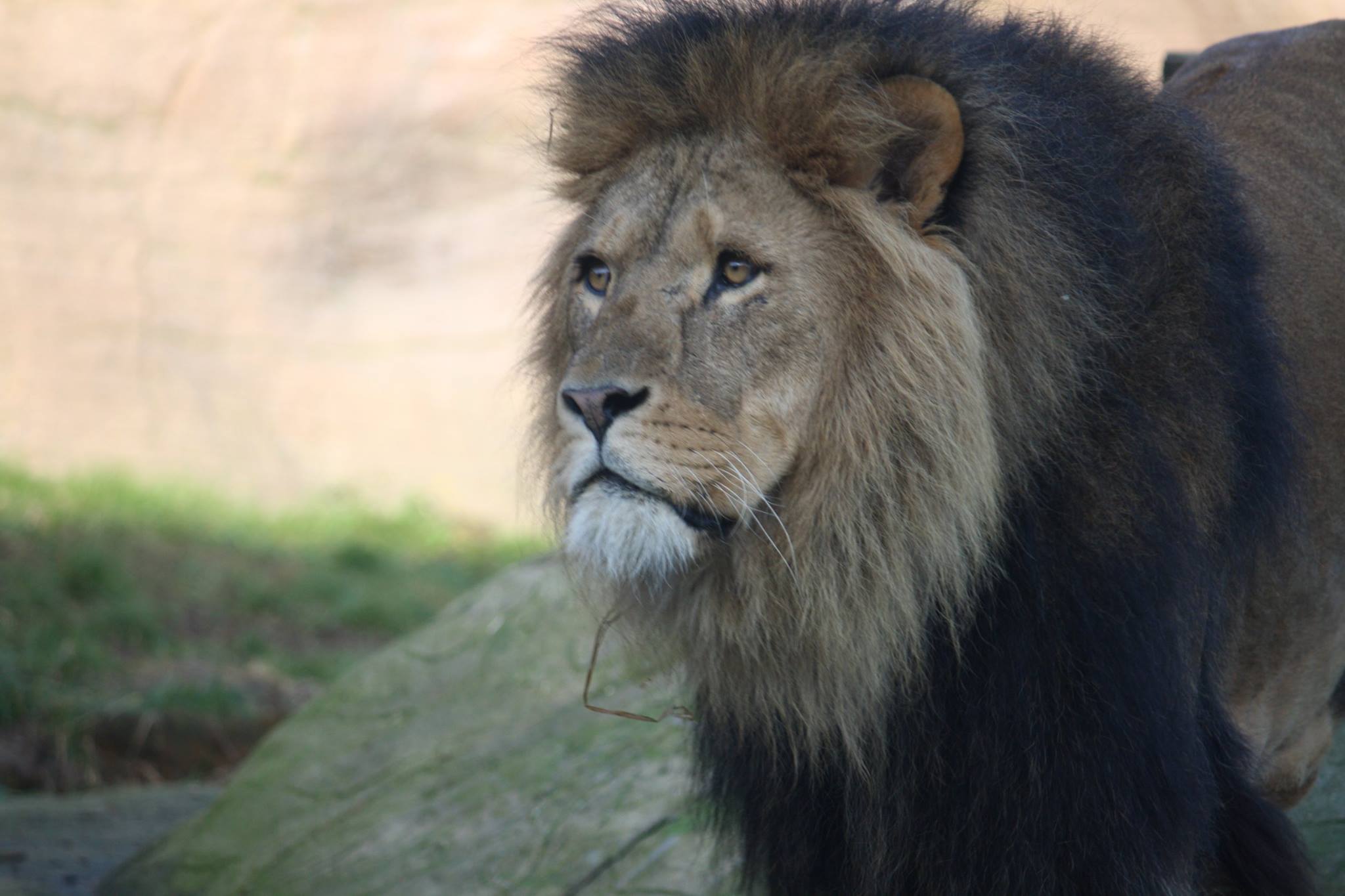
I took this photo on January 23rd this year and put it on Facebook with the following caption: “This lion is called ‘Bailey’ (wild animals should not be named) the only male lion at Colchester Zoo. He was born on June 27th, 2007 at Woburn Safari Park. His father, ‘Shane’, was born at Knowsley Safari Park in June 1997, and his mother, ‘Tamby’, was born at Woburn on October 13, 1998. All these lions are descended from those brought into the UK from Uganda by Jimmy Chipperfield, of Chipperfield’s Circus, to counter the inbreeding of British lions over the centuries.” (Photo: Alexander Fiske-Harrison)
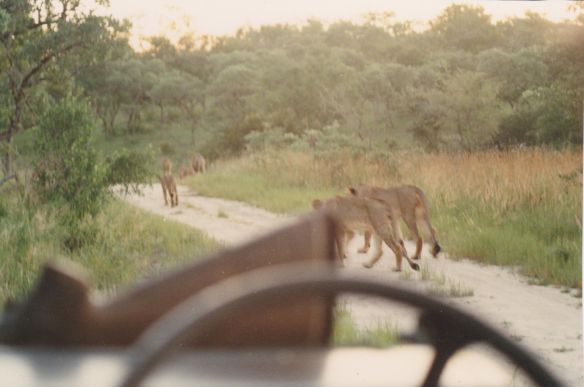
I myself fell under the aesthetic spell of lions aged nine –thirty years ago – in London and Colchester Zoos, joined and raised funds for the WWF from that point on, went up to Oxford to study Zoology under renowned Africa ecologist Dr. Malcolm Coe, and myself visited the Hwange Reserve almost twenty years ago where I followed the pride made up of the grandparents, and probably parents, of that lion, whom I photographed at the time.
Following the pride in the Hwange National Park, Zimbabwe in 1996 (Photo: Alexander Fiske-Harrison)




 Alexander's Journal