FINANCIAL TIMES
FT Weekend
March 6/March 7 2004
LATIN AMERICA: ARGENTINA
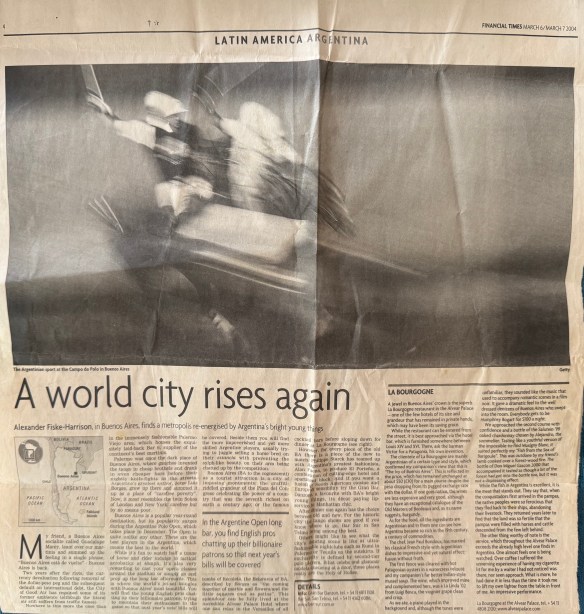
[Photo Caption: The Argentinian sport at the Campo de Polo de Buenos Aires – Getty]
A world city rises again
Alexander Fiske-Harrison, in Buenos Aires, finds a metropolis re-energised by Argentina’s bright young things
My friend, a Buenos Aires socialite called Guadalupe Marey, leant over our martinis and summed up the feeling in a single phrase, “Buenos Aires está de vuelta” — Buenos Aires is back.
Two years after the riots, the currency devaluation following removal of the dollar-peso peg and the subsequent default on international debt, the City of Good Air has regained some of its former ambience (although the literal air still suffers from traffic fumes).
Nowhere is this more the case than in the immensely fashionable Palermo Viejo area, which houses the exquisitely laid-back Bar 6, supplier of the continent’s best martinis.
Palermo was once the dark place of Buenos Aires, where gauchos invented the tango in cheap brothels and drank in even cheaper bars before their nightly knife-fights in the streets. Argentina’s greatest author, Jorge Luis Borges, grew up there and summed it up as a place of “carefree poverty”. Now, it most resembles the twin Sohos of London and New York: carefree but by no means poor.
Buenos Aires is a popular year-round destination, but its popularity surges during the Argentine Polo Open, which takes place in December. The Open is quite unlike any other. These are the best players in the Argentina, which means the best in the world.
While it’s fun to watch half a tonne of horse and rider indulge in tactical acrobatics at 30mph, it’s also very rewarding to cast your opera classes around the stadium or simply go and prop up the long bar afterwards. This is where the world’s jet-set mingles with Buenos Aires’ most beautiful. You will find the young English pros chatting up their billionaire patrons, trying to maintain their enthusiasm in the game so that next year’s vets’ bills will be covered. Beside them you will find the more impoverished and yet more skilled Argentine players, usually trying to juggle selling a horse bred on their estancia with preventing the sylph-like beauty on their arm being chatted up by the competition.
Buenos Aires (BA to the cognoscenti) as a tourist attraction is a city of imposing monuments: the graffiti-riddled grandeur of the Plaza del Congreso celebrating the power of a country that was the seventh richest on earth a century ago; or the famous tombs of Recoleta, the Belgravia of BA, described by Borges as “the coming together of marble and flowers/and the little squares cool as patios”. This splendour can be fully lived at the incredible Alvear Palace Hotel where one can relax in the Versailles of all cocktail bars before sloping down for dinner at La Bourgogne (see right).
However, for every piece of the old BA there is a piece of the new to match. Philippe Starck has teamed up with Argentina’s greatest fashionista, Alan Faena, to produce El Porteño, a combination of cutting-edge hotel and apartment block. And if you want a fusion of South American cuisine and European sensibility try the Gran Bar Danzon, a favourite with BA’s bright young things, its décor paying lip-service to Manhattan chic.
After dinner one again has the choice between old and new. For the historic city the tango shows are good if you know where to go, Bar Sur in San Telmo being among the best.
Others might like to see what the city’s dancing scene is like at ultra-fashionable nightclubs such as Rumi in Palermo or Tequila on the outskirts. If exclusivity is defined by second-tier polo players, B-list celebs and glamour models queueing at a door, these places really are the Holy of Holies.
DETAILS
Info: Gran Bar Danzon, tel. +54 11 4811 1108
Bar Sur, San Telmo, tel. +54 11 4362 6086;
http://www.bar-sur.com.ar
LA BOURGOGNE
A jewel in Buenos Aires’ crown is the superb La Bourgogne restaurant in the Alvear Palace – one of the few hotels of its size and grandeur that has remained in private hands, which may have been its saving grace.
While the restaurant can be entered from the street, it is best approached via the hotel bar, which is furnished somewhere between Louis XIV and XVI. There, ask the barman Victor for a Patagonia, his own invention.
The clientele of La Bourgogne are mainly Argentinians of a certain type and style, which confirmed my companion’s views that this is “The Ivy of Buenos Aires”. This is reflected in the price, which has remained unchanged at about $50 (£30) for a main course despite the peso dropping from its pegged exchange rate with the dollar. If one goes native, the tines are less expensive and very good, although there may be an exceptional catalogue of aged Old Masters of Bordeaux and, as its name suggests, Burgundy.
As for the food, all the ingredients are either Argentinian and in them one can see how Argentina became so rich in the 19th century, a century of commodities.
The chef, Jean Paul Bondoux, has married his classical French style with Argentinian ingredients to impressive and yet natural effect: fusion without froth.
The first fence was cleared with hot Patagonian oysters in a watercress velouté and my companion’s far better Indian-style mussel soup. The wine, which improved mine and complemented hers, was a La Linda ’02 from Luigi Bosca, the viognier grape clean and crisp.
As we ate, a piano played in the background and, although the tunes were unfamiliar, they sounded like the music that used to accompany romantic scenes in a film noir. It gave a dramatic feel to the well-dressed denizens of Buenos Aires who swept into the room. Everybody gets to be Humphrey Bogart for $100 a night.
We approached the second course with confidence and a bottle of the Salutein ’99 oaked chardonnay chosen by Alejandro, the sommelier. Tasting like a youthful version of the impossible-to-find Musigny Blanc, it suited perfectly my “Fish from the Sea of Barigoule”. This was outdone by my friend’s lamb cooked over a forest-wood fire. The bottle of Don Miguel Gascon 2000 that accompanied it tasted as though a bit of the forest had got into the bottle too, but it was a rot displeasing effect.
While the fish in Argentina is excellent, it is the meat that stands out. They say that, when the conquistadors first arrived in the pampas, the native peoples were so ferocious that the Spaniards fled back to their ships, abandoning their livestock. They returned years later to find that the land was so fertile that the pampas were filled with horses and cattle descended from the few left behind.
The other thing worthy of note is the service, which throughout the Alvear Palace exceeds the already high level one finds in Argentina. One almost feels one is being watched. Over coffee I suffered the unnerving experience of having my cigarette lit for me by a waiter I had not noticed was there, nor seen approach. What is more, he had done it in less than the time it took me to lift my own lighter from the table in front of me. An impressive performance.
La Bourgogne at the Alvear Palace, tel. +54 11 4808 2100; http://www.alvearpalace.com
 Alexander's Journal