My latest article in The Telegraph: The European countries with the strictest lockdowns have come out no better


THE TELEGRAPH


COMMENT


The European countries with the strictest lockdowns have come out no better

I’ve been under different lockdowns in Spain, Austria and the UK – and still, there are no clear winners


(The full length and slightly edited version can be found by subscribers at The Telegraph online here.)


Since the beginning of the novel coronavirus pandemic I have written in these pages about the European countries in which I have suffered their various countermeasures.

I witnessed Marines patrolling the streets in one of the hardest lockdowns in Europe, Spain, where I ran a half-marathon inside a small apartment in an attempt to stay sane and fit while they locked their physically vulnerable elderly and psychologically vulnerable children away from all sunlight and exercise, despite the measurable protection these two factors offer against the virus.

I returned to England when I was allowed, and was invited to bear witness to the catastrophic collapse of the hospitality industry, with hotels and restaurants desperately trying to outweigh the off-putting countermeasures of the odour of bleach, enforced hand-sanitisation, masks, and social-distancing, by practically begging customers – and travel writers like myself – to visit.

(Thank you to the lovely Gilbeys Restaurant & Townhouse in Eton, the splendid Old Parsonage Hotel & Grill in Oxford, the comforting The Winning Post pub in Windsor Great Park and the splendour of Mossiman’s at Guards Polo Club – I hope you all make it: you certainly deserve to.) Continue reading

My article in The Telegraph: As an expat in Vienna, I love everything about Europe (except the EU)


THE TELEGRAPH


COMMENT


As an expat in Vienna, I love everything about Europe (except the EU)

Selfishly, I have indeed benefited from the EU, but that’s not to say it’s the best thing for Britain


(The original article can be found by subscribers at The Telegraph online here.)

It was at a lunch with several grandees of old Vienna where I was forcibly reminded that it was in this city that the longest European peace since the original ‘Pax Romana’ – from the fall of Napoleon to the rise of the Kaiser – was negotiated between a British Foreign Secretary, Viscount Castlereagh, and Prince Metternich, the chief negotiator of the European Unionists of that epoch, the Habsburg Monarchy, who had only just renounced the title of Holy Roman Emperor.

The 1815 Congress of Vienna was soon followed, in 1820, by Britain’s official and complete withdrawal from European affairs into “splendid isolation”. The effects of this, the original Brexit, were so positive that one US Secretary of State, Henry Kissinger, would later publish his Harvard PhD thesis on the period under the title ‘A World Restored’.

Personally, there is no denying that as a British citizen living in Mitteleuropa, and who spent the first lockdown as a resident in Spain, I have encountered a great deal of incomprehension among my Continental friends as to why Britain would want to leave this benevolent, if quasi-Imperial, set up.

And, as an Englishman with an Austrian fiancée, a Belgian shepherd dog and a breeding herd of horses all descendant from an Irish thoroughbred (Elstar, first cousin to the legendary Frankel no less), I truly do see myself as, in Metternich’s own phrase, “a Citizen of Europe”. Continue reading

My postcard in The Telegraph: Salzburg is well-suited to lockdown – scenic, old-fashioned and healthy

Scenic, old-fashioned and healthy – Salzburg is well-suited to lockdown

Fresh air, regular exercise and a diet of moderation are all we have here until the vaccine comes

My dispatch in The Telegraph: From Vienna, ‘I woke from my Covid sickbed to the sound of gunfire’

‘I woke from my Covid sickbed to the sound of gunfire’ – dispatch from Vienna


On the eve of the city’s second lockdown, it faced a new – yet all-too familiar – trauma

Having just written a postcard in these pages praising Vienna as the best travel destination I have visited in some time, I did not expect to be writing again so soon, and under such different circumstances.

Last night at 8pm an unknown number of armed men fanned out into the streets of the first district where I am staying and opened fire at random, in a manner all-too familiar these days, while invoking the greatness of God in his Qur’anic name.

Reports have the shooters moving down from the city’s main Synagogue to the seat of its Archbishop, St. Stephen’s Cathedral, although this is more likely a ‘happy’ coincidence for the terrorists involved. This is the main pedestrianised bar area in Vienna’s old city, and they struck, with neither provocation nor warning, on the night before the city returns to lockdown due to a surge in hospitalisations for Covid-19.

The police response was rapid. One terrorist was shot on the spot, later identified as a 20-year-old Albanian, with dual Austrian and North Macedonian nationality, who had been sent to jail for attempting to join Islamic State in Syria, but released a year early from his 22-month sentence in December. Continue reading

My postcard in The Telegraph: From Vienna, where common sense reigns supreme

A postcard from Vienna, where common sense reigns supreme – ‘No hysteria, no virtue-signalling’


In Austria, Alexander Fiske-Harrison found a completely different atmosphere to the UK

Vienna is at, indeed perhaps just is, the very heart of Europe. It was capital of the Holy Roman Empire for the majority of its thousand-year existence – until it confronted Napoleon at the Battle of the Three Emperors at Austerlitz. It was the “city of music” that made Mozart; it was the “city of dreams” that bred Freud. In 1938 the French author Albert Camus wrote, “Vienna stands at the cross-roads of history. Around her echoes the clash of empires. Certain evenings when the sky is suffused with blood, the stone horses on the Ring monuments seem to take wing.”

And yet, less than a decade later, Graham Greene would write, “I never knew Vienna between the wars, and I am too young to remember the old Vienna with its Strauss music and its easy charm; to me it is simply a city of undignified ruins.”

There was dark romanticism even in the ruins, as Greene knew, hence he made the city the third character in his and Carol Reed’s film The Third Man (although the great Orson Welles added a few lines of his own, including the famous one about the Borgias and cuckoo clocks.)

Continue reading

My article in The Telegraph: Essex – The hidden secrets of England’s most underrated county

THE TELEGRAPH

TRAVEL

The hidden secrets of England’s most  underrated county

Secrets lurk in Essex, from fine stately homes like Audley End House to lions that roar in the night CREDIT: GETTY

The Queen has agreed Southend in Essex will be granted city status, in honour of Sir David Amess, Prime Minister Boris Johnson has announced. The resort town on the Thames Estuary, with the longest pleasure pier in the world, is just one of many gems of my home county, which is so often (wrongly) overlooked by visitors, both domestic and international.

The recent reputation of Essex seems to be a construct of the media, most recently reality television, based on a parody of a small southern strip of the county. That strip, from Dagenham through Basildon to Southend, was formed far more by its proximity to London, especially the East End, than with rural East Anglia. This was especially true after whole new towns were built to house those Londoners rendered homeless by the Blitz.

However, before London even existed, Essex was the centre of Britain. Before Christ was born, the dominant Celtic tribe, the Trinovantes, had built their capital Camulodonum there, and after the Roman conquest there it remained. Continue reading

My column in The Telegraph: Pamplona’s spectacular bull-runs are too often misunderstood

For the original article, available to subscribers only, please click here

Pamplona’s spectacular bull-runs are too often misunderstood

ALEXANDER FISKE-HARRISON

“I’d much rather be a Spanish fighting bull than a farm cow”

I left the site of my last Andalusian postcard with a heavy heart and burning ears: apparently some locals had taken offence to the “elitist” connotations of my comparison of their town to Notting Hill. People take things the wrong way with a vengeance nowadays: as with Montparnasse in Paris, the artists that first made Notting Hill famous were followed by richer creative-types and the resulting economic gear-change had both upsides and downsides.

Notably, though, these complaints were British ex-pats. The Spanish were delighted, with the Mayor of the town, a socialist, writing to say how much he looked forward to hosting Telegraph readers.

After Gaucín, for the first time in a decade I did not know where to go in Spain mid-July. Normally, I would head north to Pamplona for the Feria of San Fermín, known here simply as Fiesta.

Some people think running with bulls, a pastime for which that city is most famous, is dangerous and anachronistic, and the end place of that run, the bull-ring, is a place of torture and death. And indeed, all Spain’s bull rings are registered abattoirs – they have to be, because the carcass of every bull ends up in the food chain. The only difference, in terms of the bull’s welfare, is the manner and duration of their life and the manner and duration of their death, but perhaps not in the way readers think.

A Torrestrella bull is caped by the late matador Ivan Fandiño in Pamplona on July 11th, 2013. This photo also appears, among many others by the same award-winning photographer, in The Bulls Of Pamplona. Jim Hollander has run bulls and photographed them for over fifty years, between other assignments for Reuters and EPA around the world. (Photo © Jim Hollander / EPA)

Continue reading

My column in The Telegraph: Gaucín – A postcard from Spain’s most picture-perfect town

THE TELEGRAPH

TRAVEL

A postcard from Spain’s most picture-perfect town

My column in The Telegraph: Seville Rises Again

DAILY TELEGRAPH

Europe’s most sensuous city in a time of social distancing

Alexander Fiske-Harrison

Six weeks ago I wrote about a dream of wandering the streets of Seville, far away from my prison quarantine in Jimena de la Frontera in the forested wilds of central Andalusia.

But no imagining could have been quite as dreamlike as finally stepping off the bus at the Prado de San Sebastián, where they once burned heretics, but now welome tourists.

Photo by Nicolás Haro

The Sevillian sunlight in late June has that perfect golden slant, between the chilling white of winter or the infernal yellow of true summer which comes at the end of July. The temperature here is already mid-30s in the shade and a coronavirus cleansing 40 degrees in the sun.

I am met by my old friend, Nicolás Haro, a native of the city, who I have not seen since the pandemic began.

“It has been strange, mi amigo, to be locked away because the government lacked the hospitals and personal protective equipment to allow us to be together. After all, we will all catch this virus.”

I agree with his fatalism, but, for the moment at least, Seville is one of the clearest places on Earth, with a mere seven Covid-19 hospital patients in a city of over a million, and just two in intensive care.
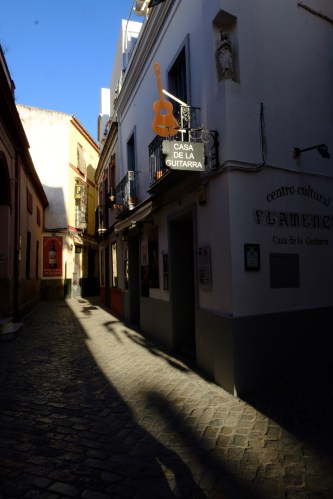
Photo by Nicolás Haro

Despite this, we drive down almost deserted streets and those people we do see are masked and separated. The bars and restaurants for which the city is famed are shuttered.

I hope so as well, but also I cannot help feeling that I have never seen Seville so alluringly peaceful. With its bustle and feverish heat, rendered in purified form by its twin emblems of bullfighting and flamenco, Seville has always struck me as an overwhelming sensuous city. Now it is its grandeur that is on show, the remnants of a wealth that once outstripped all other cities on Earth.

In over 20 years of visits, I have never seen it look so striking.

“It is waiting,” says Nicolás simply.

It will not have to wait for long, for all the signals are that by the end of June quarantine-free travel will occur between Seville and the rest of Europe, possibly even the UK. For now I have the city to myself and am determined to take full advantage.

I decide to retrace the steps of my usual pilgrimage, as described in these pages, and am delighted to find Bodega Antonio Romero open, even if I begin the evening as the only customer there.
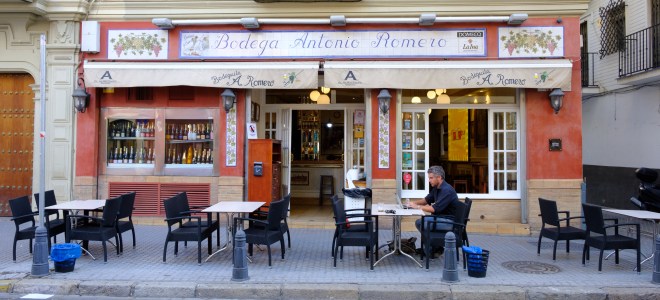
Alexander Fiske-Harrison at Bodega Antonio Romero – Photo by Nicolás Haro

However, my other favourites – Casa Matías, Casa Morales, Las Teresas – we find shuttered, and I retire to bed.

Even that is trickier than usual: the owners of my two mainstays, the Hotel Inglaterra and Las Casas de la Judería, had both told me they were closed. So I reach out to an old friend, Patrick Reid Mora-Figueroa, whose family owns the exquisite boutique Hotel Corral del Rey. To no avail. “Sorry my friend, I’m in Marbella – we’re closed until September.”

Deciding to put to an end to further exchanges I contact Marriot International, which runs the largest, grandest and most historic of all the hotels in the city, the Alfonso XIII. Closed until July 1.

Luckily, Nicolás’s brother Kinchu owns the nicest short-stay apartments in town, Almansa 11, a series of rooms carved out of the Marqués de Villamarta’s former mansion in the old El Arenal district of the city, so I finally find my rest.
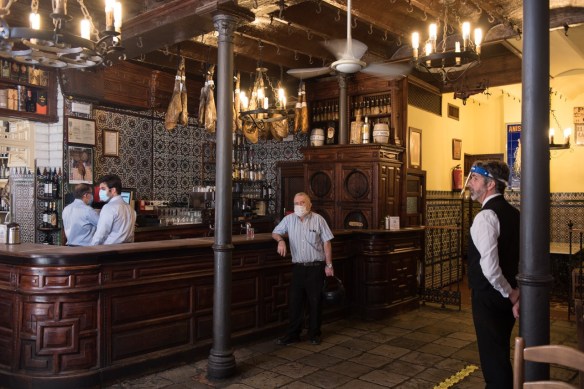
El Rinconcillo – Photo by Nicolás Haro

The next day, Monday, Spain begins to reopen, including the Balearic Islands to certain forms of foreign tourism. But in Seville, where the Alcazar welcomes visitors for the first time in months, hearing the exclusive use of the Spanish language in the streets and bars has its own charm.

“It is as though the Sevillanos have reconquered the old city centre, where once it was so filled with tourists many locals stayed away,” says Nicolás.

We start the day at the usually packed El Rinconcillo, the oldest tapas bar in existence (founded in 1670) where Javier de Rueda, whose family have owned it for the last seven generations, greets us at the bar.

Javier de Rueda Santiago – Photo by Nicolás Haro

From there we crisscross the city, from the taurine characters who prop up the Bodega San José next to the bullring, to Casa Cuesta over the river in old Triana, at each stop meeting with more and more people – although all distanced, all protected, all obeying the measures which finally brought the virus in Andalusia to its knees.

And as the day draws to a close, and we sit down to dine at the finest white table cloth restaurant in the town, Casa Robles, with its perfect chuletón steak and its exhaustive list of riojas, I once again quote to myself the motto of the city which is engraved on every lampost and manhole cover, and which occurs to me each time I visit: Sevilla no me ha dejado, “Seville, she has not deserted me.”

Bodega San José – Photo by Nicolás Haro


Casa Cuesta – Photo by Nicolás Haro
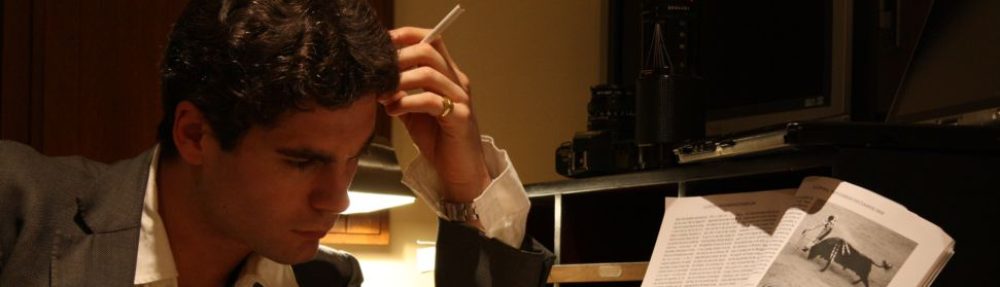
My article in The Spectactor on my late family friend Peter Beard

Read the original online here.

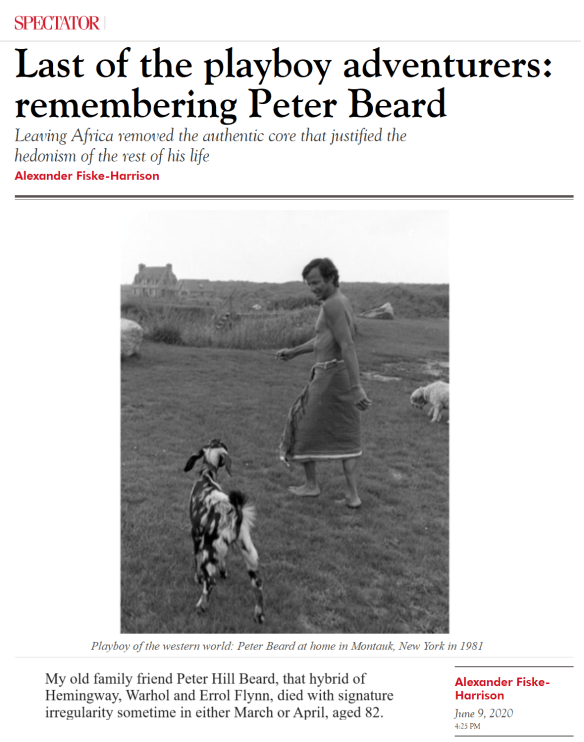
My old family friend Peter Hill Beard, that hybrid of Hemingway, Warhol and Errol Flynn, died with signature irregularity sometime in either March or April, aged 82.

The obituaries say he was ‘known as “the last of the adventurers”’ so often that one suspects he may have coined that himself.

Peter was old money. His great-grandfather James Jerome Hill, born in 1838, founded the Great Northern Railway and from him descended a line of New York stockbrokers with a mansion on the Upper East Side and an estate in Tuxedo Park. William Waldorf Astor and J.P. Morgan attended Peter’s grandparents’ wedding. His grandmother later married Pierre Lorillard V, scion of the oldest tobacco family in the United States and the original developer of Tuxedo Park along with Newport, Rhode Island.

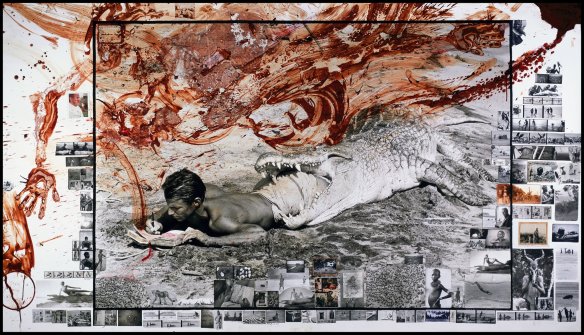
No financier, Peter became a photographer, focusing on his beloved Africa. Always trying to get the shot others couldn’t — in 1996 he was gored by an elephant — he developed a signature style of collaging the original image with handwritten notes and color washes, often using materials from the moment the photo was taken, such as elephant dung or his own blood. His works, enhanced by his personal cachet, sold well in exhibitions and from his friend Michael Hoppen’s gallery in London’s Chelsea.

Beginning as an African conservationist — a word he hated for evoking ‘tourist’ — Peter published his most important book in 1965, The End of the Game. But it was befriending Karen Blixen of Out of Africa fame and buying the neighboring ranch to hers in Kenya that created his African name.

Peter in Africa in the old days

Continue reading