
Donations gratefully accepted via our Just Giving page here.

Donations gratefully accepted via our Just Giving page here.

Donations gratefully accepted via our Just Giving page here.
Alexander Fiske-Harrison & Klarina Pichler
This is the new project we have been working on for some time to bring polo to Mauritius has been agreed: with the government’s tourism agency, the owner of the grandest hotel on the island, Sanjiv Ramdanee, and the man who has been the single greatest innovating force in exotic location non-club based polo, Reto Gaudenzi of Badrutt’s Palace in St. Moritz and the World Snow Polo Championships. More details follow at www.InternationalPoloEvents.com.


Mauritius is set to host a prestigious polo match later in the year following the signing of a new partnership.
The news was announced at the annual Snow Polo World Cup, hosted each year in St. Moritz.
Arvind Bundhun, chief executive of the Mauritius Tourism Promotion Authority, made the announcement during a gala dinner hosted at Badrutt’s Palace Hotel.
He was welcomed to the stage by Reto Gaudenzi, chief executive of St. Moritz Snow Polo, and joined by Sanjiv Ramdanee, chief executive of Maradiva Villas Resort & Spa.
International Polo Events join Mr Bundhun, Mr Ramdanee and Mr Gaudenzi to make this happen. We thank our new partners for inviting us to help bring polo back to the Indian Ocean: more details soon at www.MauritiusPolo.com.


contact@internationalpoloevents.com
International Polo Events Ltd.
Incorporated at Companies House, 80 Petty France, Westminster, London SW1H 9EX, United Kingdom
Company Number 12348482

Famed ‘Torrestrella’ bull-breeder – and founder of the Royal Andalusian School of Equestrian Art – Álvaro Domecq Romero, Spain’s number one matador Juan José Padilla, author Alexander Fiske-Harrison, photographer Nicolás Haro, and Don Álvaro’s favourite pura raza, ‘Pure Spanish’, stallion at Los Alburejos in 2009 (Photo: AFH personal collection)
It was sad to see confirmed in the press the rumour I heard from the Núñez del Cuvillo family that Álvarito Domecq has sold his legendary ranch, where he not only bred the famed Torrestrella – ‘Star Tower ‘ – bulls, so named for the ruined castle overlooking his estate, but also bred his pura raza Española horses – what we call ‘Andalusians’ in English – and founded one of the most important Schools of Riding in the World. Mind you, €20 million is not a bad price for a house in rural Spain.
Meanwhile, I have been working on some other bull and horse projects, which will come out through Polo Andalusia and Bullfighting Andalusia in the next few weeks. Along with a book and documentary film project on which more at The Last Arena blog in the same time frame.
Oh, and a visit to the House of Deputies – the House of Commons or Congress of Spain – although not as the Spanish newspaper ABC is suggest to promulgate a “Law Fiske-Harrison”!
¿Se imaginan una Ley Fiske-Harrison de Teo García Egea para derogar la Ley Rhodes de Pablemos?
The full article is, in Spanish, available here:
https://www.abc.es/opinion/abci-ignacio-ruiz-quintano-ley-rhodes-202002120018_noticia.html#
Alexander Fiske-Harrison

I found it odd when it was pointed out to me here in wilds of Andalusia, working on building up Polo Andalusia, that the papers had decided to name me pin-up boy for the parties of the Right in Spain, especially under the surname of one of my maternal ancestors, Cecil Rhodes. (The headline El otro Rhodes translates as ‘The Other Rhodes.’)
However, it was another Rhodes they referenced: a ‘celebrity’ musician who plays classical music – by which I mean a person whose public profile as a musician has piggy-backed on his public profile for revelations (his own) about his private life rather than his talent – who has also moved to Spain. Apparently he has decided to wax lyrical in the media about his views on the political failings of the country he has just moved to. A cultural, or rather touristic, imperialism I personally find abhorrent….
That said, although the intention of this article was flattering, I could not find myself flattered by it… you see, my politics, which are usually a private matter, do not match those of the role they are proposing me to fill.
The article, online here, says:
We need another Englishman similarly Hispanophile to admire.
Alexander Fiske-Harrison (pictured) is my proposal. He is English… of good type … graduated in biology and philosophy at Oxford and London… If Rhodes is immersed in our customs, what Fiske-Harrison likes is The Custom: bullfighting. He is a great aficiondao and a few years ago he published a book about the Fiesta, Into The Arena: The World Of The Spanish Bullfight. Apparently, his mentor in bullfighting was Adolfo Suárez Illana [son of the first democratically elected Prime Minister of Spain after the death of Franco, and himself number two in the conservative Partido Popular, ‘Popular Party’, for Madrid.]
Fiske-Harrison is presented as “writer and bullfighter”, maintains a blog on bullfighting in English, www.TheLastArena.com, and is also a great aficionado of bull-running, and usually runs dressed in white and with an elegant red jacket looking like a character out of P. G. Wodehouse skidding into calle Estafeta in Pamplona.
Fiske is a patrician, a dandy, an enviable Englishman and also a lover of Spain. Fiske-Harrison is a taurine pro, perhaps the great English taurino of the moment.
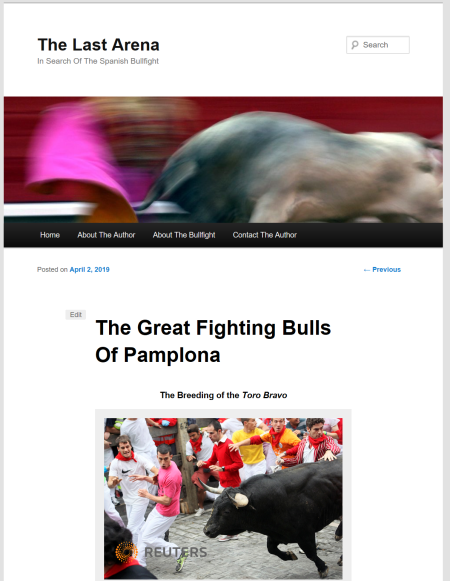
I am completing the conversion of my taurine blog ‘The Last Arena: In Search Of The Spanish Bullfight‘ into the reference site in the English language that it by now should already be.

My latest addition is this new post on the great breeds and bloodlines of fighting bull, in part at the behest of Pamplona’s largest tour operator, Running Of The Bulls, Inc., but also with a nod to the Fundación del Toro de Lidia, ‘Foundation of the Fighting Bull’, the Spanish industry body with whom I am working.

It is also nice to see the ancient University of Valladolid are referencing the book that that blog grew into, Into The Arena: The World Of The Spanish Bullfight, as one of three works on the subject written in English in the past three centuries that have become works of reference.
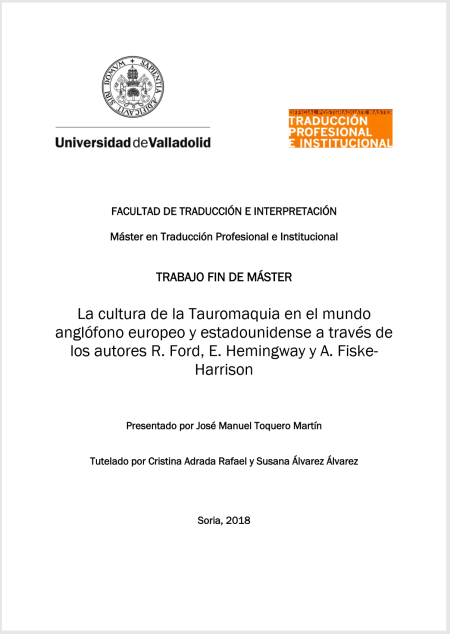
(Click here to download the full thesis.)
Alexander Fiske-Harrison

My article in today’s Daily Mail (original as image below).
SEVILLE’S motto is “she has not deserted me”. In the 13th century the city rose in favour of King Alfonso the Wise against a rebellious son.
Nowadays, it’s the tourists who do not desert her. From the Gothic splendours of the cathedral to the alleys of the old Jewish Quarter, it is a place to wander and wonder.
HISTORIC LESSON
AS THE birthplace of Roman Emperors, Trajan and his wall-building successor Hadrian, Seville’s classical origins are apparent. There are magnificent ruins, including at 25,000-seat amphitheatre, at nearby Italica.
By the 16th century Seville was at the heart of Spain’s Golden Age, due to its exclusive Royal license for all trade with the newly discovered Americas.
Notorious fictional knight, Don Quixote de la Mancha, was born here in 1597 while his creator was in prison in the Royal Jail of Seville. The country’s greatest painter Diego Velázquez was born here two years later. Continue reading
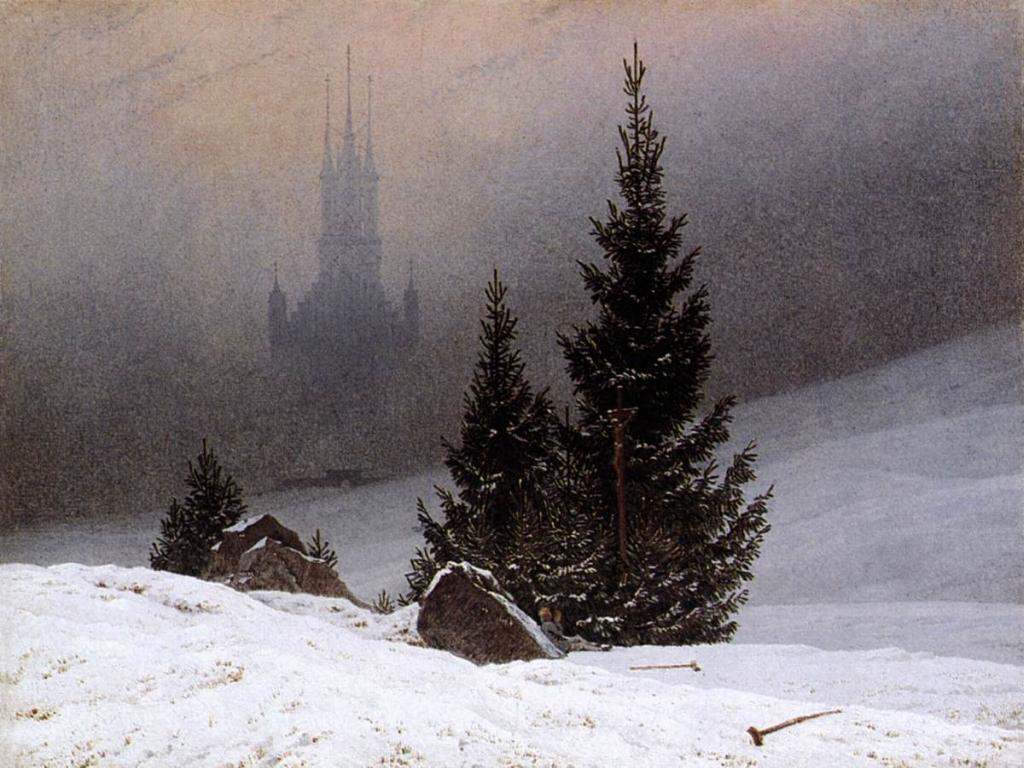
Caspar David Friedrich – Winter Landscape (1811)
Some say that ever ‘gaint that season comes
Wherein our Saviour’s birth is celebrated,
The bird of dawning singeth all night long.
And then, they say, no spirit dare stir abraod.
The nights are wholesome. Then no planets strike,
No fairy takes, nor witch hath power to charm,
So hallowed and so gracious is that time.Hamlet, Act One, Scene One
Xander
Note: For details on the classes, go to our website http://www.theactofwriting.co.uk
I’ve been meaning to write a post on author Thomas W. Hodgkinson’s mooting of the “new literary movement” (ahem) of ‘method writing’ since he first spoke about it on BBC Radio 4’s Today programme a week or so ago. (You can listen to it excerpted on the BBC here.)
However, ironically, I was too busy practising what he was preaching, as I was living in the Montparnasse apartment of one of the real-life protagonists of a short historical fiction I was writing to enter in the Prix d’Hemingway in France.
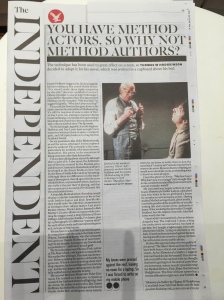
So it wasn’t until I returned to London late last night that I discovered he had launched the intended project in this morning’s The Independent (online here.)

My Research
Thomas tells an abridged version of the story of why I am one of his three “method authors” in the piece.
Alexander Fiske-Harrison… trained as a matador in Spain as research for his book about bullfighting, Into the Arena. He is also an actor who, like Dustin Hoffman, has honed his technique at the Actors Studio. So for him, nothing was more natural, when he sat down to write, than to don the same black “country suit” and short jacket he’d worn in the arena. Between bursts of typing, he would move about the room, performing what is known as toreo de salon.
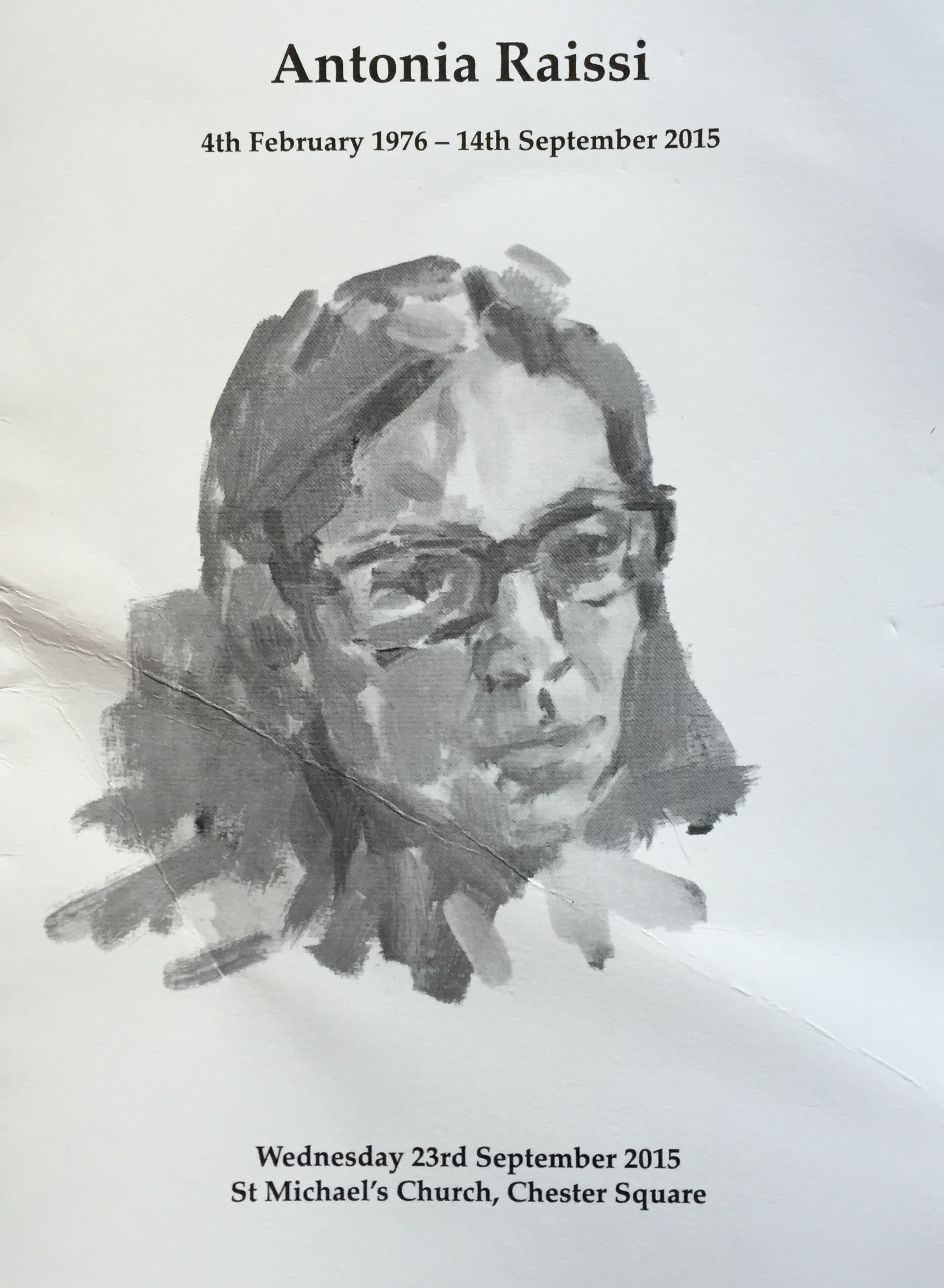
I have come to hold the belief that one of the most powerful and definitively human compulsions is that of being remembered: that when the physical reality of self has perished, that echo of appearance, the memory of self in other minds, should be confirmed in defiance of death. Hence the funeral, the oration, the headstone, the monument, the memorial service, the obituary and this, the personal memoire. That, and an expiation.
So I am not writing claiming I knew Antonia better than others – her mother and stepfather, her husband and her sons, her other family and many of her other friends had that privilege – but we had our moments over twenty or so years. I want to write down those I remember, and those I can repeat, before my recollections of them change and mutate any more than they already have. To ‘re-member’ to, as the word suggests, is to piece back together the members, the parts, of a dismembered whole. At best this is a jerry-rigged fiction that just about passes muster and at worst an outright lie, fuelled by want, and perspective, and sorrow.
AFH
* * *
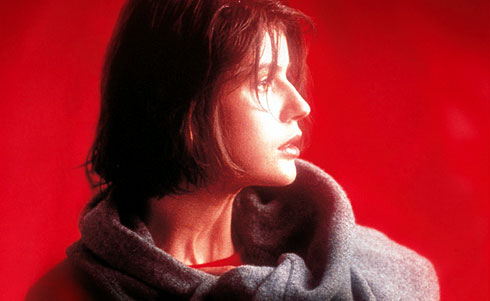
It was in her room in the top floor of Matthews Building I first met her, second on the right. A single bed, a desk, armchair and a basin in cupboard, divided by no more space than you could lie down in, loo and shower down the corridor. St. Peter’s College, Oxford, wasn’t exactly as glamorous as Brideshead Revisited, but Antonia was. Tall, lithe, exquisite faced which she fought against – admiring the strong more than the pretty – speaking with clipped St. Mary’s (Calne) tones and Eton-cropped black hair, which I would later cut to make her look more like Irène Jacob in Kieslowski’s Trois Couleurs : Rouge the film we all fell in love with that year. Just as we all fell in love with her.
 In that tiny room we were all packed, a group, almost exclusively male at its core, and regarded as deeply, almost hilariously pretentious even by the standards of Oxford undergraduates. However, looking back one can see it was just curiosity and fascination and youthful gaucheness.
There was Hugh Dancy, George Pendle and Paul Curran, all studying English under Dr Francis Warner, Dominic Elliot studying Archaeology and Anthropology, and Steven France studying Philosophy under Dr John Kenyon. Antonia would within her first year abandon Geography for English, and I would only make it to the end of my second before switching from Biology to Philosophy under Kenyon.
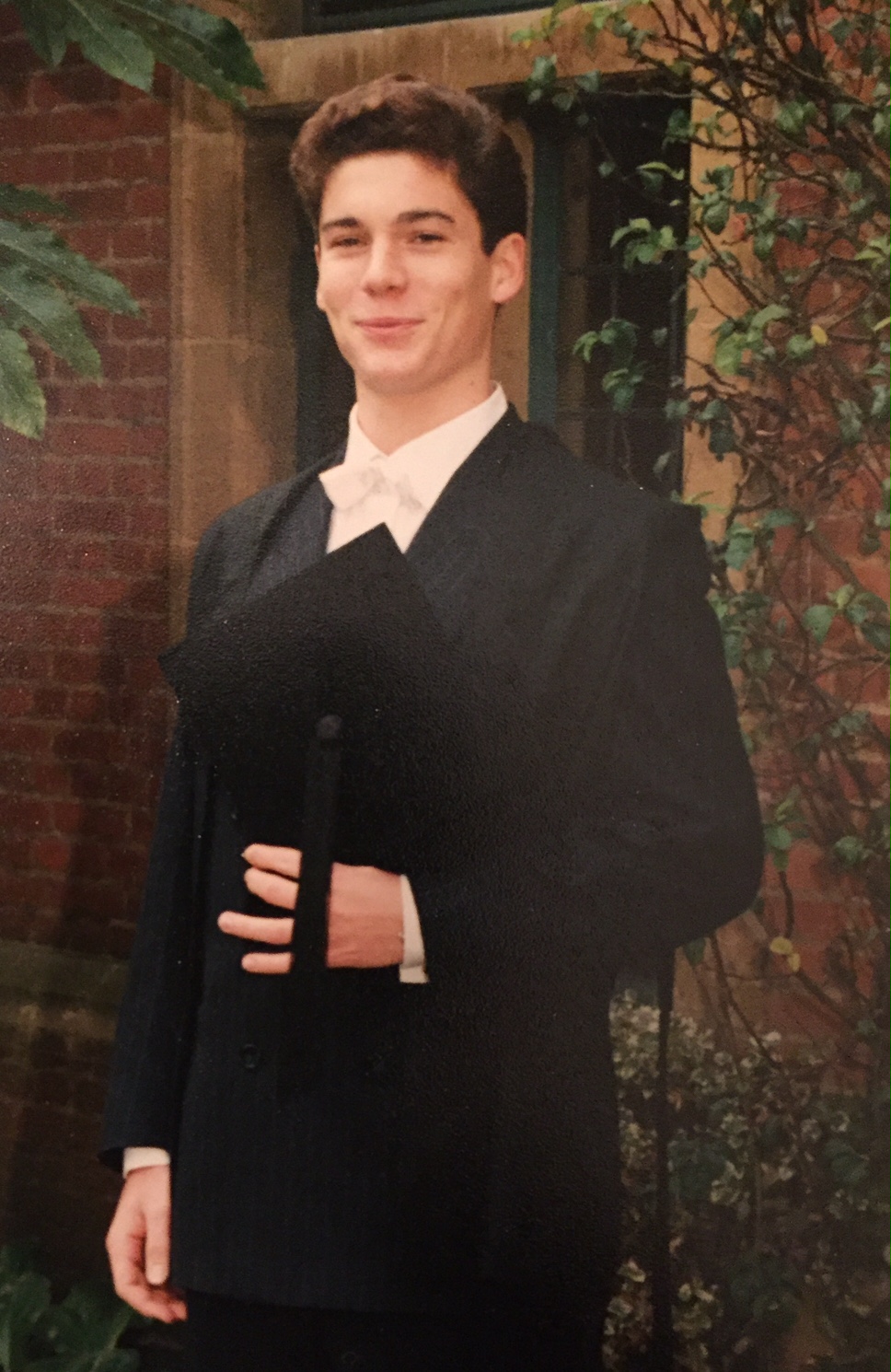 Me, matriculation day, October 1994
One of her first stories to me, a story which would have perhaps annoyed the more sophisticated and subtle person she became, was of her summer holiday, just prior to coming up to Oxford, in Kenya. I remember still the image she conjured so well of her sitting, dressed in white, smoking Cartier cigarettes, the only non-male, and indeed only non-Masai sitting around a camp fire in The Mara. She would have been eighteen years old.
I wonder if she viewed us like Masai too. She certainly preferred the company of us men, and although she was not a tomboy in the sense of climbing trees, her way of speaking was… well, like anti-aircraft fire – not always deadly accurate, but incessant and intimidating to fly amongst, the dark crumping bursts of her conversational shells peppering the night sky. And it was usually night sky – we sat up late into the night talking and talking, me smoking Marlboro, her Lights, me Coke, her Diet. She wasn’t much of a drinker, disliking the silliness, the loss of control, or so she claimed. When I did see her tipsy for the first time I was surprised at how girly she became. I think that was what she feared most.
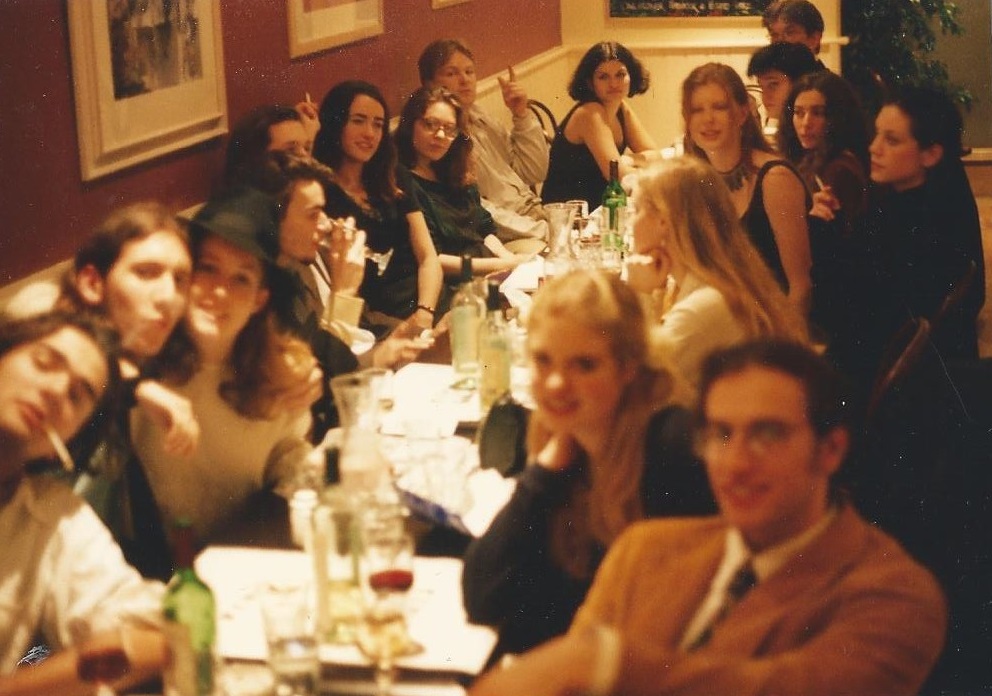 Antonia’s 19th Birthday Party, Gloucester Green pizza restaurant, clockwise from bottom left: George Pendle, Dave – & ?, Steven France, Hugh Dancy, Genevieve Connors, ?, John Mühlemann, ?, David Collard, David Budds, Biranda Ford, Lucy -, Antonia Francis, Caroline Early, Catherine Bagshaw, Joshua Steckel (Photo by Alexander Fiske-Harrison)
 Detail from above (Photo: Alexander Fiske-Harrison)
It was inevitable that I would fall head over heels for her – I mean I was only a few months out of an all boys boarding school, grew up without sisters and had never had a girlfriend. And here was this stunning and exotic creature, fitting no standard feminine norm that I knew of – never a skirt or dress, but black boots and jeans on those very long legs, and almost invariably a black polo neck, channelling Juliette Greco with a hint of Audrey Hepburn. Of course, now in retrospect I can see that Antonia wasn’t oblivious to the effect she had on us boys – and we were just boys – wrangling us to some extent with those quirks honed to charms, equalising the gender imbalance using that weapon among all the others at her disposal. Continue reading
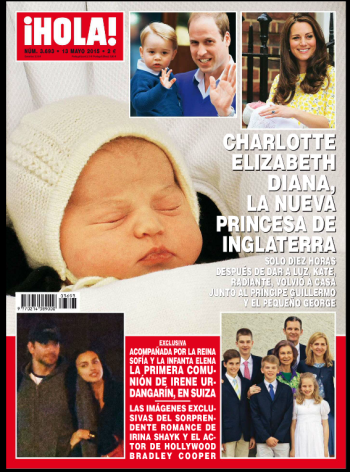 The May 13th (2015) edition of ¡Hola! magazine Spanish parent of Hello! magazine (which runs through Latin America as well), opens with a long feature with the headline “Alexander Fiske-Harrison, the English ‘gentleman’ who one day became an expert on bullfighting” (pp.4-12.)
I enclose the text of my interview in the original English below. Interview, introductory preamble and captions are by Mamen Sánchez, director of ¡Hola!
With thanks to the Hotel Alfonso XIII in Seville and my family tailors, Gieves & Hawkes, No.1 Savile Row, for my suit and Ralph Lauren for providing me with clothes in the Feria de Abril in Seville this year.
Alexander Fiske-Harrison
[Post updated February 25th, 2019]
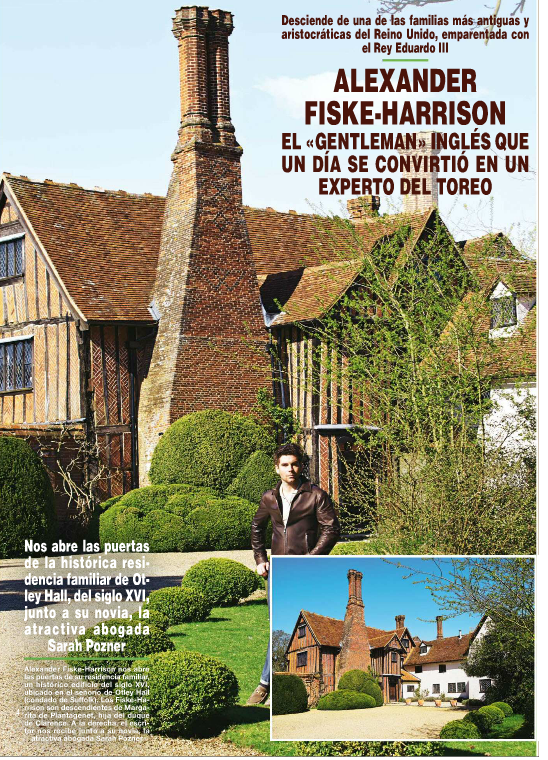
Alexander Fiske-Harrison comes from one of the oldest and most illustrious families in England. The Fiske-Harrisons are the descendants of Margaret Plantagenet, daughter of the Duke of Clarence, brother of Edward IV and Richard III, Kings of England.

Alexander Fiske-Harrison (photo by Andrea Savini, suit by Gieves & Hawkes)
Educated at Eton, he holds Masters in Arts and Sciences thanks to his studies in Philosophy and Biology at the Universities of Oxford and London. Son of a prosperous investment banker in ‘The City’, Alexander can presume to be the genuine “gentleman”. Elegant, humanist, lover of nature and man of letters, he is the author of numerous books and essays, a playwright and a regular contributor to newspapers and magazines including The Times, Financial Times and The Spectator.
Following in the footsteps of Ernest Hemingway, there awakened in him an interest in bullfighting which brought him to Spain, first as a researcher and later as an authentic lover of the ‘fiesta de los toros’. From the hand of great Maestros such as Juan José Padilla, Eduardo Dávila Miura and Cayetano Rivera Ordóñez and through his friendship with Adolfo Suárez Illana [son of Spain’s first democratic president, the Duke of Suárez], who first introduced him to the world of bullfighting, Alexander has become a valiant bullfighter. He killed a bull of Saltillo and participated in various festivals, he has run for six years in the bull-runs of Pamplona and has written one of the most referenced books on the world of bullfighting: Into The Arena.

“The Fiskes arrived to this part of England as Vikings, at the Battle of Maldon, in 991A.D.”
A complete discovery, Alexander, greets us in Otley Hall, a historic Tudor Manor in the county of Suffolk. This building, dating from the 16th Century, connects the Fiske-Harrison family and the Kings of England, and a great-granddaughter of Margaret Plantagenet here contracted marriage with the then Lord of the Manor of Otley Hall, John Gosnold.

 Alexander's Journal