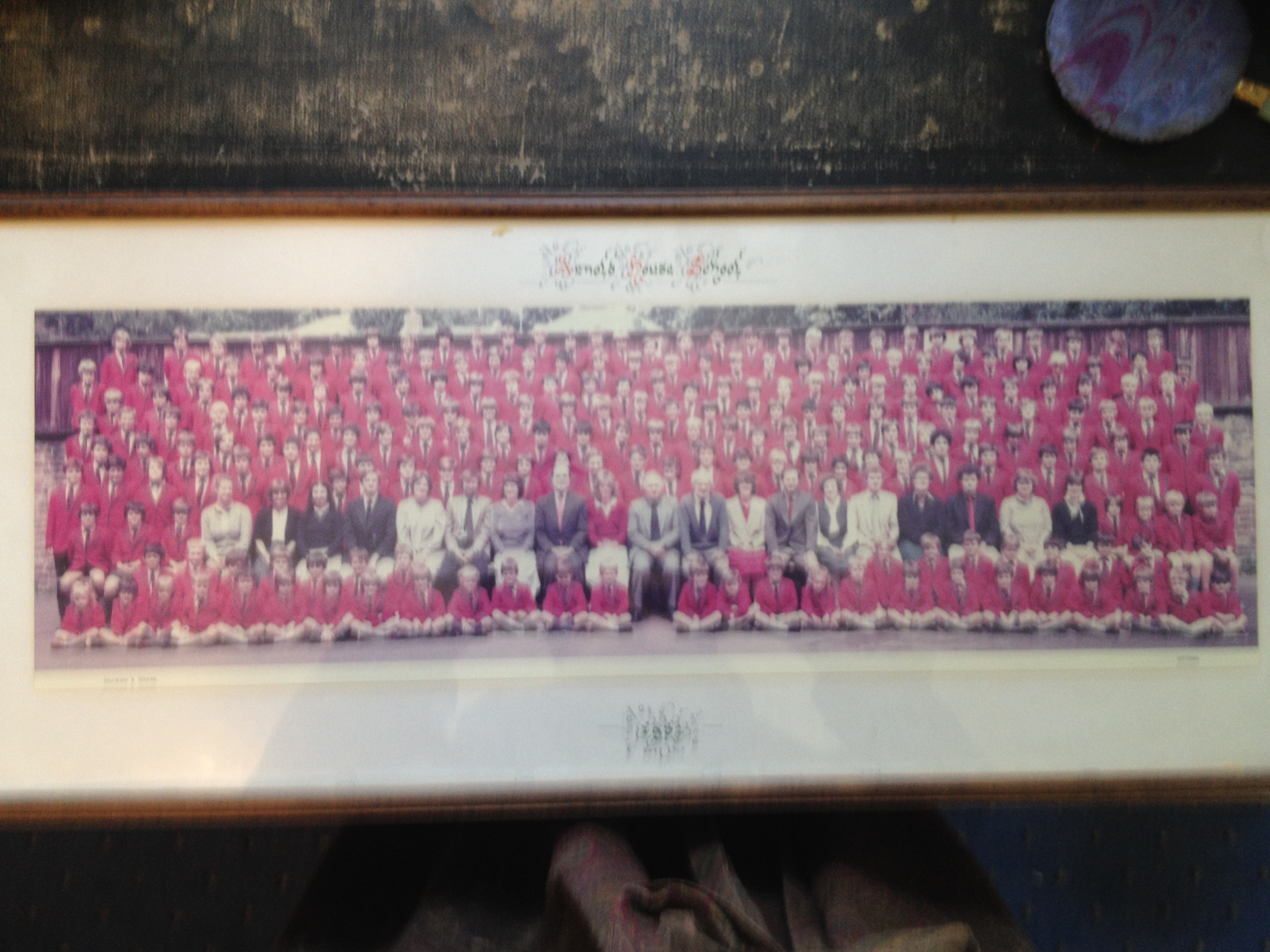
Arnold House School Photo 1982 – as blurred as the author’of this post’s memories of the time
James Rhodes and Arnold House School
“Remembrance of things past is not necessarily the remembrance of things as they were.”
Marcel Proust, 1913
“Many people believe that memory works like a recording device, but decades of research has shown that’s not the case. Memory is constructed and reconstructed. It’s more like a Wikipedia page — you can go change it, but so can other people.”
Dr Elizabeth Loftus, cognitive psychologist, Distinguished Professor at the University of California, 2013
These statements ring particularly true to me since one of my earliest memories is of having another, even older, memory proved false by my brother Jules. The memory he challenged was that I had been able to fly but had subsequently lost the ability. He managed to convince me that what I had actually done was miscategorise the memory of a dream of flying as a memory of the reality of doing it. As Carl Jung pointed out, the very verb itself, ‘to re-member’, to put back together, is the strongest clue of all to its fallibility.
We live, at this moment in time, in the midst of a deluge of dark memories erupting on to the pages of our newspapers, with accusations of sexual abuse coming thick and fast against public figures, and inevitably, some of them are true and some of them are false, and the ratio of true to false is perhaps the greatest battle ground of all.
This, of course, is a cyclical thing. The last time the wheel turned to this point, the scandal was concerning ‘repressed’ memories, a witch-hunt which surpassed Salem with claims of satanic abuse circles in the 1980s. I was a philosophy of science postgraduate when that one finally died the death and remember studying that piece of pseudoscience being brilliantly taken apart by Professor Richard McNally of Harvard in his seminal 2003 book Remembering Trauma. As he pointed out, how many Auschwitz survivors forgot about the Holocaust, even when it wasn’t being discussed (as it wasn’t, for some time after)?
And with that rather obvious realisation the whole structural underpinning of things like Dissociative Identity Disorder (commonly called Multiple Personality Disorder) comes into question.
My own childhood was thankfully free from such darknesses, or so my memory had me believe. Until, that is, I came across an article in The Times in May with the headline ‘James Rhodes thanks Cumberbatch and Fry for support over abuse memoir’. Something stirred in my recollective recesses at that, and so I read on.
Apparently Rhodes, something of a Nigel Kennedy-figure in the world of classical piano, had just won a court case against his ex-wife, and was as a result free to publish his memoirs containing detailed memories of his serious sexual abuse as a child. There was something terribly familiar about the name, although I didn’t know him as a pianist.
Then I read that the “memoirs detail how Peter Lee, his boxing coach at Arnold House preparatory school in north London, began raping him when he was six.”
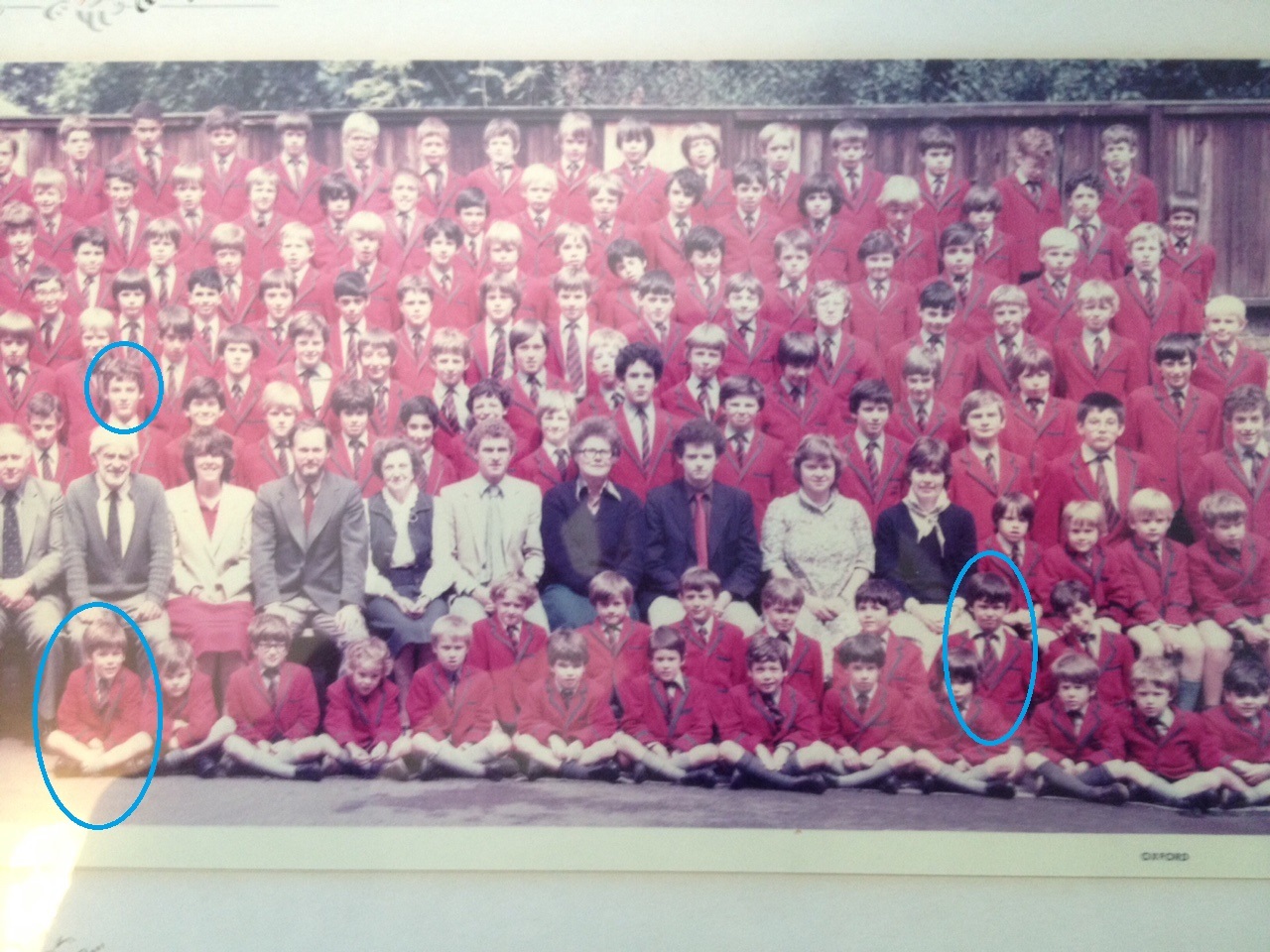
And it suddenly came to me: I knew James Rhodes because I was at Arnold House school with him in those boxing classes with Peter Lee. The of us are in the photo above taken in the summer of 1982 when I was almost six and he had just turned seven. In the detail below you can see us both, while standing in line above me is my brother Jules and somewhere in the photo is Rhodes’s own older brother Matthew.
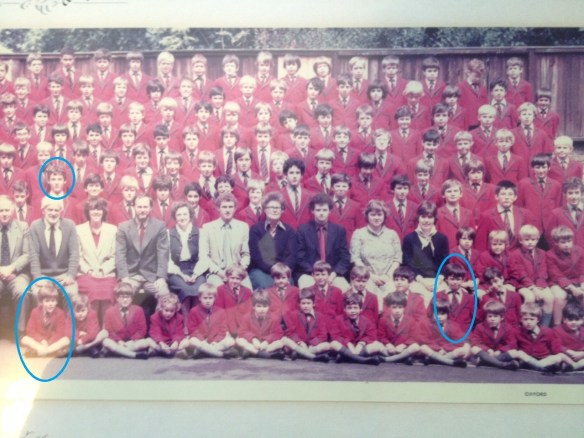
Detail of 1982 photo – author of this post bottom left
I first met Peter Lee at about that time and trained with him consistently for years, as the medals in the other photo attest, and my memories of him are jarringly different to those of Rhodes. My brother Jules was one of his pupils, but he is now sadly dead so I could not ask him, but our oldest brother Byron had been one of Lee’s star boxers in the 1970s. So I asked him what he thought about these ‘revelations’, and his reply was frankly, unprintable. Let’s just say that his memories of “Mr Lee” are more like mine. As are our parents, who employed the man on an out of school basis for a decade and a half.
However, as I’ve noted, memory is a false friend and the darkness and inscrutability of the human soul is something of which I am all too aware. Is it possible he was a predatory paedophile, I asked myself, and the answer came back: yes, humans are animal, and in some the bestial comes out only intermittently, only when the environment allows it. So then I asked myself about that environment: how, logistically, could this have happened?
By which I mean, how could someone rape a six year old child and get away with it? After all, Arnold House was and is an urban preparatory day school, not a care home, nor some great sprawling country boarding school where boys seldom see their parents and there are plenty of dark corners for dark things to occur in. Arnold House is made up of three small buildings on just over half acre of north-west London, containing fourteen classrooms in constant use, a gym, a dining room and a small, tarmac-covered playground. In that tiny space dwell two hundred pupils under the scrutiny of twenty teachers, not including catering, cleaning, maintenance and secretarial staff. It was a hothouse, in both the disciplinary and academic senses, being a feeder for the almost five century-old Westminster School where both my brother’s and niece attended, and such illustrious cousins over the years as the philosopher John Locke.
I can best illustrate how ‘clean’ that atmosphere was with an anecdote: I was a rebel as a child, constantly in trouble, but when I arrived at Eton aged thirteen, I had never smoked a cigarette. So when, in my first week, a friend from the 70-acre boarding school Summer Fields took me for my first cigarette somewhere in Eton’s 400 acre grounds, I was taken aback at the sheer quantity of ungoverned space available for misbehaviour. (I went on to hold the record for misbehaviour at that school, as reported in The Spectator.)
What was more, this was – as mentioned – a day school, and the Rhodes family lived on the same street as the school, about 50 doors, or 500 yards, further down. He was dropped at the school in the morning, and collected in the afternoon by his mother. To put it bluntly, brutally even, how did no one notice the injuries caused by an adult male raping a three foot tall, forty pound child? Was he allowed to bathe entirely autonomously aged six? I am not denying it happened,I lack the right for I was there and I don’t know – but how did it happen? Continue reading →