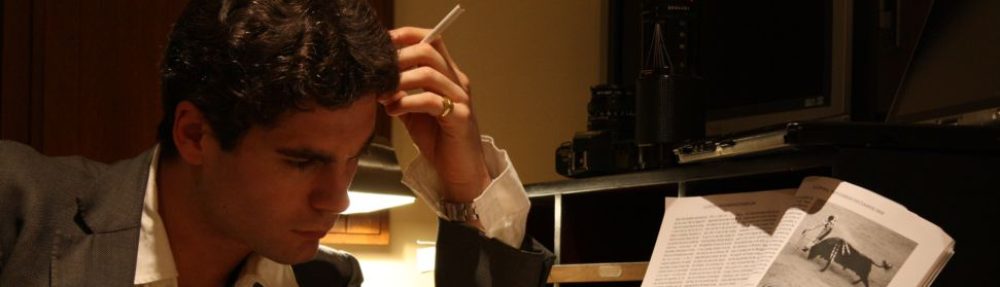
“Britain’s leading bullfighter” in The Times


by Alexander Fiske-Harrison
For Camile Natta

I was told this story by an elderly Englishman who boarded the ‘Ciudad de Sevilla’ alongside me at the Port of Marseilles, en route to Rio de Janeiro in the Spring of 1940. His French was rusty and this had led to some confusion with the marseillais-speaking porters, so I assisted him and he thanked me in my own native Castillian, even though we had conversed in English up until that moment.
Seeing him dining alone that evening, I accepted his invitation to join his table. The rest of the ship’s passengers were refugees from Europe’s troubles, and that difference in itself gave us something in common.
He was clearly a man of private means and was journeying to Petrópolis to pay his respects at the funeral of the son of the old Emperor, whom he had known as a young man. I told him that I worked as a translator and had been sent by a publishing house to assist one of their authors, an Austrian, who had fled due to his religion and race and was seeking safe haven in Latin America.
We bonded over a shared love of history and storytelling and, as the wine flowed, he gained confidence and began to switch readily between my language and his, and I remarked that he must have spent some time in Spain.
This remark, innocently made, gave him pause, and I wondered if I had offended him or opened some old wound, and I apologised. He brushed my words aside and, having made some internal decision, began to tell me the story which I recount below, to the best of my ability and memory.
What shocked me at the time was not the story itself – fiction is at least half of my work – but the way that he told it. As I say, I cannot speak for its truth, although one wonders how an Englishman would know so accurately the inner workings and ritual of that closed, arcane and cruel world of ‘tauromachy’.
However, on his absolute sincerity I would bet my life: he believed every word he spoke. With each passing segment of memory his skin flushed and paled, his fingers trembled and steadied and the tendons of his hands and neck swelled and became distinct as though in a much younger man under great physical and emotional strain. This was not a performance, but a reliving of events both terrible and mystifying.
As a side note I should add that the ship docked at Barcelona the next day to take on a last group of passengers before heading out into the Atlantic. When I did not see the Englishman at dinner I enquired of the steward and was told he had unexpectedly disembarked in Spain. Whether he caught another ship or ever even made it to Brazil, I do not know.
* * *
I travelled through Spain in my twenties on a small inheritance. I had served in the Second Battle of Ypres, where I lost my innocence and the use of one leg, which explains the silver-headed cane which I carry to this day. Being no use in battle, and with the war between the various descendants of the Celts and the Saxons continuingly so bloodily in the north, I travelled south, to Madrid, and gained an interest in the more personal, less mechanised form of slaughter so wrongly called by my countrymen the bull-fight.
It was for that reason I saw a famous young toreador of the day with a bull named Barbero on the 27th of June 1917. It was the same day my brother succumbed to wounds received at Messines. Such were the times. That is also why I remember the date, although I should always remember that bullfight. Until, that is, I saw one better. I get ahead of myself, though. Suffice to say it was no coincidence that it was then that my passing interest turned to a fascination in that strange, formalised dance between man and beast that is la corrida.
I spoke with friends in the city, and they told me to head further south, and, from there, friends in Seville sent me out into the countryside so I could see from where those magnificent animals and valorous young men gain their instincts and their techniques.
I saw things in those days I had not thought possible. I have seen courage in the field: I have seen a regiment of men hold steady as half their number, comrades and friends, were snatched out of existence as though by the hand of some impatient deity, leaving behind a mist of pale redness and the sound of roaring thunder.
However, I had never seen a man, armed only with a piece of cloth, hypnotise a half of a ton of wild beast until it rests its horn against him like the Lady and the Unicorn in those tapestries which were also the products of Flanders but in a more civilised age.
As with the visionary and the zealot, at each new revelation my obsession grew. Continue reading


Padilla at home (Photo Zed Nelson/GQ/Condé Nast 2012)
It was the last bullfight of the Spanish season, held, as it has been for centuries, in the 250-year-old plaza de toros in Zaragoza in north-eastern Spain.
Juan José Padilla, a 38-year-old matador from Andalusia in the south, was fighting the fourth bull of six (he’d also fought the first.)
The bull, ‘Marqués’, was a 508kg (1,120lb) toro bravo born 5 years and 8 months previously on the ranch of Ana Romero, also in Andalusia. Before entering this ring it had lived wild, ranched from horseback, and had never before seen a man on the ground.

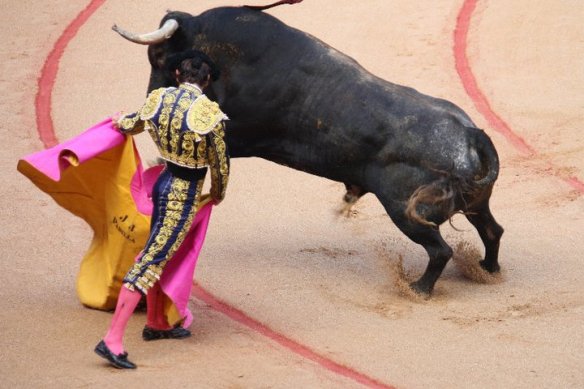
Padilla passing a bull with the magenta and gold two-handed capote, ‘cape’ (Photo: Alexander Fiske-Harrison 2012)
Padilla was midway through the second of the three acts of the spectacle. He had already caped the bull with the large, two-handed magenta and gold cape, the capote, then the picador had done his dirty work with the lance from horseback, tiring the bull and damaging its neck muscles to bring its head down.
Now Padilla, rather than delegate to his team as other matadors do, was placing the banderillas himself, the multi-coloured sticks with their barbed steel heads. He had put in two pairs and was on the third. He ran at the bull with a banderilla in either hand, it responded with a charge, Padilla leapt into the air, it reared, he placed his sticks in its shoulders and landed.

Padilla places the banderillas
Running backwards from the charging bull, his eyes were focused on the horns coming at him in an action he had performed tens of thousands of times before. However, this time his right foot came down slightly off centre and in the path of his left, foot hit ankle, and then he was down.
In a breath the bull was on him and its horn took Padilla under his left ear, cracking the skull there, destroying the audial nerve, and then driving into the jaw at its joint. It smashed up through both sets of molars and ripped through muscle and skin before exploding his cheek bone as surely as a rifle bullet, stopping only as it came out through the socket of his left eye – from behind – taking his eyeball out with it, shattering his nose and then ripping clean out of the side of his head.
There is an image I will never lose, much as I wish I could. It is of a man standing with half his face held in his right hand. Cheek, jaw and eyeball, like so much meat, resting in his palm as he walked towards his team uncomprehending, and they, with looks of absolute horror, grabbed his arms and rushed him to the infirmary of the ring.

The second worst image
And yet here, in the amongst the carnage inflicted on a human body by a half ton of enraged animal, is the key to Juan José Padilla. The clue is in the phrase “stood up.”
Soccer players are stretchered off the field from a tap to the ankle. Boxers go down from a padded glove. This was more than half a ton of muscle, focused into a pointed tip that ploughed through his skull like a sword through snow. And the man got up and walked.
Then came coma and intensive care and surgery after surgery.
Click here to read on at my bullfighting blog, The Last Arena…

For the original article, available to subscribers only, please click here. It is also available, for free, on MSN here.
(This follows on from my Telegraph article on Gaucín three years ago, ‘A postcard from Spain’s most picture-perfect town‘, which went viral in Spain, from national newspaper ABC to ¡Hola! magazine.)
Gibraltar has always been an outpost. In antiquity it was one of the Pillars of Hercules on which were inscribed the warning to sailors: “nothing further beyond”. Its name derives from the Berber military commander who landed there and began the Moorish conquest of Spain in 711 AD. A thousand years and 14 sieges later the Rock became a British fortified-enclave. However, under the blistering Spanish sun its confines bred fever and mutiny. The inhabitants craved access to the mainland, looking up to the cooler mountains of Ronda, two days’ ride away up rocky, bandit-stricken trails.
To cater to this need, Alexander Henderson founded the Algeciras-Gibraltar Railway Company in 1888 in a deal with the Spanish government. Henderson had already built railroads across the mountains and jungles of South America. Not permitted to run the railway onto British soil, Henderson arranged a daily steamboat across the bay to the first station on the line at Algeciras, and all materials were shipped from England, right down to the station clocks. The result was – and still is – one of Europe’s most remarkable train journeys, but which today takes tourists, rather than British army officers, to Ronda in 90 minutes for €11.50.

To ensure comfortable digs both before boarding and at journey’s end, Henderson also hired the architect of The Savoy to build the Hotel Reina Cristina at Algeciras and a sister establishment, the Hotel Reina Victoria, in Ronda. There are also stops in San Roque and Gaucín, offering the chance to break up the journey.
Today, Algeciras is an industrial port city and the Reina Cristina (rooms from £90), while a grand structure, is run down, its rolling gardens out of place between the docks and tenement buildings. In its time it hosted movie stars and politicians: Orson Welles and Ava Gardener, Roosevelt and Churchill (both as Prime Minister and earlier, as Telegraph reporter at the Algeciras Conference on the fate of Morocco in 1906). Its carefully restored twin in Ronda, the Reina Victoria (rooms from £100), remains a lovely hotel.
There are three daily trains along Mr Henderson’s Railway, departing at 06:20, 10:50 and 17:04. I boarded the second and headed out towards the mountainous backdrop of the Serranía de Ronda. The rails are far nicer than the road, exchanging motorways and flyovers for verdant coastal countryside. The steam trains have gone, but their smooth, air-conditioned replacements, operated by Renfe (the state-owned railway), are perfectly good.

The original passengers were often British Army officers, which explains why the first stop along the line is San Roque, home to the luxurious Sotogrande with its famed polo clubs. It was the British Army who adopted this equestrian sport while serving in India and went on to teach it to the horse-obsessed Spanish nobility.
I disembark and head for lunch at the restored 18th-century marvel that is El Monasterio, one of the most beautiful small hotels in Andalusia. Afterwards I catch a practice session at the neighbouring polo ground, Luciano Irazábal and Nano Iturrioz’s ‘Iron Bridge’, and see Klarina Pichler, semi-finalist in last July’s British Women’s Open at Cowdray Park, the Wimbledon of the Game of Kings, and who coaches the British Royal Dragoon Guards who brought the sport to Europe. (Indeed, she is the only British Hurlingham Polo Association licensed instructor in Spain.)
I make the last train from San Roque at 17:18. From here it is all about the views and admiration of the technique and industry required to dynamite your way through the hillsides to follow the mountainous forest-course of the river Gaudiaro through the sparkling wonders of the Natural Park of Los Alcornacales.
A little over an hour later I arrive at Gaucín station, although it is a few miles from the town so a taxi is required. The last time I was here it was under the shadow of Covid-19. I am pleased to see Daniel Beauvoir’s La Fructuosa (rooms from €110) remains the most pleasant of village retreats, with elegant and spacious rooms looking out over the valley.

The real surprise, though, is Restaurant Azulete, under the new management of a Franco-Colombian couple: Parisian chef, Gabriel Arnaud, who met his wife Daniela Rodriguez while they were working Ferran Adrià of El Bullí fame, before they came here. In 25 years of writing about this country, I can’t recall a finer dining experience.
The final section of track winds through an undulating landscape, softening from epic to pastoral, a transition highlighted by the stop-motion effect of a dozen tunnels within 40 miles.
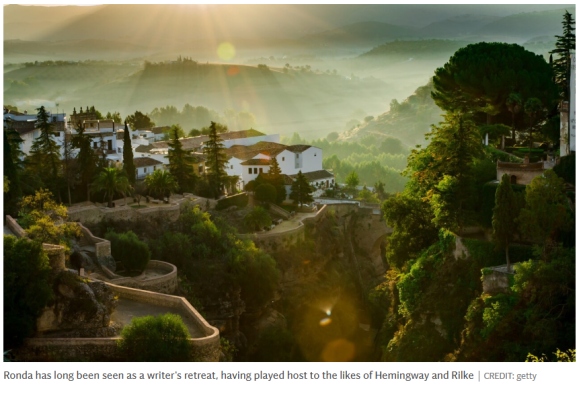
At the end of it all lies Ronda, the haven. A writer’s retreat, it has statues to visitors like Hemingway, the centenary of whose first visit to Spain is this year, and the Austrian poet Rilke.
I meet Jon Clarke, editor of the local English newspaper, at the tapas bar La Barrafina. He updates me on the gossip over thin-sliced jamón ibérico – the owner is a national champion jamón-cutter – and ice-cold manzanilla, before I check into one of his wife Gabriella’s self-catering apartments (rooms from €140), hidden gems a short walk from the Arab Baths along the city walls.

From there one can stroll up past the three historic bridges – Arab, Old and ‘New’ (1790s in vintage, 390 feet in height) – culminating in the vertiginous glories of the Tajo gorge, one of the most visited monuments in Spain.
Next to it is another, the 450-year-old Maestranza plaza de toros of Ronda, still operated by the longest running dynasty of matadors, whose present title holder, Cayetano Rivera Ordoñez, excels in the ring to this day.
Finally, one is at the breezy summit of one of the peaks of Spain’s history and culture. The steam from the locomotives may have long ago evaporated, and the gun-smoke of the bandits has dispersed, but the poetry of this coast-to-mountain, British-built train service remains as uplifting as it always was.

The golden age of the sleeper-car railways began 140 years ago. That summer, the quintessence of luxury trains set forth on its maiden voyage from Paris to Vienna. The Orient-Express was the pinnacle of design and hospitality in travel.
In those days, the train was the fastest thing their was: twice as fast as a galloping horse. Only a cheetah could beat it by a nose, and then only over two furlongs. It was fifty years before the automobile or aeroplane could compete for speed.
In fact, trains were so unnaturally fast that the medical community railed against them, suggesting they could cause hysteria in women, mania in men, and death through vibrational organ failure in both. Despite this, the locomotive was and remains the safest method of fast transport available. Horses bolt – taking any carriages they might be drawing with them – and automobile and even aeroplane crashes remain far more probable and lethal than derailments. There are also the environmental arguments.
The Orient Express last ran in 2009. The hotel on rails which took its name – and its 1920s-issue carriages – is an unrelated venture. It is a travel experience, not a form of transport eastward.
However, when the delusional global blanket of COVID-19 restrictions was lifted, ÖBB, Österreichische Bundesbahnen ‘Austrian Federal Railways’, opened the Nightjet, a sleeper service on the same route Paris-Vienna line as the original OE.
There is something about the idea of trains which has always fuelled the literary and cinematic imagination. The railways are places of romance – Brief Encounter – and revenge – Murder On The Orient Express – of psychopathic killers – Strangers On A Train – and secret agents – From Russia With Love.
My theory is that when fiction writers, who live by imagination and pursue a solitary profession, are put on trains, they are forced into proximity with people about whom they know nothing. After a few hours fantastical thoughts naturally begin to form. As Graham Greene put it, one is “compulsorily at rest; useless between the walls of glass to feel emotion, useless to try to follow any activity except of the mind; and that activity could be followed without fear of interruption.”
So, invited to view the restoration of the 19th century holiday home of Emperors, the Grand Hotel Straubinger in Bad Gastein outside Salzburg (read more on this project and the Imperial Snow Polo Cup in my article in The Telegraph, outside the subscription paywall online here), I opted to travel all the way from London by rail.

Dining Car: A steward in the dining car of the Orient Express as it leaves Victoria Station, London, 1982.
The rest of this article is available to subscribers of The Telegraph online here.


Travel writers are often asked for the secret places within their areas of expertise. We have a stock of them, usually snapshots and moments that led on to other stories. In Austria, I think of learning the hidden cultural heritage of Salzburg from the Unesco professorial chair of the subject Kurt Luger or being introduced to what is now my favourite drink, Most, a dry still apple wine, by former champion skier Rupert Pichler on the slopes of Sport Gastein where they host the Imperial Snow Polo Cup.
However, there is one area of Austria that is not so much secret, as filled with secrets. Continue reading

As I said in my last post about my other nomination in the Financial Times-Oxford Literary Festival, it is always nice to be listed and good luck to us all.
It is particularly impressive for this one that they wrote the nomination in English, as well as French and Spanish, given that I was the only writer in the language on the list. (I note that when I was previously a finalist for Le Prix Hemingwa – and published in the annual collection of short stories by Au Diable Vauvert half a decade ago – they did not. Perhaps it is a Brexit thing.) Continue reading
Always nice to be listed: good luck to us all.
Alexander Fiske-Harrison


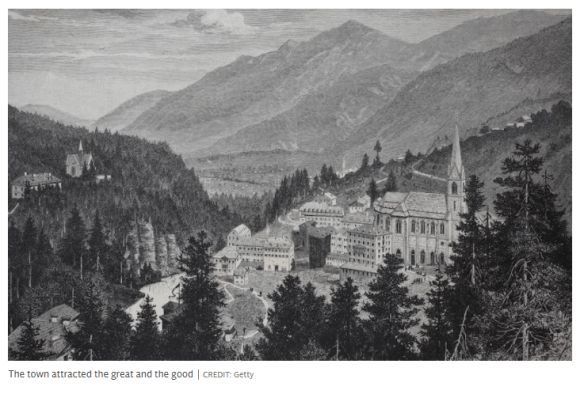
When I first came to Bad Gastein, a year ago, I could not believe that I had not only never been here before, but had never even heard of it. The vagaries of its notability in history are almost as cyclical as the rise and fall of stock markets.
In February 2020, it seemed to me a classic bustling ski resort, with extraordinary, high-level skiing, comprising 200km of pistes, half of them red runs. Admittedly, the languages you heard in the après-ski establishments tended more towards the Germanic than the frequent smatterings of English or French one might hear in Zermatt or Val d’Isère.
However, what really struck me was the look of the town. Built into the steep mountain slopes, its vertiginous streets are lined with exquisite fin de siècle houses from the heyday of the Austro-Hungarian Empire. Even the train station – 90 minutes to Salzburg, 3 hours to Munich – is an Art Deco gem, opened by Emperor Franz Joseph himself in 1905, the first such station in the Eastern Alps.
For this was the Imperial resort. The Prussian Kaisers would come and meet their Habsburg Emperor cousins here to enjoy the waters and the walking, for both of which it had been famed since the 7th century. Of course, in those pre-skiing days, summer was the high season.

For this was the Imperial resort. The Prussian Kaisers would come and meet their Habsburg Emperor cousins here to enjoy the waters and the walking, for both of which it had been famed since the 7th century. Of course, in those pre-skiing days, summer was the high season. Continue reading


AIM-LISTED Fiske, which is one of the City’s few remaining independent stockbroking and investment managers, said its results for the six months to November 30 showed continued improvement after its operating loss narrowed to £21,000. Total revenues of £2.8 million were an 11% increase on a year earlier, with investment management fees up 14%. Chairman Clive Fiske Harrison said the company retained a “healthy degree of caution regarding the immediate outlook for markets“. Shares rose 5p to 70p.