Back in London from updating the Wallpaper* City GuideMadrid, when the BBC sends me a message saying only “we’d like to talk to you about poshness”.
It turns out that one of the former members of the flagship ‘Today’ programme team on Radio 4, Steph McGovern, had said in an interview – in response to a question on the gender pay gap no less – that social class was an often ignored contributing factor to inequality in the work place.
So, their research team trawled the internet and came across a piece I’d written for The Spectator a couple of years ago headlined (by the editor) – “[James] Blunt Is Right. Being Posh In The Arts Is Career Suicide.” It is online here.
So it turns out that my debut on the Today programme is not for my travel writing, not for my forthcoming book The Bulls Of Pamplona(with chapters by John Hemingway, Ernest’s grandson, and Beatrice Welles, Orson’s daughter, and a forward by the Mayor), nor the book I am just prepping to research on wolf conservation, reintroduction and how they made us human just as we made them into dogs – provisionally titled The Land Of Wolves– but instead because I was sent to an expensive boarding school.
Oh well. The one thing I can say without reservation is that what Ms McGovern’s complaints are, with a six figure salary at 35, she is certainly being paid more than this Old Etonian freelancer at 41. For this interview, I don’t get a dime. (At least they’re sending a car.)
Anyway, in case anyone is interested, below is my most recent interview – and product placement – on the wolf project. Already been out to the last great virgin forest in Romania, and to revisit Paul Lister’s reintroduction site in the Scottish Highlands with the great biologist Prof. Doug Smith, next stop the site of Doug’s own reintroduction, Yellowstone Park…
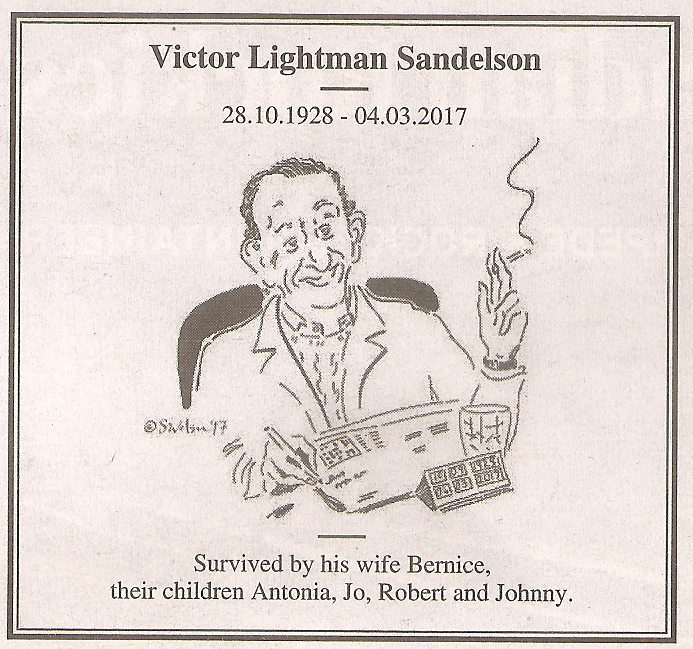
I was saddened to see in The Times that my family friend Victor Sandelson has died.
My memories of Victor are mainly from my childhood at Fiske & Co’s old summer parties on the Pavilion Terrace at the Palace of Westminster. He was one of my father’s Cambridge friends and you always could find him chatting, cigarette balanced delicately between upturned fingers (with a portable solid gold ashtray in the other hand), staring down at waters of The Thames, his words drifting between subjects with his friends, medicine or the sea with our GP Sir Nigel Southward (then Apothecary to the Royal Household and later Vice Commodore of the Royal Yacht Squadron), business or horses with Sir Martyn Arbib (then owner of both Invesco Perpetual and racehorses like Snurge who won the St Leger) or history and politics with the Marquess of Ailesbury (then a member of both the House of Lords and the board of Fiske.)
Victor’s brother Neville had been a Member of Parliament, one of the infamous Labour MPs who helped set up the Social Democratic Party, SDP, and then defected to it in 1981. Victor would always speak of his brother as “the clever one”, even though it was he had been invited back to Cambridge University to teach. Older than my father, he had poached him Sandelson & Co from Panmure’s (with David Cameron’s father Ian), until my father left for Fiske, a briefly acrimonious split which got them both in the pages of Private Eye more than once.
My fondest memory of Victor, though, is one of intellect and generosity at a dinner party of my parent’s in Eaton Square when I was twenty. I just had just begun my Philosophy, Politics and Economics (PPE) degree course at Oxford and while researching some essay or other I had come across Hugh Thomas’s 1959 book of essays The Establishment. Lord Thomas is now better known as a historian of Spain, but in those days he was a noted journalist and had coined the phrase “The Establishment” in 1954. He’d asked Victor to contribute a chapter on The City, and with characteristic wit Victor had titled it ‘The Confidence Trick.’
More than the content of the piece I remember his delight that it was still being read almost four decades later, and after I brought it up we spent a memorable evening in a discussion which began with finance, moved on to the nature of power and elites, and then and ranged everywhere from the philosophy of fin de siècle Vienna to the fate of the Jews in Europe in the 20th century – Victor was proudly a Jewish English gentleman.
Most of all from that night, I came away with a realisation that discussions of great depth could also be carried out with humour and charm if you possessed his particular lightness of touch, something I have still yet to master. This was further reinforced by my return Oxford a few days later, where I found a handwritten letter waiting at the Porter’s Lodge of my college thanking me profusely for my company at dinner and containing a book token for £100 so that I could buy at least a few of the many he had mentioned in passing. It was a gesture which I have never forgotten.
I will be talking about the encierros – the ‘bull-runs’ – of Pamplona on Classic FM South Africa at 10a.m. local time, which is 8.a.m. GMT, which gives me about ten minutes to make a coffee. For more details on the subject, read the eBook guide I edited and co-authored with contributions from everyone from the Mayor of Pamplona to John Hemingway, grandson of the great author and bulls aficionado Ernest Hemingway, The Bulls of Pamplona – click here for more details.
Some say that ever ‘gaint that season comes
Wherein our Saviour’s birth is celebrated,
The bird of dawning singeth all night long.
And then, they say, no spirit dare stir abraod.
The nights are wholesome. Then no planets strike,
No fairy takes, nor witch hath power to charm,
So hallowed and so gracious is that time.
Today my first ever article came out in The Sun – online here. Before I have always written for ‘broadsheet’ British newspapers like its News International sister paper The Times. However, after reading endless false stories about the tragic death of the Spanish matador Victor Barrio, I could not turn down the offer of a voice in Britain’s biggest selling national newspaper.
Inevitably there are ‘casualties of truth’ in a situation like this. I was commissioned to write at 3pm to complete the piece by 6pm. In Pamplona. Having run with the bulls that morning. And drunk all day. After four identical days.
I am not a matador, which is a professional title, which was explained in my writing, if not in the printed ‘copy’, I was a torero, a ‘bullfighter’. However, it is a churlish complaint when describing the arcane and esoteric to expect the sub-editor doing the headline on the edited copy – which has lost these nuances – to know the differences.
What is more, at least I did not lie.
The article attached to my article from the League Against Cruel Sports – for balance, which I respect – has no such compunctions nor attachments to research and truth.
I’ve been on every major ranch and in every major bullring and fought myself. When was a bull’s eyes ever smeared with Vaseline? Where is their evidence for this claim? A half blind bull would charge a blur of man and cape, rather than the specific part of the cape the matador dictates, and many, many more would be dead. The same goes for starving – nonsense, I have photos of them eating in the corrals of the bullring itself… guys, the blood is in the ring, you don’t need to make it up.
If anyone really wants to read about the morality of bullfighting, read my speech at the Edinburgh International Book Festival as a blog post here.
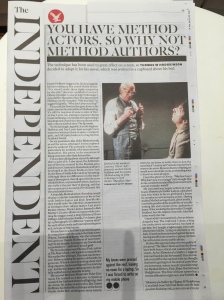
I’ve been meaning to write a post on author Thomas W. Hodgkinson’s mooting of the “new literary movement” (ahem) of ‘method writing’ since he first spoke about it on BBC Radio 4’s Today programme a week or so ago. (You can listen to it excerpted on the BBC here.)
However, ironically, I was too busy practising what he was preaching, as I was living in the Montparnasse apartment of one of the real-life protagonists of a short historical fiction I was writing to enter in the Prix d’Hemingway in France.
So it wasn’t until I returned to London late last night that I discovered he had launched the intended project in this morning’s The Independent (online here.)
My Research
Thomas tells an abridged version of the story of why I am one of his three “method authors” in the piece.
Alexander Fiske-Harrison… trained as a matador in Spain as research for his book about bullfighting, Into the Arena. He is also an actor who, like Dustin Hoffman, has honed his technique at the Actors Studio. So for him, nothing was more natural, when he sat down to write, than to don the same black “country suit” and short jacket he’d worn in the arena. Between bursts of typing, he would move about the room, performing what is known as toreo de salon.
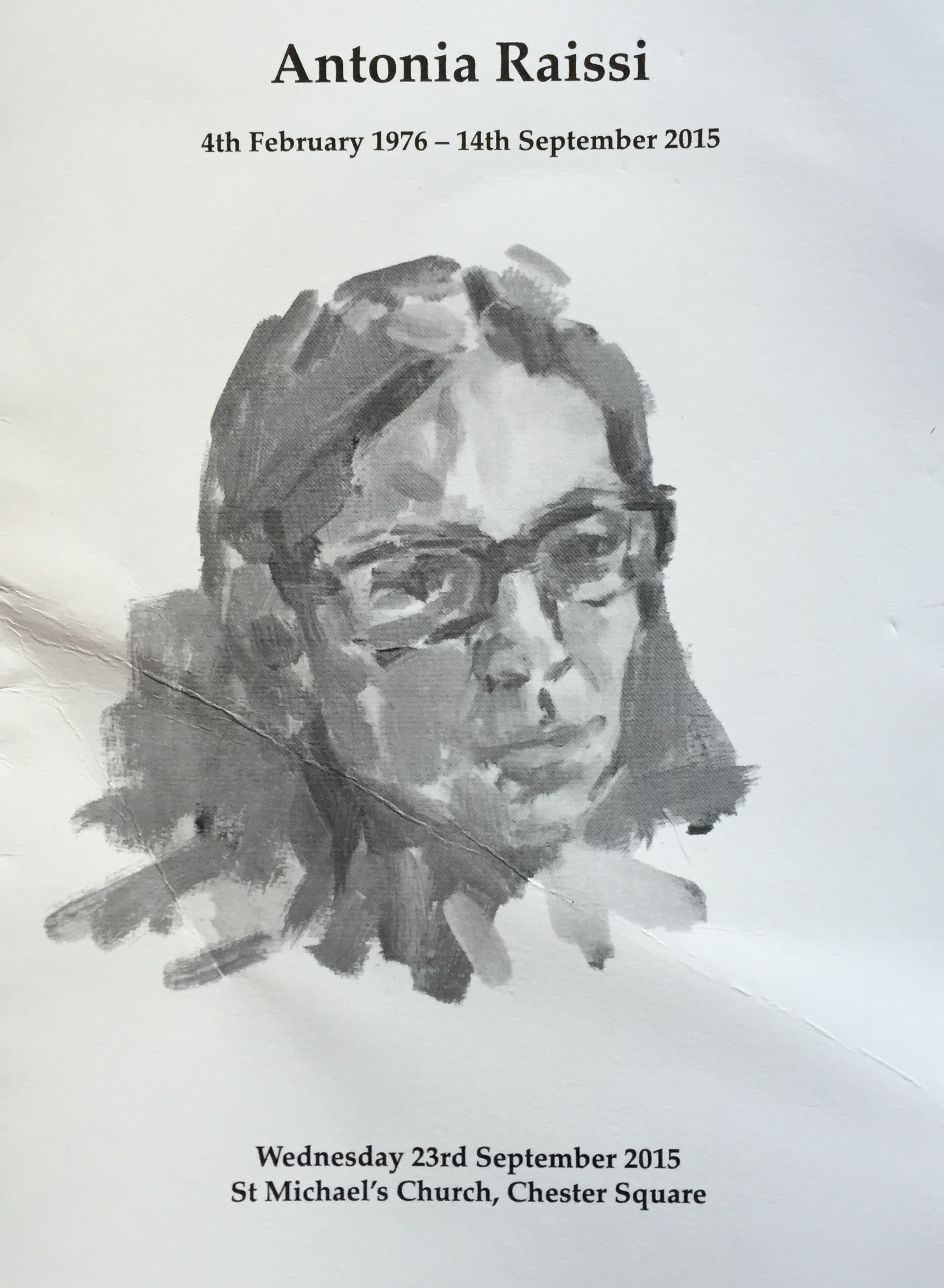
I have come to hold the belief that one of the most powerful and definitively human compulsions is that of being remembered: that when the physical reality of self has perished, that echo of appearance, the memory of self in other minds, should be confirmed in defiance of death. Hence the funeral, the oration, the headstone, the monument, the memorial service, the obituary and this, the personal memoire. That, and an expiation.
So I am not writing claiming I knew Antonia better than others – her mother and stepfather, her husband and her sons, her other family and many of her other friends had that privilege – but we had our moments over twenty or so years. I want to write down those I remember, and those I can repeat, before my recollections of them change and mutate any more than they already have. To ‘re-member’ to, as the word suggests, is to piece back together the members, the parts, of a dismembered whole. At best this is a jerry-rigged fiction that just about passes muster and at worst an outright lie, fuelled by want, and perspective, and sorrow.
AFH
* * *
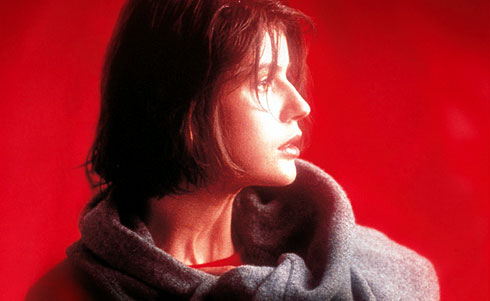
It was in her room in the top floor of Matthews Building I first met her, second on the right. A single bed, a desk, armchair and a basin in cupboard, divided by no more space than you could lie down in, loo and shower down the corridor. St. Peter’s College, Oxford, wasn’t exactly as glamorous as Brideshead Revisited, but Antonia was. Tall, lithe, exquisite faced which she fought against – admiring the strong more than the pretty – speaking with clipped St. Mary’s (Calne) tones and Eton-cropped black hair, which I would later cut to make her look more like Irène Jacob in Kieslowski’s Trois Couleurs : Rouge the film we all fell in love with that year. Just as we all fell in love with her.
In that tiny room we were all packed, a group, almost exclusively male at its core, and regarded as deeply, almost hilariously pretentious even by the standards of Oxford undergraduates. However, looking back one can see it was just curiosity and fascination and youthful gaucheness.
There was Hugh Dancy, George Pendle and Paul Curran, all studying English under Dr Francis Warner, Dominic Elliot studying Archaeology and Anthropology, and Steven France studying Philosophy under Dr John Kenyon. Antonia would within her first year abandon Geography for English, and I would only make it to the end of my second before switching from Biology to Philosophy under Kenyon.
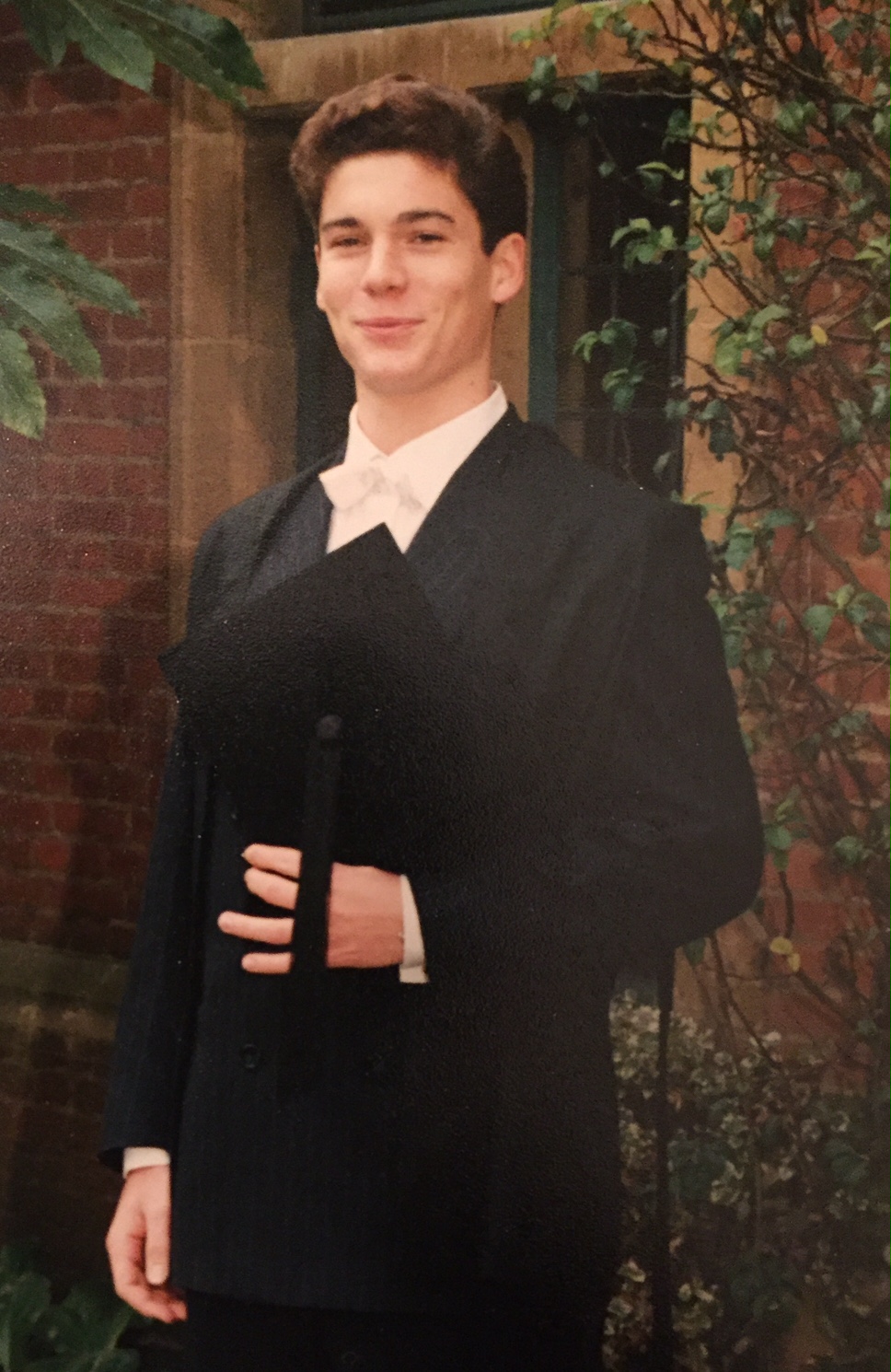
Me, matriculation day, October 1994
One of her first stories to me, a story which would have perhaps annoyed the more sophisticated and subtle person she became, was of her summer holiday, just prior to coming up to Oxford, in Kenya. I remember still the image she conjured so well of her sitting, dressed in white, smoking Cartier cigarettes, the only non-male, and indeed only non-Masai sitting around a camp fire in The Mara. She would have been eighteen years old.
I wonder if she viewed us like Masai too. She certainly preferred the company of us men, and although she was not a tomboy in the sense of climbing trees, her way of speaking was… well, like anti-aircraft fire – not always deadly accurate, but incessant and intimidating to fly amongst, the dark crumping bursts of her conversational shells peppering the night sky. And it was usually night sky – we sat up late into the night talking and talking, me smoking Marlboro, her Lights, me Coke, her Diet. She wasn’t much of a drinker, disliking the silliness, the loss of control, or so she claimed. When I did see her tipsy for the first time I was surprised at how girly she became. I think that was what she feared most.
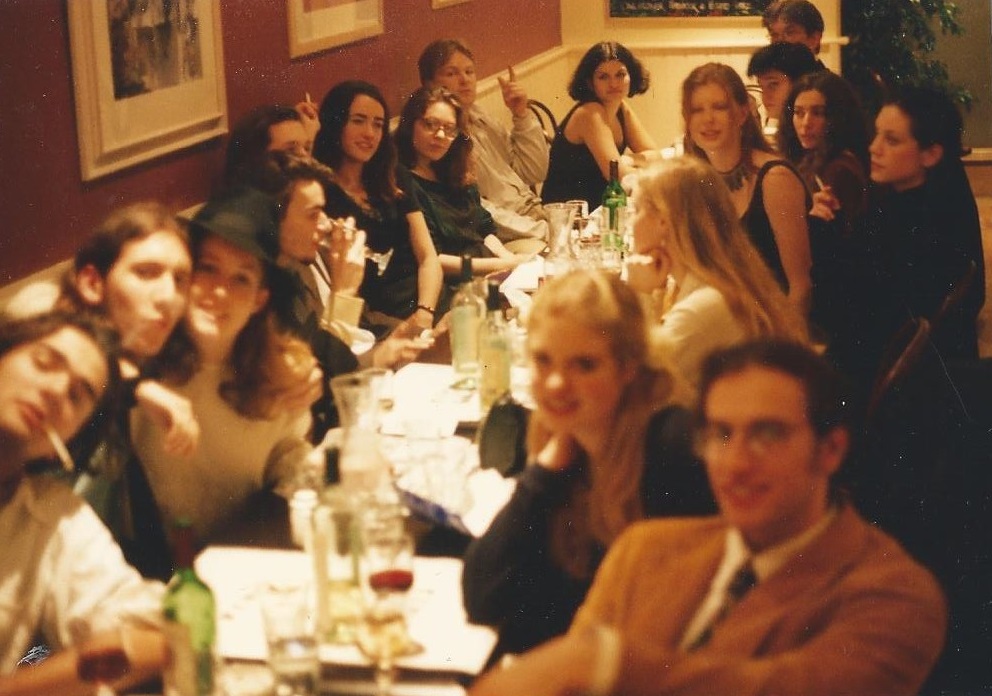
Antonia’s 19th Birthday Party, Gloucester Green pizza restaurant, clockwise from bottom left: George Pendle, Dave – & ?, Steven France, Hugh Dancy, Genevieve Connors, ?, John Mühlemann, ?, David Collard, David Budds, Biranda Ford, Lucy -, Antonia Francis, Caroline Early, Catherine Bagshaw, Joshua Steckel (Photo by Alexander Fiske-Harrison) Detail from above (Photo: Alexander Fiske-Harrison)
It was inevitable that I would fall head over heels for her – I mean I was only a few months out of an all boys boarding school, grew up without sisters and had never had a girlfriend. And here was this stunning and exotic creature, fitting no standard feminine norm that I knew of – never a skirt or dress, but black boots and jeans on those very long legs, and almost invariably a black polo neck, channelling Juliette Greco with a hint of Audrey Hepburn. Of course, now in retrospect I can see that Antonia wasn’t oblivious to the effect she had on us boys – and we were just boys – wrangling us to some extent with those quirks honed to charms, equalising the gender imbalance using that weapon among all the others at her disposal. Continue reading →
My latest contribution to my column, ‘By The Sword’, for Taki’s Magazine is out now. It concerns the current refugee crisis in Europe, but goes as far back as the Viking invasions of Britain, with reference to the epic Old English poem the Battle of Maldon, and beyond that to the Christianisation, decline and fall of the Roman Empire. It is also a paean to realpolitik and how to actually save lives, rather than make public displays of one own virtuous emotions while decrying the viciousness of others. To promote feeling above thought and then parade it in public is infantile narcissism, pure and simple.
As I was on holiday in France this piece was filed too late for publication in The Spectator, so I’ve posted it here – AFH
King Richard III, Duke of Gloucester, in portrait and remains…
The only remarkable thing about Richard III is how unremarkable he was…
Watching the reburial of King Richard III, this writer was struck by how the unearthing of his bones was being sold to those who would buy it as the unearthing of the ‘truth’ about a much maligned monarch. Conversely, Shakespeare’s play of the same name was being touted as the very zenith of propaganda and the Bard of Avon himself as a sort of Goebbels with the tongue of Goethe; history’s most gifted author prostituting his talents to defame the last and most discrete of its true kings, the Plantagenets, to justify the brash and barbaric usurpers who followed, the Tudors.
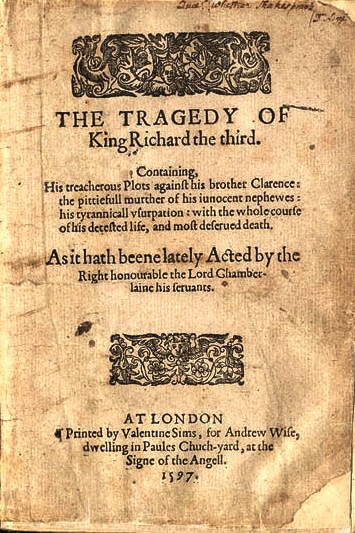
Frontispage from the First Quarto
I myself, attempting to judge events in the context of the time, take the view that the Duke of Gloucester – the name by which he was most commonly known, having held the title from age 9 – was nothing more than a minor product of those crude times whose only notability lay in providing inspiration for one of our greatest artist’s first decent works and through that stabilising a nation that had suffered two generations of civil war. In death and dramatic ignominy Gloucester achieved more for his country than his rather prosaic savagery did in life.
The first point to be made is that there isn’t a historian worth the name who doesn’t hold Gloucester responsible for the death of his nephews – the 12-year-old King Edward V and his younger brother Richard, 4th Duke of York – the ‘Princes in the Tower’.
On the death of Gloucester’s eldest brother, King Edward IV, Gloucester became Lord Protector and had the princes sent to the Tower of London “for their own safety”. He then announced that young Edward V’s coronation would be delayed, and not long afterwards the children were proclaimed illegitimate due to their father’s alleged bigamy. Two weeks later – 6th July 1483 – Gloucester was crowned King of England and France (and Lord of Ireland.) The princes were neither seen nor heard from again. Continue reading →
 Back in London from updating the Wallpaper* City Guide Madrid, when the BBC sends me a message saying only “we’d like to talk to you about poshness”.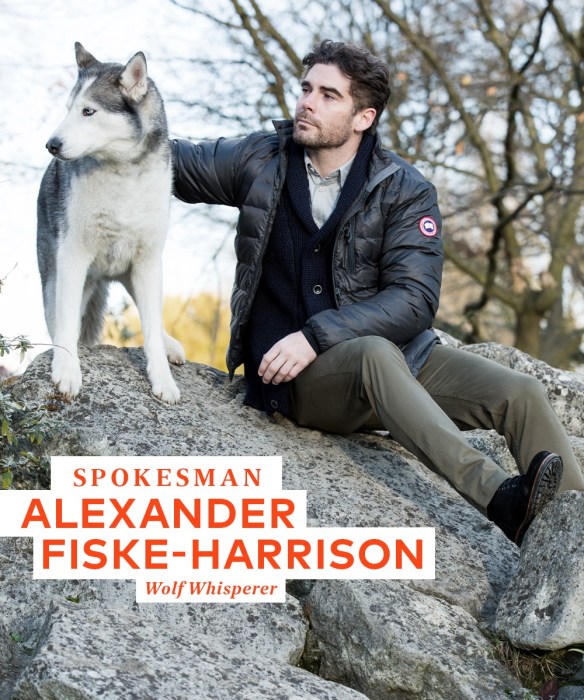






 Alexander's Journal